

Vorlon
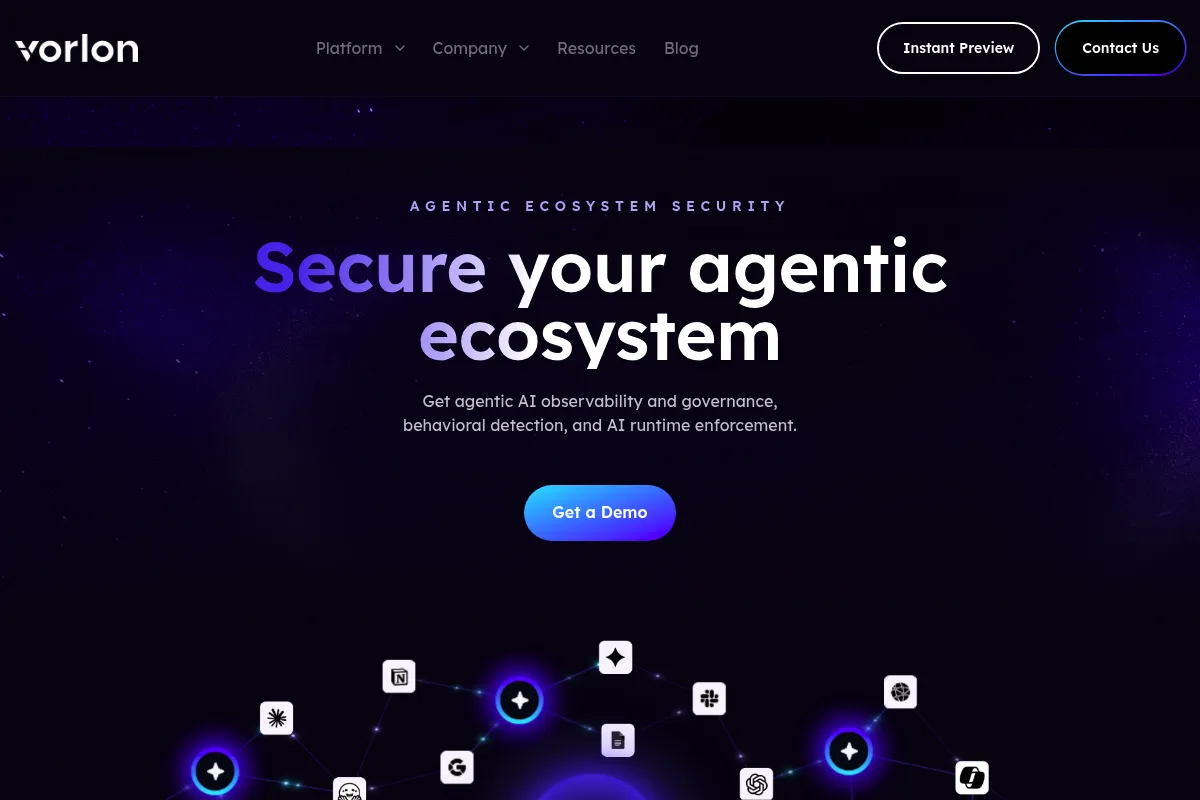
Vorlon is a security gateway for the AI supply chain that monitors and controls data flow between your internal systems and third-party AI services.
Excellent for security teams needing visibility into third-party AI agent behavior, weaker for organizations only using internal, self-hosted models.
Analysis based on product data, pricing structure, traffic signals, and public user sentiment.
Who Should Use Vorlon?
Typical users
Security operations (SecOps) teams and engineering leads at mid-market to enterprise companies integrating multiple external AI APIs.
Maturity fit
scaling
Choose this if…
- You use multiple third-party AI agents and need a centralized audit log
- Your priority is preventing PII or secrets from reaching external LLM providers
- You need to enforce compliance policies across developer-integrated AI tools
Skip this if…
- You only use local, air-gapped LLMs where data never leaves your infrastructure
- You are a solo developer looking for a simple prompt engineering tool
- Your security needs are limited to basic web filtering rather than deep API inspection
About Vorlon
Vorlon is an AI security platform focused on the 'AI supply chain.' It acts as a protective layer between an organization's data and the third-party AI services or agents developers integrate into their workflows.
What it actually does
The platform provides a dashboard for real-time visibility into every AI request and response. It automatically detects sensitive data leakage, identifies malicious activity from compromised AI agents, and allows teams to set granular access policies for different AI providers.
What makes it different
Unlike general Cloud Access Security Brokers (CASBs), Vorlon is built specifically for the non-deterministic nature of AI. It focuses on the 'shadow AI' problem—where developers connect third-party agents to internal data—by providing deep inspection of the API traffic rather than just blocking the URL.
Key Features
AI Discovery
Automatically maps all third-party AI services currently in use across the organization.
Data Leakage Prevention (DLP)
Scans prompts for sensitive information like API keys or customer data before they reach the LLM.
Agent Behavioral Analysis
Monitors third-party agents for unusual patterns that might indicate a compromised service.
One-Click Remediation
Allows security teams to revoke access to specific AI services instantly if a threat is detected.
Compliance Mapping
Aligns AI usage data with frameworks like SOC2 or ISO 27001.
Developer Proxy
Provides a secure endpoint for developers to route AI calls through without changing their code logic.
Pricing
Contact Sales
- Full AI visibility and discovery
- Real-time threat detection
- Data leakage prevention
- Enterprise SIEM integrations
- Custom policy engine
Pricing checked 4 months ago
Pricing guidance
- When moving from AI experimentation to production
- When internal audit requirements demand AI usage logs
- When the number of third-party AI integrations exceeds what can be manually tracked
- Throughput limits may apply based on the custom contract
- Specific third-party agent support may vary by version
Premium enterprise positioning aimed at high-compliance industries.
Pros & Cons
Strengths
-
Centralized visibility of 'Shadow AI'
It uncovers AI tools being used by employees that haven't been vetted by IT, reducing the risk of unmanaged data exposure.
-
Granular data control
The ability to redact specific data types (like credit card numbers) while allowing the rest of the prompt to pass through keeps AI tools functional but safe.
-
Low friction for developers
By acting as a proxy or integration layer, it doesn't require developers to rewrite their entire AI implementation to stay compliant.
Weaknesses
-
Latency overhead
As an intermediary layer inspecting traffic, it can introduce minor delays in AI response times, which might affect real-time applications.
Affects: Teams building high-speed, user-facing chat interfaces
-
Enterprise-heavy focus
The feature set and sales-led motion are overkill for small startups with simple AI needs.
Affects: Early-stage startups and solo founders
-
Opaque pricing
Lack of public pricing makes it difficult for teams to evaluate the cost-to-value ratio without a lengthy sales cycle.
Affects: Budget-conscious procurement teams
Real User Sentiment
Generally positive among security professionals who view it as a necessary 'firewall' for the AI era.
Users tend to like
- Ease of integration with existing workflows
- Clarity of the dashboard
- Effectiveness of the PII redaction
Users commonly complain about
- Lack of self-serve onboarding
- Limited documentation for niche AI providers
Recurring tradeoffs
- Users trade a small amount of performance (latency) for significantly higher security and visibility.
Happiest users
CISO and Security Architects at mid-sized tech companies.
Often frustrated
Developers who want to move fast without any middle-layer inspection.
Use Cases
Preventing developers from accidentally sending proprietary code to OpenAI
Auditing how third-party AI agents interact with internal customer databases
Ensuring AI integrations comply with HIPAA or GDPR data residency rules
Detecting if a third-party AI service has been compromised and is sending malicious payloads
Consolidating AI usage metrics across different departments for cost and risk management
Frequently Asked Questions
How much does Vorlon cost?
Vorlon does not publish its pricing online. It follows an enterprise sales model where pricing is customized based on the volume of AI traffic, the number of integrations, and the size of the organization. You must book a demo to get a quote.
How does Vorlon compare to Prompt Security or Lakera?
While all three focus on AI security, Vorlon places a heavier emphasis on the 'supply chain' and third-party agent monitoring. Lakera is often more focused on prompt injection defense for developers, while Vorlon is built more for the security team to oversee all company-wide AI activity.
Does Vorlon add latency to AI responses?
Yes, because Vorlon acts as a proxy that inspects traffic in real-time, it adds a marginal amount of latency. However, it is designed to minimize this impact through optimized inspection engines, and for most enterprise use cases, the delay is negligible compared to the LLM's processing time.
Can Vorlon block specific users from using certain AI tools?
Yes, Vorlon allows you to set granular policies based on user identity or department, enabling you to restrict access to specific AI services or limit the types of data certain groups can send to those services.
What integrations does Vorlon support?
Vorlon supports major AI providers like OpenAI, Anthropic, and Google Vertex AI, as well as various third-party AI agents. On the security side, it integrates with SIEM platforms like Splunk and Datadog to funnel security alerts into your existing stack.
Is there a free trial available?
There is no self-service free trial. Interested companies typically undergo a guided Proof of Concept (PoC) after an initial discovery call with their sales team.
Why trust this page?
This evaluation combines product positioning, pricing analysis, traffic and market signals, and public user sentiment into a single decision-support page. Content is generated editorially — not copied from the vendor's website.
Funding & Company
Founded
2022
Stage
Series a
Total Raised
$15.7M
Latest Round
Series A (Apr 2024)
Notable Investors
Vorlon has raised a total of $15.7 million, primarily from a Series A round in April 2024 led by Accel. This funding is aimed at expanding its business operations and developing its platform for securing third-party AI and API integrations.
Market Signals & Traffic
Estimated visits, global rank, geography, traffic sources, monthly visit trends, and organic search keywords (Similarweb)—on a dedicated page built for depth and search.
- Estimated visits
- 6,722
- Global rank
- #2,530,985
- Snapshot
- Apr 2026
- Traffic trend
- Surging
Estimated monthly visits
Similar Tools
AuraScape
Privacy & Compliance, Developer Tools

Real-time security and governance platform for generative applications.
Noma
Privacy & Compliance, Developer Tools

Secures the entire AI lifecycle from development to production.
Mithril Security
Privacy & Compliance, Developer Tools

Secure deployment platform for private and compliant language models.
Voyage AI
Developer Tools, Search

High-performance embedding models and rerankers for retrieval-augmented generation.
MuleSoft Anypoint Platform
Automation & Agents, Developer Tools

Connect applications, data, and devices through APIs and automated workflows.
Apidog
Developer Tools, Documentation, Automation

Integrated platform for API design, documentation, debugging, and automated testing.