

An open-source data integration engine that prioritizes connector breadth and developer flexibility, though reliability varies across its massive community-contributed library.
Excellent for engineering teams needing custom connectors and open-source control, weaker for those requiring 100% managed stability for long-tail SaaS sources.
Analysis based on product data, pricing structure, traffic signals, and public user sentiment.
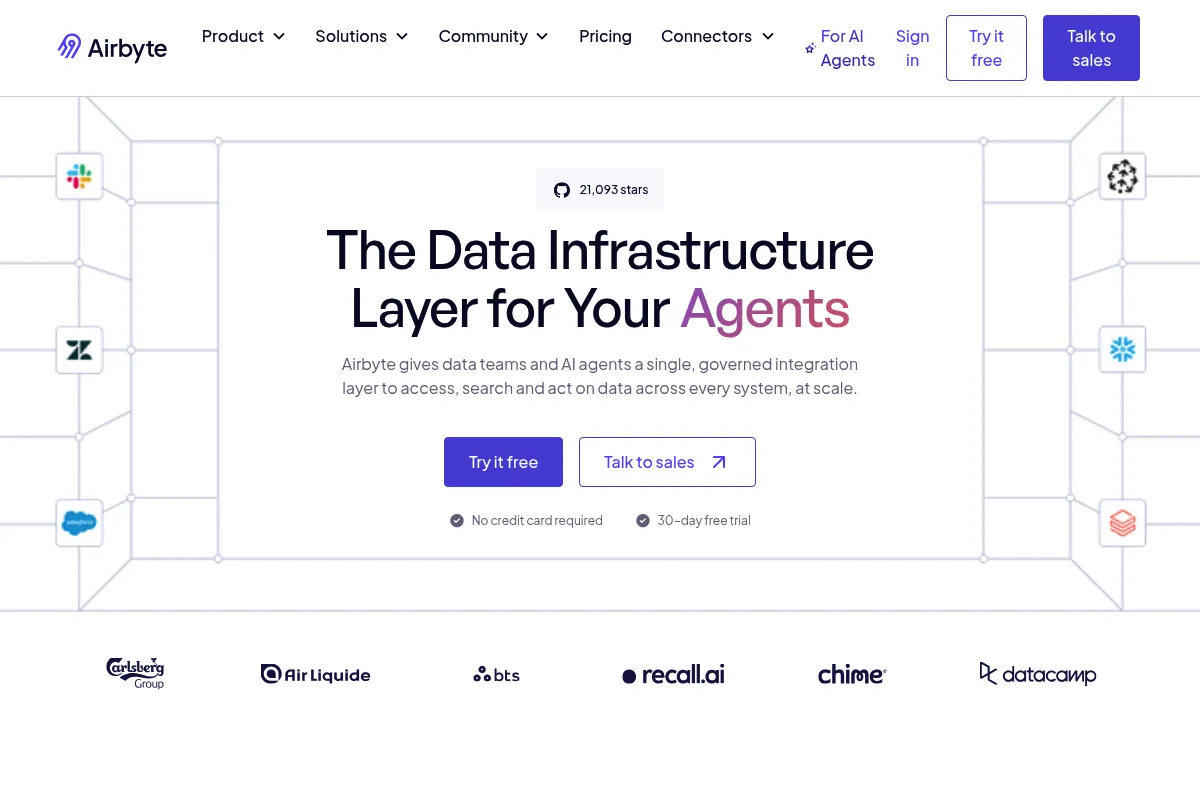
Who Should Use Airbyte?
Typical users
Data engineers and developers in mid-to-large organizations who need to move data from niche APIs or internal databases to warehouses.
Maturity fit
scaling to advanced
Choose this if…
- You need to build custom connectors quickly using a Python-based CDK
- Your priority is avoiding vendor lock-in through an open-source core
- You require self-hosting for strict data privacy and compliance reasons
- You want to move data into vector databases for AI/RAG workflows
Skip this if…
- You have zero engineering resources to maintain self-hosted infrastructure
- You only need standard SaaS connectors and want 'set and forget' reliability
- Your workflow requires complex in-flight data transformations before loading
About Airbyte
Airbyte is an open-source ELT platform designed to commoditize data integration by providing a standardized framework for moving data. It bridges the gap between rigid SaaS ETL tools and manual Python scripts by offering a massive library of pre-built connectors and a development kit for custom needs.
Official profiles
What it actually does
It synchronizes data from APIs, databases, and files to destinations like Snowflake, BigQuery, and Pinecone. Users manage sync frequency, normalization, and monitoring through a web UI, API, or Terraform provider.
What makes it different
Unlike closed-source competitors, Airbyte provides a Connector Development Kit (CDK) that allows users to build and maintain their own connectors in hours. Its 'all-you-can-eat' open-source tier contrasts with the high-volume pricing of managed alternatives.
Ratings across the web

Ratings aggregated from independent review platforms.
Key Features
Connector Development Kit (CDK)
Allows developers to generate new connectors using templates, reducing boilerplate code.
No-Code Connector Builder
Enables non-developers to create API integrations through a web interface.
Airbyte Cloud
Managed service that handles infrastructure, scaling, and security updates.
PyAirbyte
Python library for running Airbyte connectors locally in notebooks or scripts.
Change Data Capture (CDC)
Efficiently syncs only modified database rows using logs rather than full table scans.
Octavia CLI
Manages Airbyte configurations via YAML files for version control and CI/CD.
Vector Store Destinations
Native support for chunking and embedding data into stores like Pinecone and Weaviate.
Pricing
Open Source
- Self-managed deployment
- Unlimited connectors
- Community support
- Access to CDK
Cloud Growth
- Fully managed infrastructure
- Email support
- 99.9% uptime SLA
- Multiple workspaces
Cloud Enterprise
- Single Sign-On (SSO)
- Role-Based Access Control (RBAC)
- Dedicated support engineer
- Custom data retention policies
Pricing checked 5 months ago
Pricing guidance
- When self-hosting maintenance costs exceed Cloud credit costs
- When you need SSO or RBAC for organizational security
- When you require 24/7 support SLAs for production pipelines
- Credits are consumed based on compute time and data volume
- Database sources typically consume credits faster than simple API sources
- Self-hosted version lacks some UI-based management features found in Cloud
Competitive with Fivetran for high-volume users, but requires careful monitoring to prevent credit spikes.
Pros & Cons
Strengths
-
Extensive connector library
Covers niche sources that competitors often ignore, reducing the need for custom-coded scripts.
-
Open-source flexibility
The ability to self-host avoids vendor lock-in and satisfies strict data residency requirements for regulated industries.
-
Developer-centric ecosystem
Features like the CDK and Terraform support align with modern software engineering workflows rather than just analyst needs.
-
AI-ready architecture
Native support for RAG workflows makes it one of the few ELT tools that handles data preparation for LLMs.
Weaknesses
-
Connector quality variance
Community-contributed connectors can be buggy or lack documentation compared to 'certified' ones, leading to unexpected sync failures.
Affects: Teams relying on long-tail or niche SaaS integrations
-
Operational overhead
Self-hosting requires managing Docker or Kubernetes clusters, which can become a significant time sink for small teams.
Affects: Small startups without dedicated DevOps or Data Engineering resources
-
Complex credit-based pricing
The Cloud pricing model is based on compute credits, making it difficult to predict monthly costs compared to row-based models.
Affects: Budget-conscious managers needing predictable monthly spend
Real User Sentiment
Generally positive for its flexibility and open-source nature, though users frequently cite stability issues with community connectors.
Users tend to like
- CDK for custom API integrations
- Active Slack community for troubleshooting
- Transparent roadmap and rapid feature releases
- Ease of setup for standard databases like Postgres
Users commonly complain about
- Memory leaks in self-hosted Docker instances
- Breaking changes in connector updates
- Lack of transparency in credit consumption on Cloud
Recurring tradeoffs
- Choosing between the financial cost of Cloud credits vs. the engineering cost of self-hosting maintenance.
Happiest users
Data engineers at mid-market companies who need to sync data from custom internal APIs.
Often frustrated
Small teams without DevOps skills who find the self-hosted version too complex to keep stable.
Use Cases
SaaS to Warehouse
Syncing HubSpot and Zendesk data to Snowflake for executive reporting.
Database Replication
Using CDC to mirror a production Postgres DB to a BigQuery instance for analytics.
Custom API Integration
Using the CDK to pull data from a niche industry-specific ERP.
AI Knowledge Base
Moving documentation from Confluence to Pinecone for a RAG-based chatbot.
Data Lake Ingestion
Loading raw JSON files from S3 into a data lake for data science exploration.
Frequently Asked Questions
Is Airbyte actually free?
The Open Source edition is free to download and run on your own infrastructure. However, you are responsible for the costs of the servers (AWS/GCP) and the engineering time required to maintain it. Airbyte Cloud is a paid managed service.
How does Airbyte compare to Fivetran?
Fivetran is a closed-source, fully managed service known for high reliability but higher costs. Airbyte is open-source, offering more flexibility and a CDK for custom connectors, but some of its community connectors may be less stable than Fivetran's.
How does credit pricing work in Airbyte Cloud?
Airbyte Cloud uses a credit-based model where you are charged based on the volume of data moved and the compute time required. This differs from Fivetran's 'Monthly Active Rows' model, making Airbyte potentially cheaper for high-volume, low-frequency syncs.
Can I run Airbyte on my own VPC?
Yes, the Open Source version can be deployed via Docker or Kubernetes within your own Virtual Private Cloud (VPC), which is a common requirement for companies with strict data security policies.
Does Airbyte support real-time data synchronization?
Airbyte is primarily a batch-based ELT tool. While it supports Change Data Capture (CDC) for databases which can sync as frequently as every minute, it is not a real-time streaming platform like Apache Kafka.
What happens if a connector I need doesn't exist?
You can use the Airbyte Connector Development Kit (CDK) to build it yourself in Python, or use the No-Code Connector Builder for REST APIs. This is one of Airbyte's core advantages over competitors.
Why trust this page?
This evaluation combines product positioning, pricing analysis, traffic and market signals, and public user sentiment into a single decision-support page. Content is generated editorially — not copied from the vendor's website.
Funding & Company
Founded
2020
Stage
Series b
Total Raised
$181.35M
Latest Round
Series B (Dec 2021)
Notable Investors
Airbyte has raised a total of $181.4M, culminating in a $150M Series B in late 2021 that valued the company at $1.5B. This significant funding from top-tier investors like Altimeter, Coatue, Benchmark, and Accel provides a substantial runway and resources for product development and market expansion.
Market Signals & Traffic
Estimated visits, global rank, geography, traffic sources, monthly visit trends, and organic search keywords (Similarweb)—on a dedicated page built for depth and search.
- Estimated visits
- 217,623
- Global rank
- #177,601
- Snapshot
- Apr 2026
- Traffic trend
- Steady
Estimated monthly visits
Similar Tools
SGLang
Developer Tools, Automation & Agents, Workflow

High-performance framework for structured and efficient model inference.
Photoroom
Design, Content Creation

Professional photo editor for background removal and product photography
Amplemarket
Marketing Automation, Automation, Communication

Sales platform for lead generation and multi-channel outreach automation.
Viam
Developer Tools, Automation

Software platform for building and managing smart hardware devices.
Weights & Biases (W&B)
Developer Tools, Research

Developer platform for tracking, visualizing, and managing machine learning experiments.
Ambience Healthcare
Health & Wellness, Automation, Documentation

Operating system for automated clinical documentation and healthcare workflows.