
SGLang
A high-performance LLM inference framework that prioritizes throughput and structured output through a specialized runtime and intelligent KV cache sharing.
Best for developers building high-volume agentic workflows or structured data extractors, weaker for teams seeking a simple, low-config OpenAI wrapper.
Analysis based on product data, pricing structure, traffic signals, and public user sentiment.
Who Should Use SGLang?
Typical users
Machine learning engineers and backend developers managing their own GPU infrastructure for production LLM applications.
Maturity fit
advanced
Choose this if…
- Your priority is maximizing throughput over minimizing latency for single requests.
- You need to generate complex, valid JSON or regex-constrained data at scale.
- Your application involves multi-turn conversations or agents that share long system prompts.
- You want an open-source alternative to vLLM with better prefix caching.
Skip this if…
- You do not manage your own GPUs and prefer serverless API providers.
- Your workflow consists of simple, independent chat completions with no shared context.
- You require the most mature ecosystem and widest community support, where vLLM still leads.
About SGLang
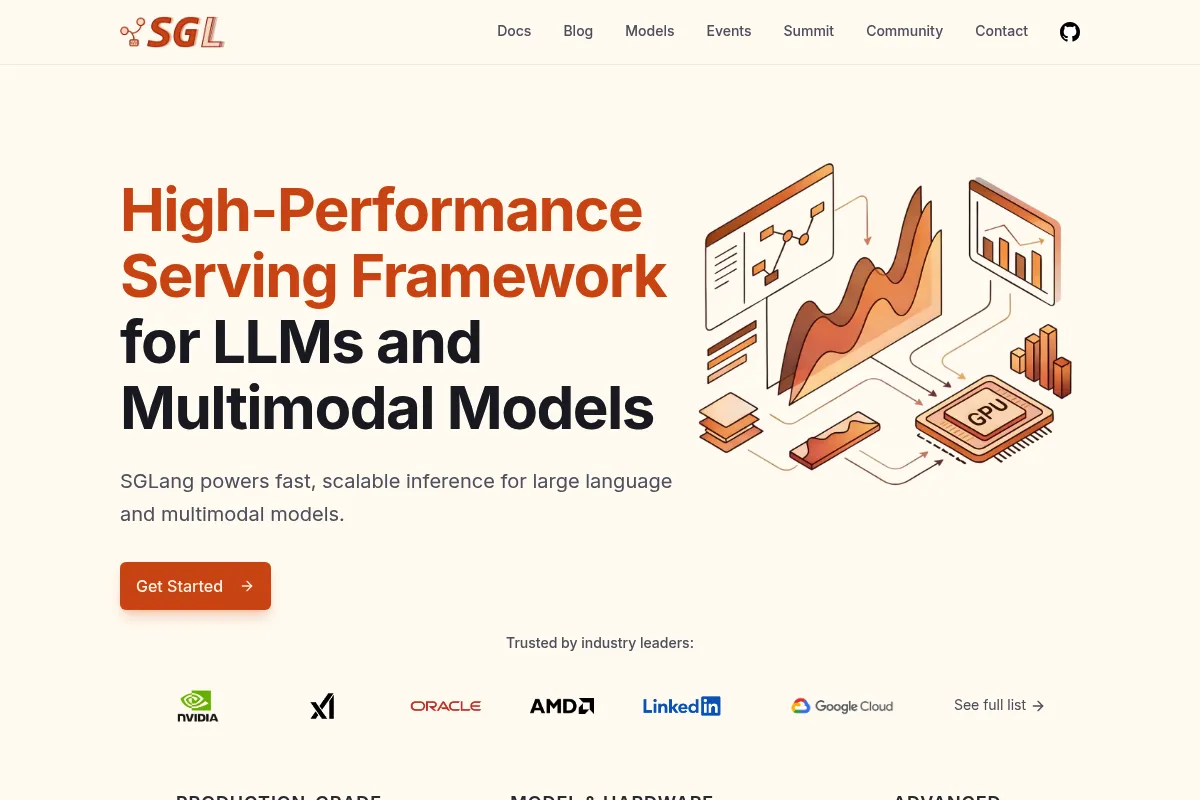
SGLang is an open-source serving framework designed to optimize large language model inference and control. It provides a specialized runtime that handles the complexities of hardware acceleration while offering a Python-based language for defining model logic.
Official profiles
What it actually does
It enables high-speed model serving by managing how prompts are processed and how memory is allocated on the GPU. Users write programs in the SGLang DSL to control multi-step generation, while the backend uses RadixAttention to reuse previous computations and speed up response times.
What makes it different
The core differentiator is RadixAttention, which treats the KV cache as a tree structure rather than a flat buffer. This allows the system to automatically share and reuse prefixes across different requests, which is significantly more efficient for agentic workflows than the PagedAttention used by competitors like vLLM.
Key Features
RadixAttention
Automatically reuses KV cache for shared prefixes, drastically reducing redundant computation in multi-turn tasks.
Compressed Finite State Machine (FSM)
Accelerates constrained decoding, making JSON generation much faster than standard sampling.
SGLang DSL
Allows developers to write LLM programs with control flow (if/else, loops) directly in Python.
Data Parallelism
Scales throughput by distributing requests across multiple GPU instances.
FlashInfer Integration
Uses high-performance kernels to optimize the attention mechanism on NVIDIA hardware.
Chunked Prefill
Prevents large prompts from stalling the generation of shorter responses in a shared batch.
Multi-modal Support
Handles vision-language models like LLaVA alongside standard text models.
Pricing
Open Source
- Full access to source code (Apache 2.0)
- RadixAttention and KV cache sharing
- Structured generation engine
- Multi-GPU support
- Community-driven updates
Pricing checked 4 months ago
Pricing guidance
- When you need professional support or managed hosting (look to third-party providers like RunPod or Lambda Labs).
- When your throughput requirements exceed the capacity of a single GPU node.
- No built-in GUI for monitoring; requires external tools like Prometheus/Grafana.
- Performance gains are highly dependent on prompt prefix overlap.
Open-source framework with no direct licensing costs.
Pros & Cons
Strengths
-
Superior throughput for structured data
The FSM-based decoding engine outperforms most other frameworks when generating strict JSON or following complex schemas.
-
Efficient memory management
RadixAttention's ability to cache and evict prefixes based on usage frequency keeps GPU memory utilization optimal during long-running sessions.
-
Flexible programming model
The DSL allows for complex 'chain-of-thought' or agentic patterns without the overhead of multiple independent API calls.
Weaknesses
-
Steeper learning curve
To get the most out of it, developers must learn the SGLang-specific syntax and runtime architecture rather than just sending strings to an endpoint.
Affects: Teams looking for a quick, drop-in replacement for simple APIs
-
Ecosystem maturity
While growing fast, it has fewer third-party integrations and community-contributed tutorials compared to vLLM.
Affects: Junior developers or teams relying on extensive documentation
-
Hardware specificity
Optimizations are heavily tuned for NVIDIA GPUs; support for other hardware (AMD, Gaudi) is present but less battle-tested.
Affects: Teams using non-NVIDIA cloud instances
Real User Sentiment
Highly positive among technical users who prioritize performance and control over ease of setup.
Users tend to like
- Significant throughput improvements over vLLM in multi-turn scenarios
- Reliability of JSON output
- Active development and frequent performance patches
- The efficiency of the prefix caching system
Users commonly complain about
- Documentation can be fragmented across GitHub and the main site
- Initial setup and environment configuration can be finicky
- The DSL feels unnecessary for very simple use cases
Recurring tradeoffs
- Users trade the simplicity of a standard API for the performance of a specialized runtime.
Happiest users
ML Engineers building complex agent frameworks or high-volume data extraction pipelines.
Often frustrated
Developers trying to run LLMs on consumer hardware with limited VRAM or those who want a 'one-click' deployment.
Use Cases
High-volume JSON extraction
Converting thousands of unstructured documents into valid, schema-compliant data.
Multi-agent orchestration
Running complex workflows where agents share a long 'world state' or system prompt.
Interactive Chatbots
Reducing latency in long conversations by caching the chat history prefix.
Code Generation
Using constrained decoding to ensure the model only outputs valid syntax for specific programming languages.
Batch Inference
Processing massive datasets where throughput is the primary bottleneck.
Frequently Asked Questions
Is SGLang free to use?
Yes, SGLang is open-source software under the Apache 2.0 license. There are no licensing fees, though you are responsible for the costs of the GPU hardware or cloud instances required to run it.
How does SGLang compare to vLLM?
SGLang generally offers higher throughput in scenarios with shared prompt prefixes (like agents or multi-turn chat) due to its RadixAttention mechanism. While vLLM is more widely used and has a larger ecosystem, SGLang is often faster for structured generation and complex logic.
What are the hardware requirements?
SGLang is optimized for NVIDIA GPUs with CUDA support. It requires significant VRAM depending on the model size (e.g., Llama-3 70B typically requires multiple A100 or H100 GPUs).
Does it support OpenAI-compatible APIs?
Yes, SGLang includes a launch script that starts an HTTP server compatible with the OpenAI API specification, making it easy to swap into existing applications.
Can I use SGLang for multi-modal models?
Yes, SGLang supports several vision-language models, including LLaVA, allowing for high-performance image-to-text generation.
What is RadixAttention?
It is a technique that manages the KV cache as a tree. When multiple requests share the same beginning (prefix), SGLang only computes and stores that part once, saving memory and time.
Why trust this page?
This evaluation combines product positioning, pricing analysis, traffic and market signals, and public user sentiment into a single decision-support page. Content is generated editorially — not copied from the vendor's website.
Funding & Company
Founded
2025
Stage
Seed
Total Raised
$100M
Latest Round
Seed (May 2026)
Notable Investors
RadixArk, the commercial entity behind the SGLang open-source project, launched with a massive $100 million Seed round in May 2026. The round, led by Accel and Spark Capital, valued the company at $400 million post-money, signaling significant investor confidence in its mission to commercialize AI inference tools.
Market Signals & Traffic
Estimated visits, global rank, geography, traffic sources, monthly visit trends, and organic search keywords (Similarweb)—on a dedicated page built for depth and search.
- Estimated visits
- 0
- Global rank
- —
- Snapshot
- May 2026
- Traffic trend
- —
Estimated monthly visits
Alternatives to SGLang
View all alternatives
Similar Tools
Wordware
Developer Tools, Automation & Agents, Workflow

IDE for building and deploying complex LLM applications
Duckie
Developer Tools, Automation & Agents, Workflow

Autonomous software engineer that resolves technical tickets and bugs.
Back4App
Developer Tools, Automation & Agents, Workflow

Backend-as-a-Service platform for building and scaling applications.
Phidata
Developer Tools, Automation & Agents, Workflow

Framework for building multi-modal agents with memory and tools.
Julep
Developer Tools, Automation & Agents, Workflow

Development platform for building stateful agents with long-term memory.
Mirascope
Developer Tools, Automation & Agents, Workflow

Pythonic library for building LLM applications with structured outputs.