

A managed Parse Server provider that simplifies backend development through automated API generation and relational data modeling, offering a flexible alternative to proprietary NoSQL platforms.
Excellent for developers who prefer an open-source foundation with relational capabilities, but weaker for those requiring a native SQL environment or predictable flat-rate pricing at high scale.
Analysis based on product data, pricing structure, traffic signals, and public user sentiment.
Who Should Use Back4App?
Typical users
Solo developers, startup founders building MVPs, and small engineering teams migrating away from Firebase or self-hosted Parse instances.
Maturity fit
beginner to scaling
Choose this if…
- You want the flexibility of Parse Server without the DevOps burden of self-hosting.
- Your application requires relational data structures rather than a flat NoSQL document store.
- You want to avoid vendor lock-in by using an open-source backend framework.
- You need to quickly prototype using AI-generated schemas and cloud functions.
Skip this if…
- You require a native PostgreSQL or MySQL environment (Supabase is a better fit).
- Your project has massive, unpredictable traffic where Firebase's scaling costs are more favorable.
- You need advanced real-time collaboration features like those found in specialized sync engines.
About Back4App
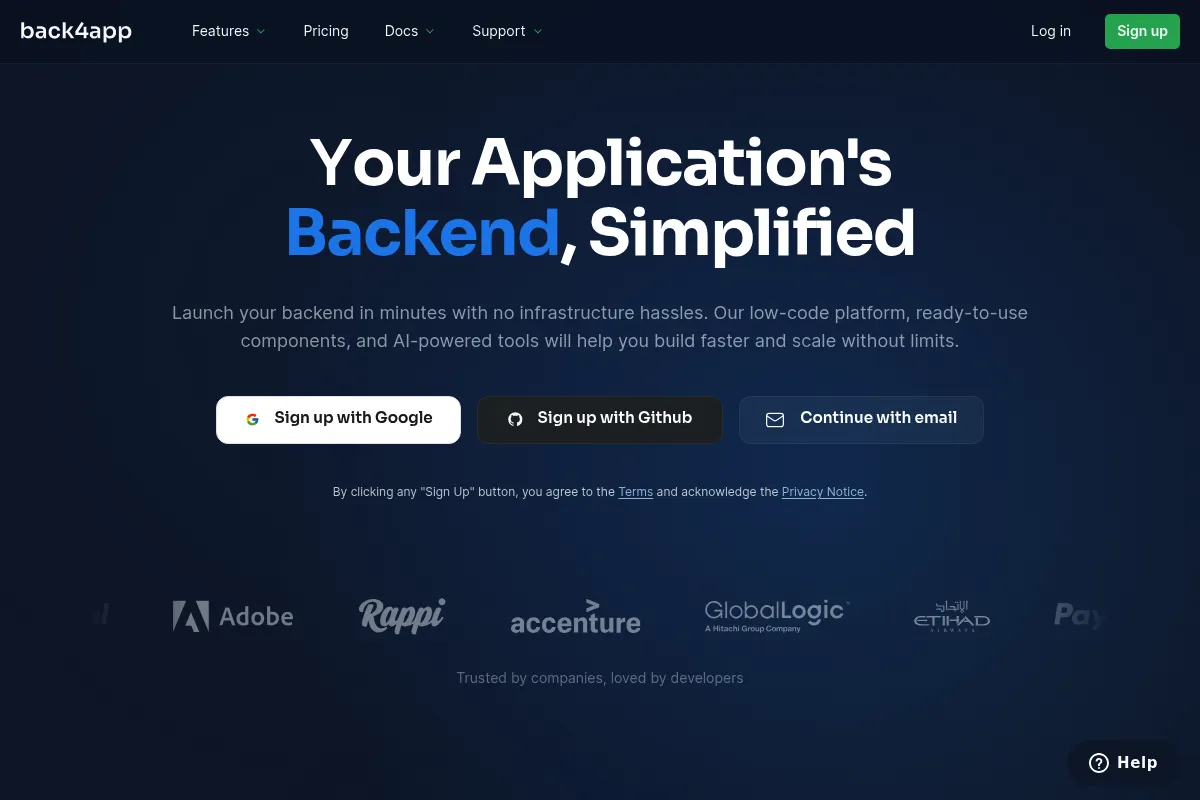
Back4App is a Backend-as-a-Service (BaaS) platform built on the open-source Parse Server. It provides a managed environment for databases, APIs, and file storage, designed to help developers launch applications without managing servers.
Official profiles
What it actually does
The platform automates the creation of REST and GraphQL APIs based on defined data schemas. It handles database management, user authentication, push notifications, and serverless logic through Node.js cloud functions.
What makes it different
Unlike Firebase, Back4App is built on an open-source core, allowing users to export their code and host it elsewhere if needed. It also integrates a dedicated AI agent that can build backend structures from natural language prompts, which is more advanced than simple code completion tools.
Ratings across the web

Ratings aggregated from independent review platforms.
Key Features
Parse Dashboard
Provides a spreadsheet-like interface to manage complex relational data without writing manual queries.
Back4app AI
Generates database classes, security roles, and cloud function logic from text descriptions.
LiveQuery
Enables real-time updates for chat apps or live feeds by pushing data changes to clients instantly.
Cloud Code
Allows running custom JavaScript logic on the server side to handle complex business rules or integrations.
Back4app Containers
Deploys Dockerized applications, allowing you to run custom microservices alongside your BaaS.
Automated Backups
Handles daily data backups and point-in-time recovery to prevent data loss.
User Management
Built-in modules for email verification, password resets, and social logins (OAuth).
Pricing
Free
- 25k Requests
- 250MB Data Storage
- 1GB Data Transfer
- 1GB File Storage
Starter
- 50k Requests
- 500MB Data Storage
- 2GB Data Transfer
- 2GB File Storage
Basic
- 500k Requests
- 2GB Data Storage
- 10GB Data Transfer
- 10GB File Storage
Standard
- 2M Requests
- 10GB Data Storage
- 50GB Data Transfer
- 50GB File Storage
Pay-as-you-go
- 5M Requests
- 40GB Data Storage
- 250GB Data Transfer
- 250GB File Storage
Pricing checked 6 months ago
Pricing guidance
- Exceeding the 25k monthly request limit
- Needing more than 250MB of database storage
- Requiring custom domains or background jobs
- Overage charges for data transfer and file storage can be high if not monitored.
- Shared resources on lower tiers can lead to occasional latency spikes.
Affordable for early-stage development, but transitions to a premium pricing model as you scale into production tiers.
Pros & Cons
Strengths
-
Relational data handling
Unlike document-based NoSQL stores, it handles complex relationships between data objects natively, making it easier to build structured applications.
-
Open-source foundation
Because it is based on Parse, you can migrate your entire backend to your own AWS or DigitalOcean instance if you outgrow the platform.
-
AI-assisted development
The AI agent significantly reduces the time spent on boilerplate code by creating schemas and functions based on simple prompts.
-
Consolidated toolset
Combines database, file storage, hosting, and notifications in one place, reducing the number of third-party services a small team needs to manage.
Weaknesses
-
Steep pricing jumps
The cost increases significantly when moving from the Starter to the Basic tier, which can be a shock for growing startups.
Affects: Bootstrapped startups and scaling MVPs
-
Parse-specific learning curve
Developers used to standard SQL or pure NoSQL may find the Parse-specific way of handling queries and cloud code restrictive at first.
Affects: Experienced backend engineers
-
Dashboard performance
The web-based management console can become sluggish when dealing with very large datasets or complex schemas.
Affects: Teams with high-volume data management needs
Real User Sentiment
Generally positive, with users praising the speed of deployment and the relational data structure, though some express frustration over the cost of scaling.
Users tend to like
- Ease of setting up a relational database
- Responsive and helpful customer support
- The ability to use GraphQL out of the box
- Simple migration from self-hosted Parse
Users commonly complain about
- High cost of higher-tier plans
- Occasional dashboard instability
- Documentation can be outdated for specific edge cases
Recurring tradeoffs
- You trade the control of a raw database for the speed of a managed BaaS.
- You gain relational features but lose some of the massive ecosystem support found in Firebase.
Happiest users
Mobile app developers building MVPs who need a structured database without managing a server.
Often frustrated
Developers who experience sudden traffic spikes and find the request-based pricing model expensive.
Use Cases
Mobile App MVP
Quickly build a backend for iOS/Android apps with user auth and data sync.
Real-time Chat Application
Using LiveQuery to handle instant messaging without complex socket management.
IoT Data Collection
Storing and querying structured data from connected devices.
Internal Business Tools
Creating a secure, managed database for company-wide applications.
Web App Prototyping
Using the AI agent to generate a functional API in minutes for frontend testing.
Frequently Asked Questions
How does Back4App compare to Firebase?
Back4App is built on the open-source Parse Server and uses a relational data model, whereas Firebase is a proprietary Google product using a NoSQL document store. Back4App is better for structured data and avoiding vendor lock-in, while Firebase offers a more extensive ecosystem of integrated Google services.
Is the free plan actually usable for production?
The free plan is primarily for development and prototyping. With a limit of 25,000 requests and 250MB of data, most production apps will hit these limits quickly. The $15 Starter plan is the realistic entry point for production.
Can I migrate my data out of Back4App?
Yes. Since it is based on Parse Server, you can export your database (MongoDB or PostgreSQL) and your Cloud Code to host it on your own infrastructure or another Parse provider.
Does Back4App support custom domains?
Custom domains are supported on all paid plans, starting with the $15/month Starter tier. The free plan uses a back4app.io subdomain.
What programming languages does it support?
Back4App provides SDKs for JavaScript, Flutter, React Native, iOS (Swift/Objective-C), Android (Java/Kotlin), .NET, and PHP. Cloud Code logic is written in Node.js.
What are the main limitations of the platform?
The primary limitations are the cost of scaling requests and storage, and the fact that you are tied to the Parse Server framework's logic, which may not be as flexible as a custom-built Node.js or Go backend for highly specialized requirements.
Why trust this page?
This evaluation combines product positioning, pricing analysis, traffic and market signals, and public user sentiment into a single decision-support page. Content is generated editorially — not copied from the vendor's website.
Funding & Company
Founded
2015
Stage
Seed
Total Raised
—
Latest Round
Seed (Jun 2018)
Notable Investors
Back4App has raised at least two seed rounds, though the total amount of funding is not publicly and consistently disclosed across data providers. The company is backed by a mix of accelerator programs and venture capital firms, suggesting early-stage validation and support for its backend-as-a-service platform.
Market Signals & Traffic
Estimated visits, global rank, geography, traffic sources, monthly visit trends, and organic search keywords (Similarweb)—on a dedicated page built for depth and search.
- Estimated visits
- 592,384
- Global rank
- #64,439
- Snapshot
- Apr 2026
- Traffic trend
- Surging
Estimated monthly visits
Alternatives to Back4App
View all alternativesAmazon CodeWhisperer
Developer Tools

AI-powered coding companion that generates code recommendations.
Backendless
Developer Tools, Website Builder, Automation & Agents

Visual app development platform with backend-as-a-service and UI builder.
Appwrite
Developer Tools, Automation

Backend platform for building web, mobile, and flutter applications.
Similar Tools
Mendix
Developer Tools, Automation & Agents, Workflow

Low-code platform for building and deploying enterprise applications.
Phidata
Developer Tools, Automation & Agents, Workflow

Framework for building multi-modal agents with memory and tools.
Julep
Developer Tools, Automation & Agents, Workflow

Development platform for building stateful agents with long-term memory.
Abacus.ai
Developer Tools, Automation & Agents, Workflow

Platform for building and deploying enterprise-scale machine learning models.
Wordware
Developer Tools, Automation & Agents, Workflow

IDE for building and deploying complex LLM applications
Duckie
Developer Tools, Automation & Agents, Workflow

Autonomous software engineer that resolves technical tickets and bugs.