

Julep
Julep is a managed backend for AI agents that offloads the complexity of state management and long-term memory to a unified API, making it a faster alternative to building custom agent infrastructure.
Excellent for developers building persistent, multi-session AI assistants, but weaker for those who require full control over their own vector database or orchestration logic.
Analysis based on product data, pricing structure, traffic signals, and public user sentiment.
Who Should Use Julep?
Typical users
Software engineers and product teams building production-grade AI agents that need to remember users across sessions.
Maturity fit
scaling
Choose this if…
- You want to build agents with long-term memory without managing a vector database.
- Your priority is reducing boilerplate code for session management and state persistence.
- You need a managed alternative to the OpenAI Assistants API that supports multiple LLM providers.
Skip this if…
- You require a no-code interface; this is a developer-first SDK and API.
- You need to keep all data within your own VPC for strict compliance.
- Your agents are simple, single-turn scripts that don't require state.
About Julep
Julep is a development platform designed to solve the 'statelessness' problem of LLMs. It provides the infrastructure layer for agents to maintain long-term memory and execute multi-step tasks. It exists to prevent developers from having to rebuild the same memory and session management logic for every new AI application.
Official profiles
What it actually does
It provides a managed API and SDKs that handle the storage and retrieval of user interactions, documents, and agent states. Developers define 'Agents', 'Users', and 'Tasks', and Julep manages the underlying database and RAG (Retrieval-Augmented Generation) processes automatically.
What makes it different
Unlike LangChain, which is a library of components you must assemble, Julep is a stateful backend. It treats memory as a first-class citizen, automatically handling the 'embedding-storage-retrieval' loop so developers can focus on agent logic rather than infrastructure.
Key Features
Stateful Agents
Maintains context and memory across different conversations and sessions.
Managed RAG
Automatically chunks, embeds, and retrieves relevant documents without manual vector DB setup.
Unified API
Switch between different LLM models without rewriting your memory or session logic.
Task Execution
Defines complex, multi-step workflows that the agent can execute autonomously.
User Profiles
Stores specific user preferences and history to personalize agent responses.
Metadata Filtering
Allows for granular control over what information the agent retrieves during a session.
Pricing
Free
- Limited monthly requests
- Basic memory storage
- Community support
- Access to standard models
Pro
- Higher request limits
- Increased document storage for RAG
- Priority support
- Advanced task orchestration
Enterprise
- Unlimited scale
- SLA guarantees
- Custom deployment options
- Dedicated account manager
Pricing checked 5 months ago
Pricing guidance
- When you need to store more than a few hundred documents for RAG.
- When your agent's monthly interaction volume exceeds free tier limits.
- When you require faster API response times and priority support.
- Token costs for the underlying LLMs are often billed separately or passed through.
- Storage limits on the free tier can be hit quickly if uploading large PDF sets.
Competitive with other managed agent platforms, positioning itself as a more affordable and flexible alternative to OpenAI's proprietary ecosystem.
Pros & Cons
Strengths
-
Eliminates infrastructure overhead
By handling the vector database and session storage, it saves weeks of engineering time spent on 'plumbing' for AI agents.
-
Model agnostic
You aren't locked into OpenAI; you can use Claude or other models while keeping the same memory architecture.
-
Open-source flexibility
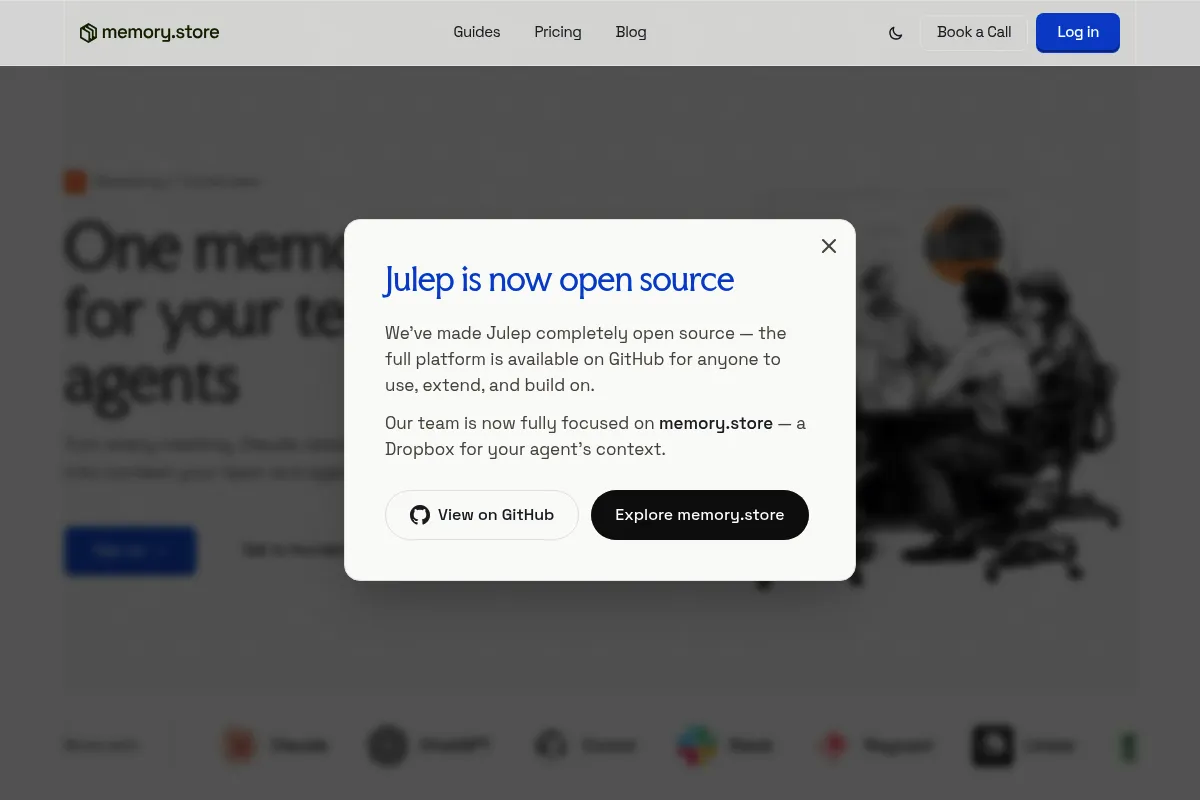
The core platform is open-source, allowing teams to start on the managed cloud and move to self-hosted if privacy needs change.
Weaknesses
-
Abstraction layer risk
Because it abstracts the memory logic, debugging why an agent retrieved a specific (or wrong) memory can be harder than in a manual RAG setup.
Affects: Advanced developers needing high precision
-
Early-stage ecosystem
The community and third-party integration library are smaller compared to giants like LangChain or LlamaIndex.
Affects: Teams looking for extensive pre-built connectors
-
Dependency on Julep's API
Using the managed version introduces a critical dependency for your application's core state and memory.
Affects: Enterprise teams with strict vendor risk assessments
Real User Sentiment
Users generally appreciate the 'it just works' nature of the memory management, though some find the documentation still evolving.
Users tend to like
- Ease of setting up persistent sessions
- Clean SDK design
- Ability to switch models easily
- Open-source availability
Users commonly complain about
- Documentation can be sparse for complex use cases
- Occasional latency in the managed API
- Steeper learning curve for the 'Task' definitions
Recurring tradeoffs
- You trade granular control over your vector search parameters for development speed.
Happiest users
Developers building personalized AI tutors, assistants, or CRM-linked bots.
Often frustrated
Engineers who want to manually tune their Pinecone or Milvus indexes.
Use Cases
Personalized AI Tutors
Agents that remember a student's progress and past mistakes over months.
Customer Support Bots
Assistants that recall previous interactions with a customer to provide context-aware help.
AI Sales Assistants
Agents that track lead interactions across multiple sessions and update a CRM.
Research Tools
Agents that can be fed hundreds of documents and queried consistently over time.
Role-playing Games
NPCs that maintain consistent personalities and remember player actions.
Frequently Asked Questions
How does Julep compare to OpenAI's Assistants API?
Julep is model-agnostic, meaning you can use it with Anthropic or open-source models, whereas the Assistants API locks you into OpenAI. Julep also offers an open-source version for self-hosting, providing more data sovereignty.
Is there a free plan available?
Yes, Julep offers a free tier for developers to experiment with. It includes basic memory and a limited number of requests per month, which is sufficient for building a prototype.
Can I use my own LLM keys?
Yes, Julep allows you to bring your own API keys for various providers, giving you control over your model spend while using their infrastructure for state.
Does Julep handle document chunking and embedding?
Yes, it has a built-in managed RAG pipeline. When you upload documents to an agent or user, Julep automatically handles the chunking, embedding, and storage.
What programming languages are supported?
Julep currently provides official SDKs for Python and Node.js, which covers the majority of AI development use cases.
Can I self-host Julep?
Yes, the core of Julep is open-source. You can find the Docker configurations and source code on their GitHub to run the backend on your own infrastructure.
Why trust this page?
This evaluation combines product positioning, pricing analysis, traffic and market signals, and public user sentiment into a single decision-support page. Content is generated editorially — not copied from the vendor's website.
Funding & Company
Founded
2023
Stage
Seed
Total Raised
—
Latest Round
Undisclosed
Notable Investors
Julep has received an undisclosed amount of funding from the early-stage venture fund Upsparks Capital and was accepted into Meta's Llama Startup Program. The lack of public funding figures makes it difficult to assess the company's financial runway, but its backing indicates some level of external validation.
Market Signals & Traffic
Estimated visits, global rank, geography, traffic sources, monthly visit trends, and organic search keywords (Similarweb)—on a dedicated page built for depth and search.
- Estimated visits
- 13,060
- Global rank
- #2,130,818
- Snapshot
- Apr 2026
- Traffic trend
- Surging
Estimated monthly visits
Alternatives to Julep
View all alternativesMem0
Developer Tools, Automation & Agents, Productivity

Persistent memory layer for personalized agents and applications.
crewAI
Automation & Agents, Developer Tools

Framework for orchestrating collaborative autonomous agents for complex workflows.
Similar Tools
Phidata
Developer Tools, Automation & Agents, Workflow

Framework for building multi-modal agents with memory and tools.
Mastra
Developer Tools, Automation & Agents, Workflow

TypeScript framework for building and deploying production-ready agents.
Wordware
Developer Tools, Automation & Agents, Workflow

IDE for building and deploying complex LLM applications
Back4App
Developer Tools, Automation & Agents, Workflow

Backend-as-a-Service platform for building and scaling applications.
Mendix
Developer Tools, Automation & Agents, Workflow

Low-code platform for building and deploying enterprise applications.
Abacus.ai
Developer Tools, Automation & Agents, Workflow

Platform for building and deploying enterprise-scale machine learning models.