

A persistent memory layer that automates fact extraction and relationship mapping to give AI agents long-term user recall without manual context management.
Excellent for developers building personalized assistants and tutors, weaker for high-volume document search or simple stateless bots.
Analysis based on product data, pricing structure, traffic signals, and public user sentiment.
Who Should Use Mem0?
Typical users
Software engineers and AI researchers building agentic applications that require cross-session personalization.
Maturity fit
scaling
Choose this if…
- You need your agent to remember specific user preferences across different sessions
- Your priority is reducing context window bloat by only retrieving relevant facts
- You want a managed service that handles the complexity of hybrid vector-graph storage
Skip this if…
- You only need standard RAG for static document retrieval
- Your application is entirely stateless and doesn't benefit from user history
- You have strict data residency requirements that forbid third-party managed memory layers
About Mem0
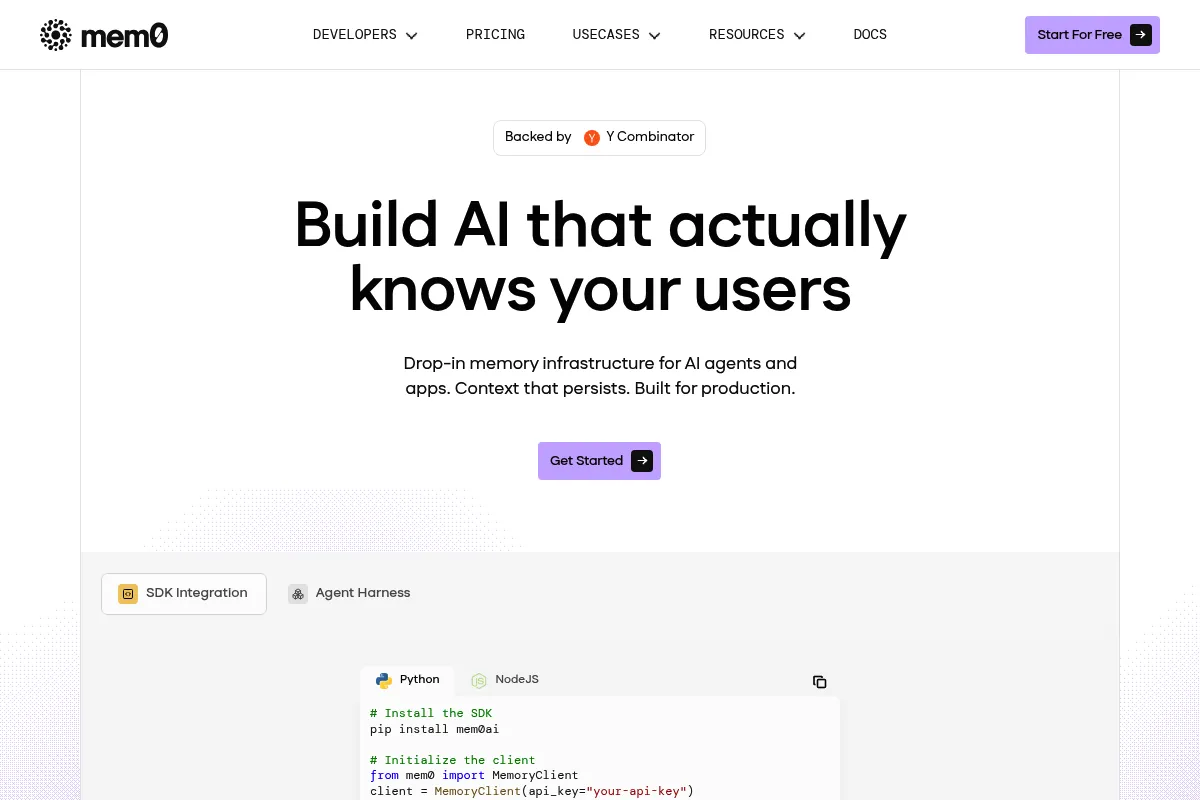
Mem0 is a specialized memory provider for LLM applications. It functions as a middle layer that listens to interactions, extracts meaningful facts, and stores them in a structured format for future retrieval.
Official profiles
What it actually does
The tool automatically parses user prompts to identify and store preferences, past actions, and relationships. When a user returns, Mem0 injects only the relevant historical context into the prompt, allowing the agent to 'evolve' based on past behavior.
What makes it different
Unlike standard vector databases that rely on semantic similarity, Mem0 uses a hybrid approach combining vector search with graph structures. This allows it to understand complex relationships between entities rather than just matching keywords or themes.
Key Features
Self-Improving Memory
The system updates existing memories when new, conflicting, or more specific information is provided.
Graph-Based Relationships
Maps how different entities (people, places, preferences) connect to provide deeper context.
Multi-Platform Sync
Maintains a consistent user profile across web, mobile, and Slack integrations.
Fact Importance Scoring
Prioritizes critical user data over trivial conversational filler.
Developer Dashboard
Visual interface to inspect, edit, or delete stored memories for debugging.
Open Source Core
Allows for local hosting and customization for privacy-sensitive projects.
Pricing
Open Source
- Self-hosted
- Full access to core logic
- Community support
- No memory limits
Basic
- 500 memories
- 1,000 searches
- 1 Project
- 1 User
Pro
- 5,000 memories
- 10,000 searches
- 3 Projects
- 3 Users
- Priority support
Enterprise
- Unlimited memories
- Custom rate limits
- Dedicated infrastructure
- SLA guarantees
Pricing checked 5 months ago
Pricing guidance
- When you exceed 500 stored facts
- When you need to manage multiple separate AI agents (Projects)
- When you require faster API response times via priority infrastructure
- Search limits are separate from storage limits
- Rate limits apply to the API even on paid tiers
- Graph visualization tools are restricted on lower tiers
Mid-range pricing that targets professional developers who value time-to-market over the cost of self-hosting.
Pros & Cons
Strengths
-
Reduced manual engineering
Automates the tedious process of writing logic to decide what information should be saved to a database and how to retrieve it.
-
Context window efficiency
By retrieving only specific facts rather than entire chat histories, it keeps token usage low and prevents model distraction.
-
Hybrid retrieval logic
The combination of graph and vector search handles complex queries that standard RAG systems often fail to resolve correctly.
Weaknesses
-
Black-box extraction logic
Users have limited control over exactly how the system decides what constitutes a 'fact' worth saving, which can lead to missed details.
Affects: Developers with highly specific data extraction requirements
-
Cost scaling
The managed cloud version charges per memory, which can become expensive for applications with millions of active users.
Affects: B2C startups with high user volume and low margins
-
Latency overhead
Adding a memory retrieval step before every LLM call introduces additional milliseconds of latency to the response time.
Affects: Real-time voice or high-speed chat applications
Real User Sentiment
Generally positive, with users praising the 'magic' of automated fact extraction while expressing caution about long-term vendor lock-in.
Users tend to like
- Ease of integration with just a few lines of code
- The ability to handle conflicting information automatically
- Significant improvement in agent 'personality' consistency
Users commonly complain about
- Occasional extraction of irrelevant 'noise' as facts
- Documentation for the graph features can be sparse
- Pricing jumps significantly for high-volume use cases
Recurring tradeoffs
- You trade granular control over your database schema for the speed of automated memory management.
Happiest users
Developers building AI companions or personalized executive assistants.
Often frustrated
Teams with strict data privacy requirements who find the cloud version's data handling opaque.
Use Cases
Personalized Tutors
Remembering a student's past mistakes and learning pace to tailor future lessons.
Customer Support Agents
Recalling a customer's previous issues and product preferences without asking again.
AI Companions
Building long-term relationships by remembering birthdays, hobbies, and past conversations.
Executive Assistants
Storing meeting preferences, travel habits, and recurring tasks across multiple platforms.
Healthcare Assistants
Tracking patient symptoms and medication schedules over time (requires HIPAA compliance check).
Frequently Asked Questions
How does Mem0 differ from a standard vector database like Pinecone?
While Pinecone stores and retrieves text based on similarity, Mem0 is an orchestration layer. It uses an LLM to extract specific facts from text before storing them and manages the relationships between those facts using a graph, which Pinecone does not do natively.
Is there a free version of Mem0 available?
Yes, Mem0 offers an open-source version on GitHub that you can host yourself for free. They also offer a managed 'Basic' cloud tier with a limit of 500 memories and 1,000 searches per month.
Can Mem0 handle conflicting information?
Yes, one of its core features is the ability to update or overwrite existing memories when new information contradicts the old, ensuring the agent always has the most current context.
Does Mem0 integrate with LangChain or LlamaIndex?
Yes, Mem0 is designed to be framework-agnostic and can be used alongside LangChain or LlamaIndex as the dedicated memory provider for their agents.
What are the main limitations of the managed service?
The primary limitations are the storage caps on the Basic and Pro plans, and the fact that you are relying on their proprietary extraction logic, which may not always align with your specific data needs.
Is Mem0 HIPAA or GDPR compliant?
The open-source version can be made compliant if hosted on your own secure infrastructure. For the managed cloud version, you must contact their sales team for Enterprise-grade compliance agreements.
Why trust this page?
This evaluation combines product positioning, pricing analysis, traffic and market signals, and public user sentiment into a single decision-support page. Content is generated editorially — not copied from the vendor's website.
Funding & Company
Founded
2023
Stage
Series a
Total Raised
$23.9M
Latest Round
Series A (Oct 2025)
Notable Investors
Mem0 has raised a total of $23.9M, reported as $24M, across Seed and Series A rounds announced in October 2025. The funding, led by notable VCs like Basis Set Ventures and Kindred Ventures, is aimed at establishing Mem0 as the default memory infrastructure for AI agents, ensuring significant capital for product development and scaling.
Market Signals & Traffic
Estimated visits, global rank, geography, traffic sources, monthly visit trends, and organic search keywords (Similarweb)—on a dedicated page built for depth and search.
- Estimated visits
- 339,466
- Global rank
- #123,972
- Snapshot
- Apr 2026
- Traffic trend
- Surging
Estimated monthly visits
Similar Tools
Not Diamond
Developer Tools, Automation & Agents, Productivity

Intelligent model router selecting the best LLM for every prompt.
Factory
Developer Tools, Automation & Agents, Productivity

Automate software development tasks with autonomous engineering agents.
Bridgeline
E-commerce, SEO, Search

Digital experience platform for e-commerce search, content, and marketing.
11x.ai
Automation & Agents, Marketing Automation, AI Assistant

Autonomous digital workers for sales and lead generation.
Cartesia
AI Assistant, Content Creation, Developer Tools

An AI platform for building and deploying real-time, realistic voice agents and experiences.
Recall
Productivity, Research, Documentation

Summarize and organize online content into a personal knowledge base.