

Not Diamond
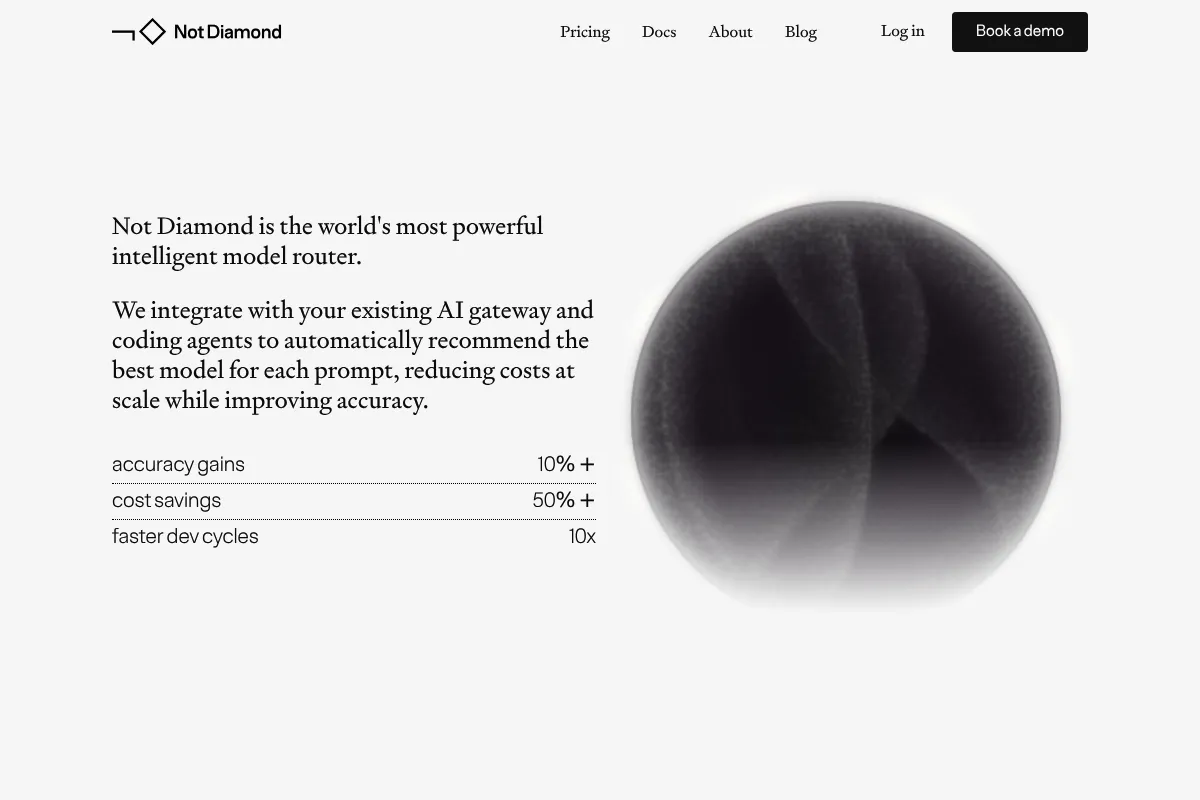
An intelligent LLM routing layer that dynamically selects the most cost-effective or accurate model for every prompt, effectively acting as a performance-optimizing switchboard for multi-model applications.
Excellent for developers scaling AI features who need to balance high-quality output with aggressive cost management, weaker for low-latency applications where every millisecond of overhead matters.
Analysis based on product data, pricing structure, traffic signals, and public user sentiment.
Who Should Use Not Diamond?
Typical users
AI engineers and product teams managing production-grade LLM applications with high query volumes.
Maturity fit
scaling to advanced
Choose this if…
- You want to use cheaper models for simple tasks and flagship models for complex logic without manual coding
- Your priority is reducing inference spend without sacrificing output quality
- You need a unified API to prevent vendor lock-in across OpenAI, Anthropic, and Google
Skip this if…
- You have a sub-100ms latency budget where the routing overhead is unacceptable
- You rely heavily on model-specific features like OpenAI's Assistants API or specific fine-tuned weights
- Your application only uses a single model for a very narrow, predictable task
About Not Diamond
Not Diamond is an automated model router designed to solve the 'one-size-fits-all' problem in LLM deployment. It sits between the application and the model providers, using a meta-model to predict which LLM will perform best for a specific input. This allows teams to treat the entire LLM market as a single, optimized utility.
What it actually does
The tool intercepts every prompt and evaluates it against a library of models to determine the best match based on user-defined priorities: cost, latency, or accuracy. It then routes the request to the chosen provider and returns the response through a unified SDK.
What makes it different
Unlike standard API proxies like LiteLLM that focus on connectivity, Not Diamond focuses on intelligence. It uses a proprietary recommendation engine trained on massive evaluation datasets to make real-time routing decisions, rather than relying on static rules or simple round-robin logic.
Key Features
Intelligent Routing
Automatically selects the best model for each specific prompt to maximize quality and minimize cost.
Unified SDK
Provides a single interface to interact with multiple LLM providers, simplifying code maintenance.
Optimization Toggles
Allows users to slide between 'Max Accuracy' and 'Min Cost' to suit different business needs.
Provider Fallbacks
Ensures high availability by automatically switching to an alternative model if the primary provider is down.
Custom Evals
Enables developers to define what 'success' looks like for their specific use case to improve routing logic.
Latency Benchmarking
Tracks and reports the response times of different models to inform routing decisions.
Usage Analytics
Centralized dashboard to monitor spend and performance across all connected LLM providers.
Pricing
Developer
- Up to 100k routed tokens per month
- Access to all major models
- Basic routing logic
- Community support
Pro
- Up to 1M routed tokens per month
- Advanced routing optimization
- Custom evaluation metrics
- Priority email support
Enterprise
- Unlimited routed tokens
- SLA guarantees
- Dedicated infrastructure
- Custom model training for routing
Pricing checked 5 months ago
Pricing guidance
- When your monthly volume exceeds 100k tokens
- When you need to define custom metrics for more accurate routing
- When you require faster support response times
- Pricing covers the routing service only; you still pay the underlying LLM providers for inference
- Token limits apply to the text processed by the router, not just the output
Value-based pricing that scales with usage, positioned as a cost-saving tool that pays for itself.
Pros & Cons
Strengths
-
Significant inference cost reduction
By offloading simple queries to models like GPT-4o-mini or Llama 3 while reserving Claude 3.5 Sonnet for complex logic, users can cut bills by 30-50%.
-
Eliminates vendor lock-in
The unified API makes it trivial to swap providers if a new model is released or if a provider changes their pricing or terms.
-
Data-driven model selection
Replaces 'vibes-based' engineering with actual performance data, ensuring the best model is used for the specific task at hand.
Weaknesses
-
Added routing latency
The process of analyzing the prompt and making a routing decision adds a small overhead (typically 50-150ms), which may impact real-time UX.
Affects: Real-time chat and voice applications
-
Increased stack complexity
Adding another layer between your app and your models introduces a new potential point of failure and another API to manage.
Affects: Small teams preferring a minimalist architecture
-
Router 'black box' logic
While you can set preferences, the exact reason why the router chose one model over another for a specific prompt can be difficult to audit.
Affects: Highly regulated industries or researchers
Real User Sentiment
Generally positive among technical users who appreciate the 'set it and forget it' nature of the cost optimization.
Users tend to like
- Ease of integration with Python and TypeScript
- Immediate and visible reduction in API costs
- The ability to test new models instantly without code changes
Users commonly complain about
- Occasional latency spikes during routing
- The dashboard can feel sparse compared to full observability suites
- Desire for more transparency in the routing decision engine
Recurring tradeoffs
- Users trade a small amount of speed (latency) for a significant gain in cost efficiency and output quality.
Happiest users
Developers managing high-volume applications where prompt complexity varies significantly.
Often frustrated
Teams building ultra-low latency tools or those who prefer total manual control over their model selection.
Use Cases
Customer Support Bots
Route simple FAQs to cheap models and complex troubleshooting to flagship models.
Content Generation
Use fast models for drafting and high-reasoning models for final editing and fact-checking.
Data Extraction
Dynamically select models based on the length and complexity of the source document.
Cost Management
Automatically cap spend by routing to open-source models once a budget threshold is reached.
A/B Testing
Compare performance across different models for the same prompt set without changing infrastructure.
Frequently Asked Questions
Does Not Diamond replace LiteLLM?
Not exactly. While both provide a unified API, LiteLLM is primarily a proxy for connectivity and load balancing. Not Diamond is an intelligence layer that decides *which* model to use based on the prompt content. Many teams use them together.
How much latency does the router add?
The routing decision typically adds between 50ms and 150ms to the total request time. For most asynchronous or long-form generation tasks, this is negligible, but it may be noticeable in highly interactive real-time chat.
Do I still need my own API keys?
Yes. Not Diamond acts as a router, but you are responsible for the underlying costs from OpenAI, Anthropic, etc. You provide your keys to the platform (or use their managed keys if available) to facilitate the requests.
Is there a free tier available?
Yes, the Developer plan is free and includes 100,000 routed tokens per month, which is sufficient for testing and small-scale personal projects.
What models are supported?
It supports all major flagship models (GPT-4o, Claude 3.5, Gemini 1.5 Pro) as well as popular open-source models like Llama 3 and Mistral via providers like Together AI or Anyscale.
How does it handle data privacy?
Not Diamond processes the prompt to make a routing decision. They state they do not use customer data to train their base models, but users should review their specific data processing agreement for enterprise compliance.
Why trust this page?
This evaluation combines product positioning, pricing analysis, traffic and market signals, and public user sentiment into a single decision-support page. Content is generated editorially — not copied from the vendor's website.
Funding & Company
Founded
2024
Stage
Seed
Total Raised
$2.3M
Latest Round
Undisclosed (May 2025)
Notable Investors
Not Diamond has raised at least $2.3M across two funding rounds from a mix of venture capital and prominent angel investors. While the total amount raised is not public, the backing from strategic investors like IBM and SAP.iO suggests strong enterprise validation and provides capital for product development and market expansion.
Market Signals & Traffic
Estimated visits, global rank, geography, traffic sources, monthly visit trends, and organic search keywords (Similarweb)—on a dedicated page built for depth and search.
- Estimated visits
- 71,947
- Global rank
- #495,931
- Snapshot
- Apr 2026
- Traffic trend
- Surging
Estimated monthly visits
Alternatives to Not Diamond
View all alternatives

Similar Tools
Factory
Developer Tools, Automation & Agents, Productivity

Automate software development tasks with autonomous engineering agents.
Mem0
Developer Tools, Automation & Agents, Productivity

Persistent memory layer for personalized agents and applications.
Terray Therapeutics
Research, Health & Wellness

Generative platform for large-scale small molecule drug discovery.
Instructor
Developer Tools, Data Extraction

Extract structured data from large language models using Pydantic.
Groq
Developer Tools, AI Assistant

AI inference acceleration platform with specialized LPU chips.
Agora.io
Communication, Developer Tools

Real-time engagement platform for voice, video, and live streaming.