

A unified API gateway that aggregates dozens of LLMs into a single interface, eliminating the need to manage multiple provider accounts and billing cycles.
Excellent for developers building multi-model applications or testing new LLMs quickly, weaker for enterprises with strict data residency or zero-retention requirements.
Analysis based on product data, pricing structure, traffic signals, and public user sentiment.
Who Should Use OpenRouter?
Typical users
Individual developers, AI hobbyists, and early-stage startup teams building LLM-powered features.
Maturity fit
beginner to scaling
Choose this if…
- You want to switch between OpenAI, Anthropic, and Google models by changing one string in your code
- You want to avoid managing 10+ different API keys and credit balances
- You need access to niche or open-source models without hosting them yourself
- Your priority is speed of experimentation over absolute minimum latency
Skip this if…
- Your legal team forbids routing sensitive data through a third-party proxy
- You require the absolute lowest latency for high-frequency trading or real-time voice apps
- You need specialized enterprise features like dedicated instances or SOC2 Type 2 compliance directly from the provider
About OpenRouter
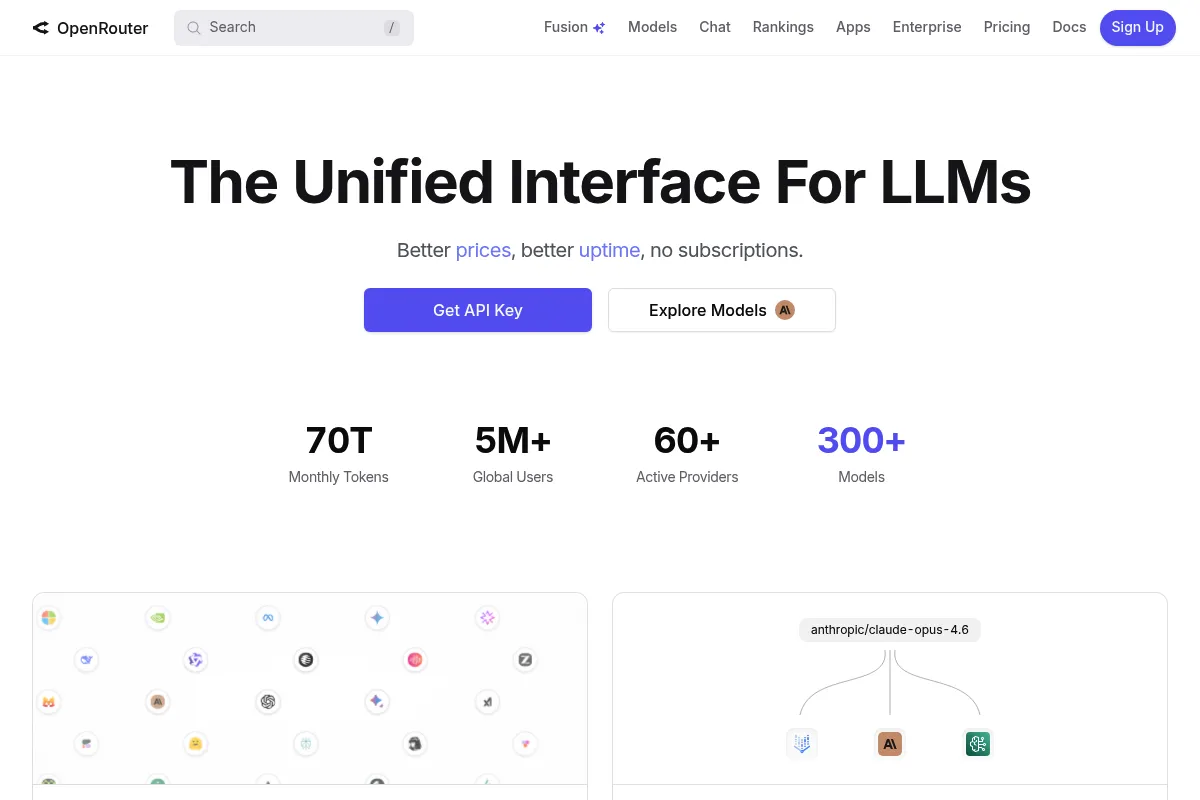
OpenRouter is an LLM aggregator that provides a standardized API for accessing models from OpenAI, Anthropic, Google, Meta, and others. It acts as a middleman that handles billing and routing, allowing developers to use a single OpenAI-compatible SDK to call almost any major model on the market.
Official profiles
What it actually does
It provides a single endpoint where users can send prompts to over 100 different models. Users deposit credits into one OpenRouter account, which are then used to pay for tokens across various providers like Together AI, DeepInfra, and the model creators themselves.
What makes it different
Unlike individual providers, OpenRouter offers a 'Rankings' page based on real-world usage and a 'Router' feature that can automatically fall back to cheaper or faster models if a primary choice is down. It also provides a free tier of models that are subsidized or hosted by the community, which is rare for a commercial gateway.
Ratings across the web

Ratings aggregated from independent review platforms.
Key Features
Unified API
Use the same code structure to call Claude 3.5 Sonnet, GPT-4o, or Llama 3.
Model Rankings
See which models are trending and their actual latency/throughput stats before choosing.
Credit-based Billing
Deposit $5 and use it across 20+ providers instead of hitting $20 minimums on each.
Free Models
Access a rotating selection of open-source models at zero cost for testing.
Provider Selection
Choose specific providers (e.g., Together vs. DeepInfra) for the same model based on price or speed.
Standardized Error Handling
Maps various provider errors into a consistent format for easier debugging.
OAuth Integration
Allow your own app users to sign in with OpenRouter and use their own credits.
Pricing
Free Models
- Access to select open-source models
- Community-hosted inference
- Rate-limited based on demand
- Ideal for testing and prototyping
Pay-as-you-go
- Access to all premium models (GPT-4, Claude 3, etc.)
- No monthly subscription fee
- Credits never expire
- Standardized OpenAI-compatible API
Pricing checked 6 months ago
Pricing guidance
- When you need access to proprietary models like GPT-4o or Claude 3.5
- When your application moves from testing to production traffic
- When you hit rate limits on the free model tier
- Minimum credit top-up is $5
- Some providers on the platform have lower rate limits than if you went direct
- Refunds on deposited credits can be difficult to process
Highly competitive; it often functions as a loss-leader or pass-through to gain developer mindshare.
Pros & Cons
Strengths
-
Zero-friction model switching
Changing your entire app's backend from OpenAI to Anthropic takes seconds because the API schema remains identical.
-
Consolidated billing
Prevents the 'death by a thousand subscriptions' problem for developers testing multiple LLM providers simultaneously.
-
Access to 'hard-to-get' models
Provides immediate access to models that might have waitlists or regional restrictions on their native platforms.
-
Transparent pricing
Often matches or beats direct provider pricing by routing requests through the cheapest available inference host.
Weaknesses
-
Added latency
Because requests go through OpenRouter before hitting the provider, there is a small but measurable millisecond overhead.
Affects: High-performance, real-time applications
-
Middleman risk
If OpenRouter goes down, your access to all connected models goes down, creating a single point of failure.
Affects: Production-grade applications requiring 99.99% uptime
-
Privacy concerns
Data passes through OpenRouter's servers; while they claim not to train on it, highly regulated industries may find this proxy unacceptable.
Affects: Healthcare, Finance, and Legal sectors
Real User Sentiment
Users generally view OpenRouter as an essential tool for the modern AI stack due to its convenience and 'fair' pricing.
Users tend to like
- The ability to test 50+ models in one playground
- No monthly platform fee
- Fast integration with existing OpenAI-based codebases
- The 'Rankings' leaderboard for model discovery
Users commonly complain about
- Occasional 500 errors when a specific sub-provider is down
- Slightly higher latency than direct API calls
- Lack of advanced logging/observability compared to dedicated tools like Helicone
Recurring tradeoffs
- You trade a small amount of latency and direct provider control for massive gains in development speed and billing simplicity.
Happiest users
Full-stack developers building 'wrapper' apps or internal tools who want to stay model-agnostic.
Often frustrated
Enterprise architects who need direct SLAs and data processing agreements with the model creators.
Use Cases
Model Benchmarking
Running the same prompt through 10 models to see which gives the best output.
Cost Optimization
Automatically routing simple queries to cheap models and complex ones to GPT-4.
Rapid Prototyping
Building a proof-of-concept without waiting for API approvals from multiple vendors.
Fallback Systems
Ensuring your app stays online by switching providers if OpenAI or Anthropic has an outage.
Hobbyist Projects
Using free models to build personal tools without incurring any monthly costs.
Frequently Asked Questions
Is OpenRouter more expensive than going direct?
Generally, no. OpenRouter passes through the costs from providers like Together AI or Fireworks, and for models like GPT-4, the price is usually identical to OpenAI's. In some cases, it can be cheaper because OpenRouter finds the lowest-cost inference provider for open-weights models.
OpenRouter vs. LiteLLM: Which should I choose?
Choose OpenRouter if you want a managed service that handles billing and provides the API infrastructure. Choose LiteLLM if you want an open-source library to manage your own keys and host your own proxy server for maximum control and privacy.
Does OpenRouter store my data or prompts?
OpenRouter claims they do not store the content of your prompts or completions unless you explicitly enable logging in your settings. However, because they are a proxy, your data must pass through their servers to reach the final provider, which is a dealbreaker for some high-security use cases.
Can I use OpenRouter with the OpenAI Python library?
Yes. You simply change the `base_url` in the OpenAI client to `https://openrouter.ai/api/v1` and use your OpenRouter API key. This makes it compatible with most existing AI tools and frameworks.
What happens if a specific model provider goes down?
OpenRouter allows you to specify a list of providers or use their 'auto' routing. If one provider is down, OpenRouter can automatically attempt to fulfill the request through another provider that hosts the same model, increasing your app's resilience.
Why trust this page?
This evaluation combines product positioning, pricing analysis, traffic and market signals, and public user sentiment into a single decision-support page. Content is generated editorially — not copied from the vendor's website.
Funding & Company
Founded
2023
Stage
Series a
Total Raised
$40.5M
Latest Round
Series A (Apr 2025)
Notable Investors
OpenRouter has raised a total of $40.5 million over two rounds, a Seed and a Series A, in early 2025. This funding, from top-tier investors like Andreessen Horowitz and Menlo Ventures, provides the company with significant capital to scale its operations and product development.
Market Signals & Traffic
Estimated visits, global rank, geography, traffic sources, monthly visit trends, and organic search keywords (Similarweb)—on a dedicated page built for depth and search.
- Estimated visits
- 17,919,468
- Global rank
- #2,340
- Snapshot
- Apr 2026
- Traffic trend
- Surging
Estimated monthly visits
Similar Tools
Modular
Developer Tools

Unified platform for high-performance AI development and deployment.
Tabnine
Developer Tools

AI code assistant for faster, more accurate software development.
Amazon CodeWhisperer
Developer Tools

AI-powered coding companion that generates code recommendations.
Wavespeed
Developer Tools

Serverless GPU infrastructure for high-speed AI model inference
Predibase
Developer Tools

Fine-tune and serve custom large language models at scale.
Nebius
Developer Tools

Cloud infrastructure for training and deploying machine learning models.