

Turso
A distributed SQLite database that brings data closer to users via edge replication, making it a top choice for low-latency web apps but a poor fit for heavy analytical workloads.
Excellent for global Next.js applications and edge functions, weaker for complex relational data modeling requiring full Postgres compatibility.
Analysis based on product data, pricing structure, traffic signals, and public user sentiment.
Who Should Use Turso?
Typical users
Full-stack developers and small-to-medium engineering teams building on edge runtimes like Vercel, Netlify, or Cloudflare Workers.
Maturity fit
beginner to scaling
Choose this if…
- You want the simplicity of SQLite but need it to work in a distributed, serverless environment
- Your priority is minimizing database latency for a globally distributed user base
- You are building multi-tenant applications where each user needs an isolated database
- You need integrated vector search for RAG applications without adding a separate vector store
Skip this if…
- Your application relies on Postgres-specific features like PostGIS or complex stored procedures
- You require a traditional long-lived TCP connection (libSQL uses HTTP/WebSockets)
- Your workload is primarily heavy OLAP (analytical) rather than OLTP (transactional)
About Turso
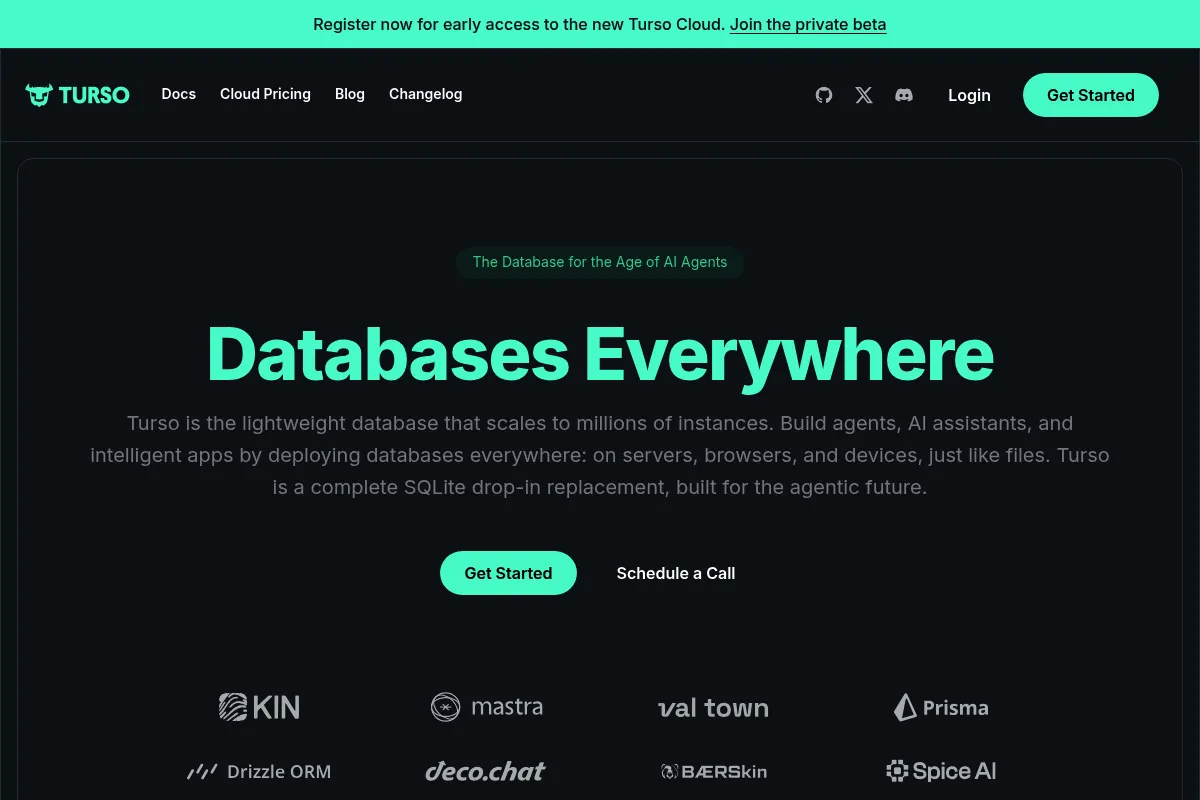
Turso is a managed database platform built on libSQL, an open-source fork of SQLite. It transforms SQLite from a local file-based database into a distributed service capable of running at the edge of the network.
Official profiles
What it actually does
It provides a serverless SQL environment where data is replicated across multiple global regions to ensure low-latency access. Developers get a production-grade database that maintains the lightweight footprint and speed of SQLite while adding features like branching and vector search.
What makes it different
Unlike serverless Postgres providers, Turso is built on the libSQL core, allowing it to offer 'micro-databases' for multi-tenancy at a much lower cost and complexity. Its architectural decision to use the HRANA protocol allows it to bypass the connection pooling issues that typically plague serverless databases.
Key Features
Global Replication
Place read replicas near your users to reduce round-trip latency.
Database Branching
Create isolated copies of your schema and data for feature testing.
Vector Search
Store and query embeddings directly within the SQL interface for AI features.
Embedded Replicas
Sync data to a local SQLite file on your server for the fastest possible reads.
libSQL Compatibility
Use standard SQLite drivers and tools with extended functionality.
Serverless Scaling
Pay based on storage and row operations rather than provisioned CPU.
Multi-DB Groups
Manage hundreds or thousands of logical databases as a single unit.
Pricing
Starter
- 9GB total storage
- 1 Billion row reads/mo
- 25 Million row writes/mo
- Up to 3 locations
Scaler
- 20GB total storage
- 25 Billion row reads/mo
- 50 Million row writes/mo
- Unlimited locations
- Point-in-time recovery
Pro
- 100GB total storage
- 100 Billion row reads/mo
- 500 Million row writes/mo
- Priority support
- Higher rate limits
Pricing checked 5 months ago
Pricing guidance
- When you need more than 3 replication regions
- When you require Point-in-Time Recovery for production safety
- When your storage needs exceed 9GB
- Row read/write limits are hard caps; exceeding them may require an immediate upgrade or overage fees.
- The free tier does not include point-in-time recovery.
Highly competitive and developer-friendly, specifically designed to undercut the cost of serverless Postgres providers.
Pros & Cons
Strengths
-
Exceptional cold-start performance
Because it is based on SQLite, Turso avoids the heavy startup overhead of Postgres-based serverless options, making it ideal for scale-to-zero edge functions.
-
Simplified multi-tenancy
The ability to spin up thousands of individual databases makes it easy to implement per-customer data isolation without massive infrastructure costs.
-
Local-first development flow
Developers can work with a local SQLite file and push to Turso, or use branching to test migrations without affecting production.
Weaknesses
-
SQLite dialect limitations
Users coming from Postgres or MySQL will miss specific data types, advanced constraints, and certain JOIN optimizations.
Affects: Developers migrating complex legacy schemas
-
Ecosystem lock-in to libSQL
While it is a fork of SQLite, some advanced features require using Turso's specific drivers rather than generic SQLite ones.
Affects: Teams wanting total vendor neutrality
-
Write latency on replicas
While reads are local and fast, all writes must go to the primary region, which can be slow if the user is far from the primary node.
Affects: Write-heavy applications with global users
Real User Sentiment
Users are generally enthusiastic about the speed and the developer experience, often citing it as the missing piece for edge-native applications.
Users tend to like
- Ease of setup with the CLI
- Generous free tier limits
- The branching workflow
- Low latency for global users
Users commonly complain about
- Documentation for non-JS languages can be sparse
- Occasional confusion over the libSQL vs SQLite differences
- Write latency for users far from the primary region
Recurring tradeoffs
- You trade the rich feature set of Postgres for the speed and simplicity of SQLite.
Happiest users
Next.js developers building high-performance web apps who want to avoid the 'Postgres tax'.
Often frustrated
Enterprise developers trying to port complex, highly-relational legacy databases that rely on specific Postgres extensions.
Use Cases
Global E-commerce
Serving product catalogs with sub-10ms latency to users worldwide.
Multi-tenant SaaS
Giving every customer their own isolated database for security and compliance.
AI Chatbots
Using the built-in vector search to store and retrieve document embeddings for RAG.
Edge Functions
Using a database that doesn't suffer from the connection overhead of traditional SQL.
Development Sandboxes
Using branching to give every developer or PR a full copy of the database.
Frequently Asked Questions
Is Turso actually just SQLite?
It is built on libSQL, which is an open-source, contribution-friendly fork of SQLite. It maintains 100% compatibility with SQLite features while adding network support, replication, and vector search.
How does Turso compare to Cloudflare D1?
Both are SQLite-based, but Turso is platform-agnostic and can be used with any hosting provider (Vercel, AWS, Fly.io), whereas D1 is tightly coupled to the Cloudflare ecosystem. Turso also offers more advanced features like branching and vector search.
What are the limitations of the free plan?
The Starter plan is limited to 9GB of storage and 3 locations. It also lacks Point-in-Time Recovery (PITR), which is essential for production databases to prevent data loss from accidental deletes.
Can I use Turso with Prisma or Drizzle?
Yes, Turso has excellent support for Drizzle ORM (which is highly recommended by the community). Prisma support is available via the libSQL connector, though Drizzle is often preferred for edge environments due to its smaller footprint.
Does Turso support vector search?
Yes, Turso includes native vector search capabilities through libSQL. You can store embeddings and perform similarity searches using standard SQL queries without needing a separate vector database like Pinecone.
How does replication work for writes?
Turso uses a primary-replica architecture. Reads are served by the nearest local replica, but all writes are automatically forwarded to the primary database. This means writes will always have the latency of a round-trip to the primary region.
Why trust this page?
This evaluation combines product positioning, pricing analysis, traffic and market signals, and public user sentiment into a single decision-support page. Content is generated editorially — not copied from the vendor's website.
Funding & Company
Founded
2021
Stage
Seed
Total Raised
$7.1M
Latest Round
Seed (Jul 2022)
Notable Investors
Turso, developed by ChiselStrike Inc., has raised a total of $7.1 million over two rounds. Their most significant funding was a $7 million Seed round in July 2022, led by Norwest Venture Partners, to build out their open-source, serverless backend platform.
Market Signals & Traffic
Estimated visits, global rank, geography, traffic sources, monthly visit trends, and organic search keywords (Similarweb)—on a dedicated page built for depth and search.
- Estimated visits
- 309,886
- Global rank
- #138,632
- Snapshot
- Apr 2026
- Traffic trend
- Steady
Estimated monthly visits
Alternatives to Turso
View all alternativesSimilar Tools
Predibase
Developer Tools

Fine-tune and serve custom large language models at scale.
Amazon CodeWhisperer
Developer Tools

AI-powered coding companion that generates code recommendations.
Hyperbolic
Developer Tools

Decentralized cloud platform for GPU resources and AI model inference.
Tabnine
Developer Tools

AI code assistant for faster, more accurate software development.
Neon
Developer Tools

Serverless Postgres database with instant branching and automatic scaling.
Wavespeed
Developer Tools

Serverless GPU infrastructure for high-speed AI model inference