

Hyperbolic
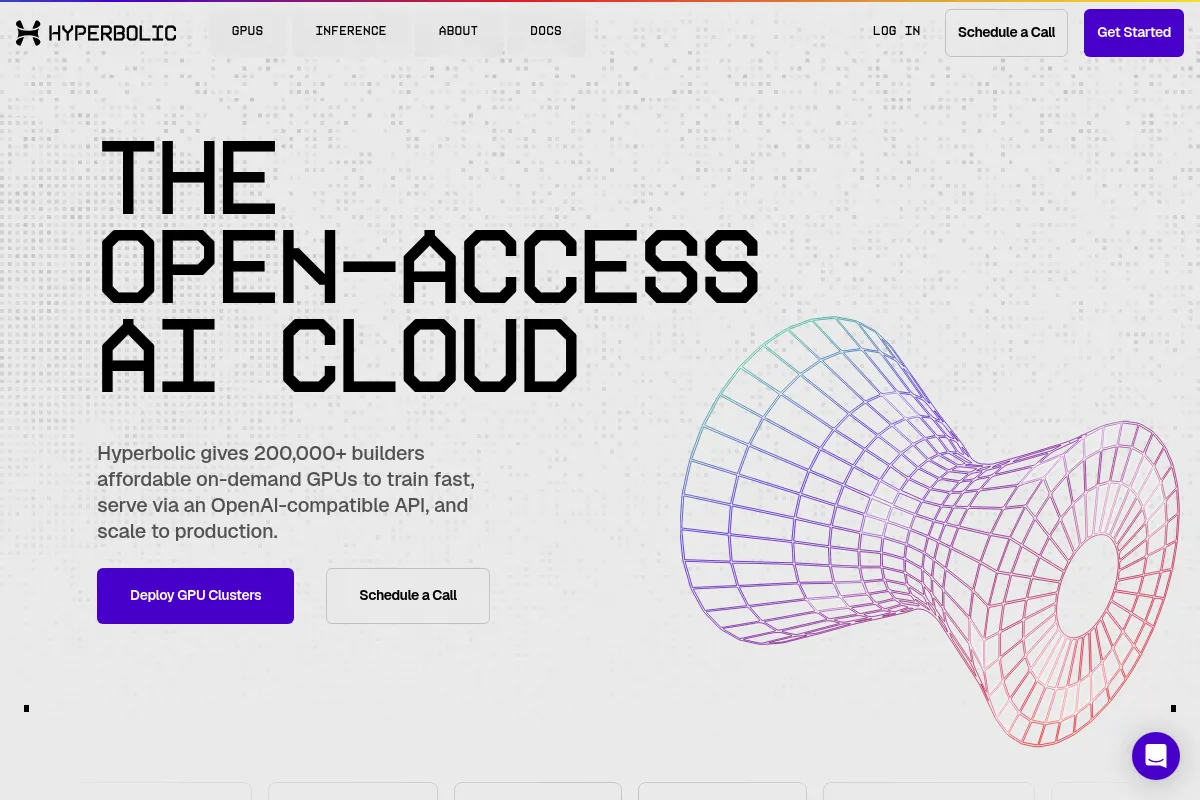
A decentralized GPU marketplace and inference provider that aggregates global compute to offer open-source LLM access at significantly lower costs than centralized cloud providers.
Excellent for developers prioritizing cost-per-token and open-source flexibility, weaker for enterprises requiring strict SOC2 compliance or guaranteed uptime SLAs.
Analysis based on product data, pricing structure, traffic signals, and public user sentiment.
Who Should Use Hyperbolic?
Typical users
AI engineers, researchers, and lean startups building on open-source models like Llama 3.1 or Mistral.
Maturity fit
scaling to advanced
Choose this if…
- Your priority is minimizing inference costs for high-volume LLM applications.
- You need immediate access to H100 or A100 GPUs without long-term contract commitments.
- You want an OpenAI-compatible API to swap providers with minimal code changes.
- You are comfortable with decentralized infrastructure in exchange for better hardware availability.
Skip this if…
- Your application requires strict data residency or HIPAA/SOC2 compliance.
- You need the proprietary capabilities of GPT-4 or Claude 3.5.
- Your workflow cannot tolerate the occasional latency jitter inherent in decentralized node routing.
About Hyperbolic
Hyperbolic is a decentralized AI infrastructure platform that pools idle GPU resources from around the world into a unified marketplace. It provides both a high-performance inference API for popular open-source models and raw compute rental for training or fine-tuning tasks.
What it actually does
The platform allows users to run large language models via a standard API or rent dedicated GPU instances (like NVIDIA H100s) on an hourly basis. It uses a verification layer to ensure that the compute provided by decentralized participants is accurate and performant.
What makes it different
Unlike centralized providers like Lambda or AWS, Hyperbolic sources its hardware from a distributed network of providers, which typically results in lower prices and higher availability for top-tier chips. It implements a 'Proof of Sampling' protocol to maintain quality control across its non-homogenous hardware pool.
Key Features
Llama 3.1 405B Inference
Provides access to the flagship open-source model at a fraction of the cost of self-hosting.
GPU Marketplace
A real-time auction-style board for renting H100, A100, and RTX 4090 instances.
Proof of Curated Layer
A technical verification system that prevents providers from returning 'hallucinated' or low-quality compute results.
One-click Deployment
Templates for quickly launching popular AI frameworks on rented hardware.
Unified Billing
Pay for both API tokens and raw hardware hours from a single balance.
Global Edge Routing
Automatically directs API requests to the geographically closest available node to minimize latency.
Developer SDKs
Native support for Python and JavaScript to integrate inference into existing apps.
Pricing
Llama 3.1 8B
- High-speed inference
- OpenAI compatible
- Global edge routing
Llama 3.1 70B
- Balanced performance/cost
- Ideal for complex reasoning
- Standard API access
Llama 3.1 405B
- State-of-the-art open source
- Massive context support
- Highest reasoning capability
GPU Rental (H100)
- Full root access
- Custom environment setup
- Market-based pricing
Pricing checked 5 months ago
Pricing guidance
- When moving from prototyping to production traffic
- When you need to fine-tune a model on your own data (requires GPU rental)
- When you hit rate limits on the public API tier
- Rate limits apply to API calls based on account tier
- GPU rental prices fluctuate based on global network demand
- Storage for custom models on rented GPUs is billed separately
Highly aggressive pricing designed to undercut centralized incumbents by utilizing a global pool of distributed hardware.
Pros & Cons
Strengths
-
Aggressive token pricing
By leveraging decentralized supply, they often undercut centralized competitors like Together AI or DeepInfra by 20-40% on popular models.
-
High-end hardware availability
Users can often find H100s available for immediate rental when they are sold out or waitlisted on major cloud platforms.
-
Zero-friction migration
The API is a drop-in replacement for OpenAI, meaning developers only need to change the base URL and API key to start saving money.
-
Support for massive models
They are among the first to offer stable, high-throughput inference for Llama 3.1 405B, which many smaller providers struggle to host.
Weaknesses
-
Reliability variability
Because nodes are decentralized, individual instances may go offline more frequently than those in a Tier-4 data center.
Affects: Production applications requiring 99.99% uptime
-
Privacy and security trade-offs
Data is processed on third-party hardware; while encrypted in transit, it lacks the 'walled garden' security of a private VPC.
Affects: Fintech, healthcare, and enterprise users with sensitive PII
-
Potential for latency spikes
Routing requests through a distributed network can occasionally lead to inconsistent Time To First Token (TTFT).
Affects: Real-time voice or chat applications
Real User Sentiment
Users are generally impressed by the price-to-performance ratio, though some remain skeptical of the decentralized backend for mission-critical tasks.
Users tend to like
- Extremely low cost for Llama 3.1 405B
- Ease of switching from OpenAI
- Availability of high-end NVIDIA chips
- Active developer community and support
Users commonly complain about
- Occasional API timeouts
- Documentation can be sparse for advanced GPU configurations
- Concerns over data privacy on decentralized nodes
Recurring tradeoffs
- You trade the rock-solid reliability of AWS for significantly lower costs and better hardware access.
Happiest users
Independent developers and AI startups who need to maximize their runway while using the most powerful open-source models.
Often frustrated
Enterprise compliance officers or developers building apps where every millisecond of latency consistency is critical.
Use Cases
Cost-effective Chatbots
Scaling customer support bots using Llama 3.1 70B without the high costs of proprietary APIs.
Model Fine-tuning
Renting an H100 for a few hours to train a LoRA adapter on a specific dataset.
Batch Processing
Running large-scale data extraction or summarization tasks where cost per token is the primary constraint.
AI Research
Accessing 405B parameter models for academic testing without investing in a $100k hardware cluster.
Image Generation Pipelines
Using the Stable Diffusion endpoints to power creative tools or marketing automation.
Frequently Asked Questions
How does Hyperbolic compare to Together AI or Anyscale?
Together AI and Anyscale are centralized providers that own or lease their own data centers, offering higher reliability and stricter compliance. Hyperbolic is decentralized, meaning it aggregates compute from many sources, which usually results in lower prices but more variability in node performance.
Is my data safe on decentralized GPUs?
Hyperbolic uses encryption in transit, but because the compute happens on third-party hardware, it does not currently offer the same level of isolation as a dedicated private cloud. It is not recommended for highly sensitive PII or regulated data at this stage.
Can I use Hyperbolic as a drop-in replacement for OpenAI?
Yes. Hyperbolic provides an OpenAI-compatible API. You simply change your base URL to Hyperbolic's endpoint and use your Hyperbolic API key in your existing OpenAI SDK setup.
What happens if a GPU node goes offline during my task?
For inference, Hyperbolic's load balancer automatically reroutes your request to another available node. For GPU rentals, if a node goes offline, your instance will stop, and you will need to restart it on a different available node.
What are the pricing tiers for Llama 3.1?
As of late 2024, Llama 3.1 8B is $0.05/1M tokens, 70B is $0.55/1M tokens, and 405B is $1.95/1M tokens. These prices are significantly lower than the equivalent performance tiers from centralized providers.
Do they offer a free tier?
Hyperbolic does not have a permanent free tier, but they typically provide new users with a small amount of free credit (usually $5-$10) to test the API and hardware performance before committing funds.
Why trust this page?
This evaluation combines product positioning, pricing analysis, traffic and market signals, and public user sentiment into a single decision-support page. Content is generated editorially — not copied from the vendor's website.
Funding & Company
Founded
2022
Stage
Series a
Total Raised
$20M
Latest Round
Series A (Dec 2024)
Notable Investors
Hyperbolic has raised a total of $20 million across three rounds, culminating in a $12 million Series A in December 2024. This funding from notable crypto and AI-focused investors like Polychain Capital and Variant provides significant capital to expand its decentralized GPU network and engineering teams.
Market Signals & Traffic
Estimated visits, global rank, geography, traffic sources, monthly visit trends, and organic search keywords (Similarweb)—on a dedicated page built for depth and search.
- Estimated visits
- 0
- Global rank
- —
- Snapshot
- May 2026
- Traffic trend
- —
Alternatives to Hyperbolic
View all alternatives
Similar Tools
Neon
Developer Tools

Serverless Postgres database with instant branching and automatic scaling.
Nebius
Developer Tools

Cloud infrastructure for training and deploying machine learning models.
Amazon CodeWhisperer
Developer Tools

AI-powered coding companion that generates code recommendations.
Modular
Developer Tools

Unified platform for high-performance AI development and deployment.
OpenRouter
Developer Tools

Unified API gateway for accessing and comparing large language models.
AskCodi
Developer Tools
AI coding assistant and unified LLM API gateway for developers.