

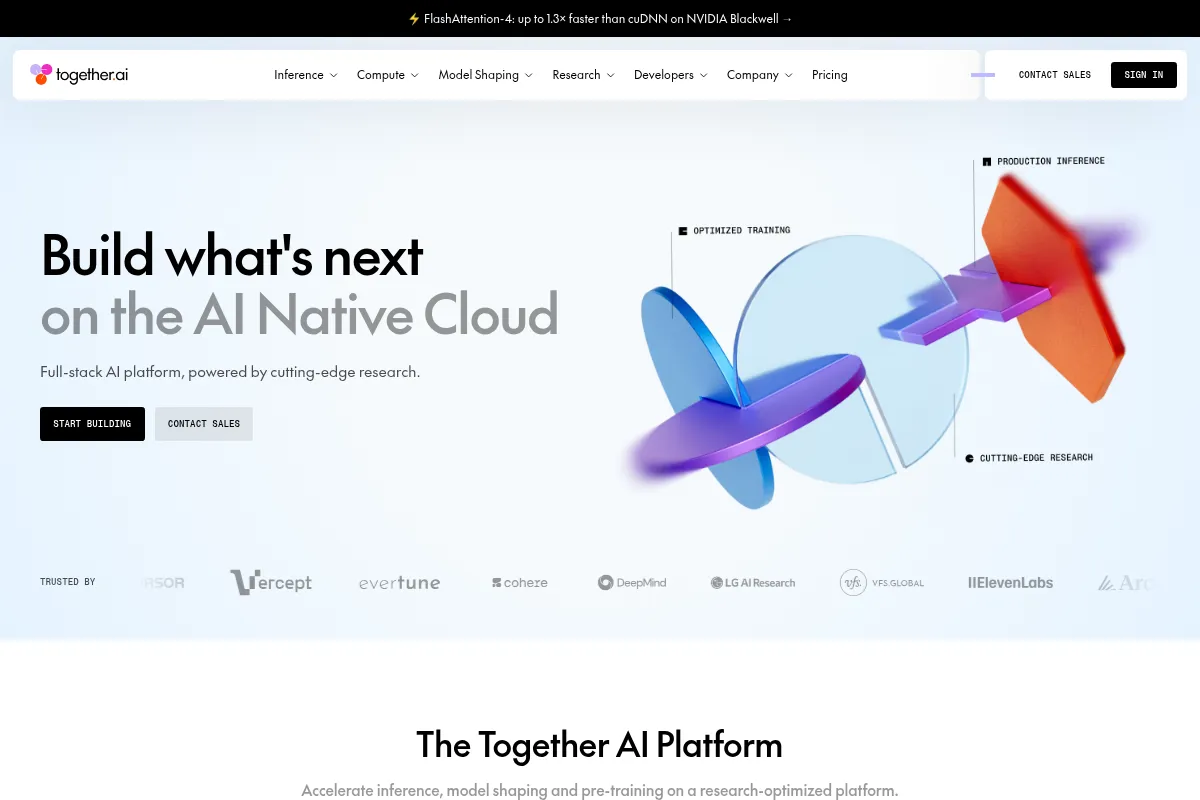
Together AI is a high-performance cloud platform for building, fine-tuning, and deploying open-source generative AI models, best suited for technically proficient teams and enterprises.
Best for developers and researchers building and deploying generative AI models, weaker for non-technical users needing ready-made solutions.
Analysis based on product data, pricing structure, traffic signals, and public user sentiment.
Who Should Use Together AI?
Typical users
Developers, AI researchers, and engineering teams within startups and enterprises who need to build, train, fine-tune, and deploy generative AI models. This includes teams with existing ML expertise and those looking to leverage open-source models at scale.
Maturity fit
scaling to advanced
Choose this if…
- You need to fine-tune open-source models with proprietary data.
- You require high-performance GPU infrastructure for AI workloads.
- You want to deploy generative AI models via APIs with OpenAI compatibility.
- Your priority is leveraging open-source AI models with control and transparency.
Skip this if…
- You are not comfortable with coding or APIs.
- You need a simple, out-of-the-box AI solution for business automation.
- Your primary focus is on visual AI (image/video generation) rather than language models.
- You require extensive, hands-on customer support for non-technical users.
About Together AI
Together AI provides an AI Acceleration Cloud, offering a full-stack platform for developing, training, fine-tuning, and deploying open-source generative AI models. It aims to make advanced AI infrastructure accessible and cost-effective for developers and enterprises, emphasizing performance, transparency, and control.
Official profiles
What it actually does
Together AI offers developers and researchers access to high-performance GPU infrastructure and a wide array of open-source generative AI models. Users can train, fine-tune, and deploy these models for various applications, with options for serverless inference, dedicated endpoints, and custom model development.
What makes it different
Together AI differentiates itself through its focus on optimizing open-source models with proprietary, high-performance kernels and infrastructure, aiming for faster inference and training times. It also emphasizes a full-stack approach, integrating compute, software, and developer tools for the entire AI lifecycle, and offers transparent, competitive pricing.
Ratings across the web

Ratings aggregated from independent review platforms.
Key Features
AI Acceleration Cloud
Provides high-performance GPU infrastructure (including GB200, B200, H100 clusters) optimized for AI workloads, reducing latency and training time.
Open-Source Model Hub
Hosts over 200 open-source models across text, code, image, and multimodal categories, including popular ones like LLaMA and Mixtral.
OpenAI-Compatible Endpoints
Simplifies migration and integration for developers by offering APIs that are drop-in replacements for OpenAI's.
Fine-Tuning Capabilities
Enables users to train and improve generative models using their own data without managing complex training infrastructure.
Serverless Inference
Offers pay-as-you-go API access to run open-source models on demand, eliminating the need for infrastructure management.
Dedicated Endpoints
Provides custom model deployment on dedicated hardware for enhanced performance, privacy, and control.
Together Kernel Collection
Proprietary software stack and optimized kernels (like FlashAttention-2) that accelerate AI performance.
Code Sandbox and Interpreter
Integrated developer tools to facilitate experimentation and development within the platform.
Pricing
Serverless Inference
- Access to 200+ open-source models
- No infrastructure management
- Pay per token processed
- Scalable on demand
Fine-Tuning
- Train models on proprietary data
- LoRA and full fine-tuning options
- No training infrastructure management
- Model ownership
GPU Clusters (AI Factory)
- Access to latest NVIDIA GPUs (GB200, B200, H100)
- Dedicated infrastructure
- High-performance compute
- Scalable resources
Pricing checked 6 months ago
Pricing guidance
- When you need dedicated, high-performance GPU resources for consistent workloads.
- When your inference or training needs exceed the limits or cost-effectiveness of serverless options.
- When you require greater control over your deployment environment and data privacy.
- When fine-tuning models on large proprietary datasets.
- While pricing is generally transparent per token or hour, actual costs can escalate quickly with high usage, requiring careful monitoring.
- Documentation can be thin in places, potentially leading to implementation challenges.
- The 'free tier' is not clearly defined for sustained use and may be limited to introductory exploration.
Tiered and usage-based pricing, with serverless inference being pay-as-you-go and GPU clusters offering custom rates, positioning it as cost-effective at scale for technical users.
Pros & Cons
Strengths
-
High Performance
Together AI leverages cutting-edge GPU infrastructure and proprietary software optimizations to deliver fast inference and training speeds, outperforming many competitors in benchmarks.
-
Extensive Open-Source Model Library
Provides access to a vast and diverse collection of over 200 open-source generative AI models, offering flexibility and choice for various applications.
-
Cost-Effective for Scale
Offers competitive pricing, particularly for large-scale deployments and inference, making it an attractive option for startups and enterprises looking to manage AI costs.
-
Developer-Centric Tools
Features like OpenAI-compatible APIs, SDKs, and integrated code sandboxes cater to developers, simplifying integration and accelerating the development workflow.
-
Transparency and Control
Emphasizes open-source models and provides users with greater control over their models and data compared to proprietary AI solutions.
Weaknesses
-
Steep Learning Curve
The platform is geared towards technically proficient users and requires a strong understanding of coding, APIs, and AI/ML concepts, making it less accessible for beginners.
Affects: Non-technical users and beginners
-
Limited Ready-to-Use Solutions
While powerful for development, it doesn't offer many out-of-the-box solutions for specific business problems like customer support automation, requiring significant custom building.
Affects: Businesses seeking immediate, off-the-shelf AI solutions
-
Potential for Cost Overruns
While competitive, the pay-as-you-go and usage-based pricing can lead to unexpected high bills if not carefully monitored and managed.
Affects: Users not closely monitoring their token usage and compute resources
-
Less Focus on Visual AI
Primarily optimized for language models, Together AI has limited capabilities in advanced visual AI tasks like video synthesis compared to specialized platforms.
Affects: Teams focused on visual AI generation and editing
Real User Sentiment
Users generally praise Together AI for its speed, performance, and extensive model library, especially for developers and researchers. However, some find it complex for non-technical users and note potential cost management challenges.
Users tend to like
- Speed and performance of inference and training.
- Vast library of open-source models.
- Cost-effectiveness for large-scale deployments.
- Developer-friendly APIs and tools.
- Control and transparency over models.
Users commonly complain about
- Not suitable for beginners or non-technical users.
- Potential for unexpected cost increases if not monitored.
- Documentation can be sparse in certain areas.
- Limited focus on visual AI compared to language models.
Recurring tradeoffs
- High performance and flexibility come at the cost of complexity.
- Cost-effectiveness at scale requires careful management.
- Open-source focus offers control but demands technical expertise.
Happiest users
Developers, AI researchers, and technical teams who need to build, fine-tune, and deploy open-source generative AI models at scale.
Often frustrated
Non-technical users or businesses looking for simple, out-of-the-box AI solutions without significant technical overhead.
Use Cases
Building custom chatbots and virtual assistants
Leveraging LLMs for conversational AI applications.
Developing AI-powered coding assistants
Fine-tuning models for code generation, completion, and debugging.
Creating content generation tools
Using generative models for text, script, or marketing copy creation.
Fine-tuning models for specific industry applications
Adapting open-source models for healthcare, finance, or legal use cases.
Running large-scale inference for production applications
Deploying models to handle high volumes of user requests.
Experimenting with frontier AI models
Accessing and testing the latest open-source research models.
Building AI-native applications with custom logic
Integrating AI capabilities into proprietary software.
Frequently Asked Questions
What is Together AI?
Together AI is an AI Acceleration Cloud platform that provides developers and researchers with high-performance GPU infrastructure and a wide selection of open-source generative AI models. It enables users to train, fine-tune, and deploy these models for various AI applications, emphasizing speed, cost-efficiency, and control.
Who is Together AI best suited for?
Together AI is best suited for technically proficient users, including developers, AI researchers, and engineering teams within startups and enterprises. It's ideal for those who need to build, customize, and deploy AI models at scale, particularly when leveraging open-source solutions and requiring significant GPU compute power.
What are the main pricing models for Together AI?
Together AI's pricing is primarily structured around three categories: Serverless Inference (pay-per-token for on-demand model usage), Fine-Tuning (cost based on tokens processed during training), and GPU Cloud (hourly or reserved rates for dedicated hardware). Specific costs vary by model and resource utilization.
How does Together AI compare to OpenAI?
Together AI focuses on open-source models, offering greater transparency, control, and often more competitive pricing for large-scale inference compared to OpenAI's proprietary models. While OpenAI provides highly capable, managed models, Together AI empowers users to fine-tune and deploy their own models on robust infrastructure, appealing to those who want to avoid vendor lock-in or require deep customization.
What are the limitations of Together AI?
Together AI's primary limitations include a steep learning curve for non-technical users, a lack of ready-to-use business solutions (requiring significant custom development), potential for cost overruns if usage isn't monitored, and a less specialized focus on visual AI compared to language models. Documentation can also be sparse in certain areas.
Does Together AI offer integrations?
Together AI provides OpenAI-compatible APIs and SDKs, which facilitate integration with existing applications and workflows. They also support integration with popular developer tools and frameworks, enabling developers to connect their applications to Together AI's infrastructure and models.
Can I use Together AI for free?
While Together AI does not explicitly advertise a broad free tier for sustained use, they may offer limited free access or introductory credits for initial exploration of certain models or services. For significant development and deployment, paid plans for serverless inference, fine-tuning, or GPU clusters are required. Pricing details are available on their website, and specific introductory offers may vary.
What kind of GPU hardware does Together AI offer?
Together AI provides access to high-performance GPU infrastructure, including clusters equipped with NVIDIA's latest GPUs such as GB200, B200, and H100. This hardware is optimized for demanding AI workloads like training and large-scale inference.
Why trust this page?
This evaluation combines product positioning, pricing analysis, traffic and market signals, and public user sentiment into a single decision-support page. Content is generated editorially — not copied from the vendor's website.
Funding & Company
Founded
2022
Stage
Late stage
Total Raised
$1.53B
Latest Round
Series C (Apr 2026)
Notable Investors
Together AI has raised over $1.5 billion, culminating in a $1 billion Series C in April 2026. This substantial backing from top-tier investors like NVIDIA, Salesforce Ventures, and General Catalyst provides a very long operational runway and signals strong market confidence in its AI infrastructure platform.
Market Signals & Traffic
Estimated visits, global rank, geography, traffic sources, monthly visit trends, and organic search keywords (Similarweb)—on a dedicated page built for depth and search.
- Estimated visits
- 792,840
- Global rank
- #59,586
- Snapshot
- Apr 2026
- Traffic trend
- Surging
Estimated monthly visits
Alternatives to Together AI
View all alternativesHugging Face
Developer Tools, Productivity

Open-source platform for machine learning models, datasets, and tools.
Replicate
Developer Tools, Content Creation, AI Assistant

Run and deploy open-source AI models via a cloud API.
OpenRouter
Developer Tools

Unified API gateway for accessing and comparing large language models.
Similar Tools
Continue
AI Assistant, Developer Tools, Productivity

Open-source coding assistant for VS Code and JetBrains IDEs
Chatbox AI
AI Assistant, Developer Tools, Productivity

Cross-platform desktop and mobile client for multiple language models
10Web
AI Assistant, Developer Tools, Productivity

AI-powered WordPress website builder, hosting, and management platform.
LobeChat
AI Assistant, Developer Tools, Productivity

Open-source chatbot framework supporting multiple large language models and plugins.
Glama
AI Assistant, Developer Tools, Productivity

Unified workspace for accessing multiple models and MCP services
DeepSeek
AI Assistant, Developer Tools, Productivity

Advanced AI models for coding, content creation, and business automation.