

Exa
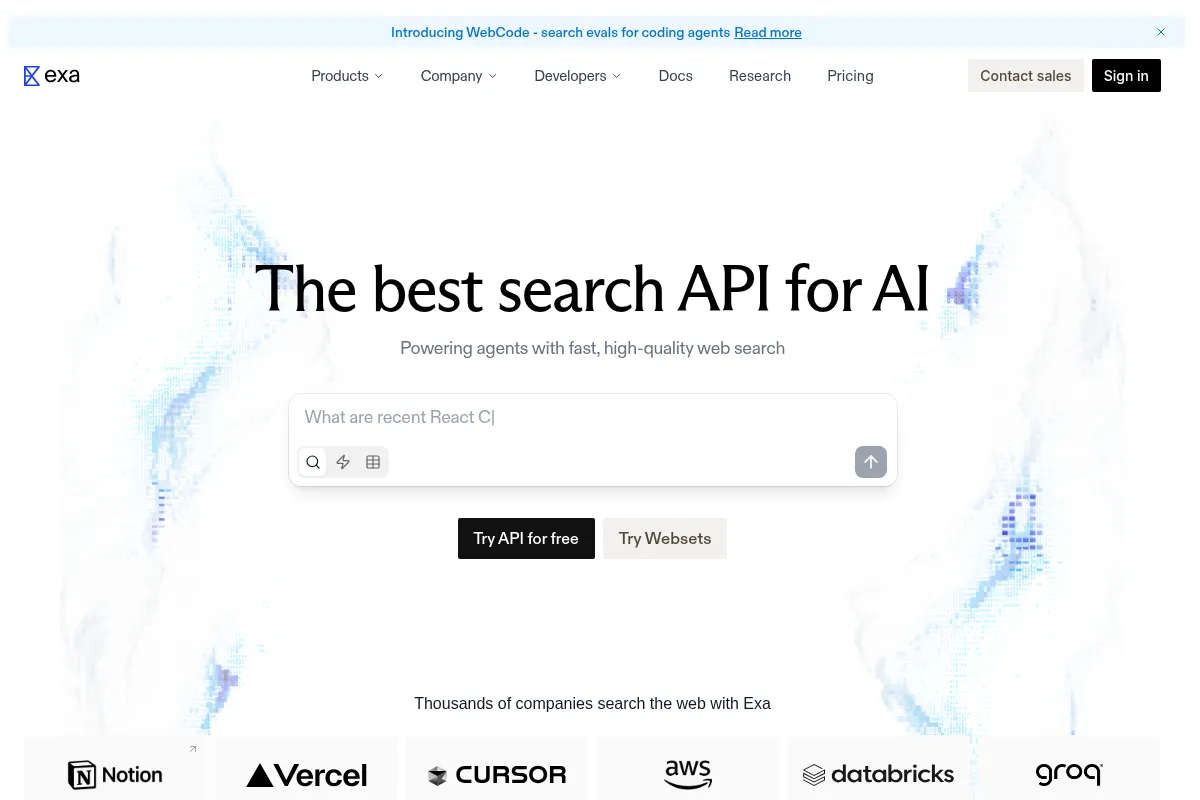
Exa is an AI-native search API for developers building applications that require high-quality, semantically relevant web data.
Best for AI developers needing precise web data for RAG and agentic workflows, weaker for general human search.
Analysis based on product data, pricing structure, traffic signals, and public user sentiment.
Who Should Use Exa?
Typical users
Developers, AI engineers, and data scientists building AI applications, RAG systems, or AI agents that require programmatic access to web data. Teams focused on AI development and integration.
Maturity fit
scaling to advanced
Choose this if…
- You need to integrate web search capabilities into an AI application or agent.
- Your priority is semantic relevance and accuracy over keyword matching.
- You require structured data outputs for LLM consumption.
- You need to minimize hallucinations in AI-generated content by grounding it in real-time web data.
Skip this if…
- You are looking for a general-purpose search engine for everyday human use.
- Your primary need is conversational AI with synthesized answers (consider Perplexity).
- You require extensive B2B contact data or go-to-market intelligence (consider Landbase).
- You need a self-hosted, highly customizable web scraping solution (consider Scrapy).
About Exa
Exa is an AI-powered search engine API designed for developers and AI applications. It focuses on providing semantically relevant web data through advanced neural search technology, aiming to enhance AI systems by offering accurate, real-time information. Its API allows AI applications to access and process web content programmatically, reducing hallucinations and improving knowledge bases.
Official profiles
What it actually does
Exa crawls and indexes the web, then uses AI models to understand the semantic meaning of queries. It provides developers with an API to access this indexed data, returning structured results, full page content, or summaries. This enables AI applications to retrieve precise, up-to-date information for tasks like RAG, AI agent reasoning, and data extraction.
What makes it different
Unlike traditional search engines optimized for human clicks and SEO, Exa is built from the ground up for AI consumption. It prioritizes semantic understanding and structured data output, offering a direct API for programmatic access. Its neural search and link prediction transformer aim to surface highly relevant content that might be missed by keyword-based searches.
Ratings across the web

Ratings aggregated from independent review platforms.
Key Features
Neural Search
Utilizes embeddings and neural networks for semantic understanding, going beyond keyword matching to grasp the meaning behind queries.
Real-time Web Crawling
Continuously updates its index by crawling new URLs every minute, ensuring AI systems access the most current information.
API Access
Provides a robust API for seamless integration, allowing AI systems to programmatically access web content.
Content Retrieval
Offers options to retrieve full page content, highlights, or custom summaries, making data ready for LLM consumption.
Structured JSON Outputs
Delivers results in a machine-readable format, optimized for integration with AI models and agents.
Similarity Search
Can find and retrieve information contextually similar to a given input, enhancing research and analysis depth.
Websets
An agentic search tool for extracting structured information from the unstructured web, useful for non-technical users for tasks like lead generation and market research.
Pricing
Free Tier
- 1,000 credits
- Limited features for Websets
Core Plan
- 8,000 credits per month
- Standard features
Pro Plan
- 100,000 credits per month
- Advanced features
Enterprise
- Volume discounts
- SLAs and MSAs
- 1:1 onboarding and support
- Zero Data Retention
- Custom rate limits
Pricing checked 6 months ago
Pricing guidance
- When you exceed 8,000 credits per month.
- When you need access to advanced features or higher rate limits.
- When you require enterprise-grade support, SLAs, or Zero Data Retention.
- Credit usage can be complex and vary significantly based on the type of search (neural, fast, deep) and whether full content or summaries are requested.
- The free tier is intended for evaluation and has limited features for Websets.
- While API limits are high (100s of QPS), specific usage might be subject to custom rate limits for enterprise clients.
Usage-based API pricing with tiered subscription plans, positioned as a premium service for AI developers and enterprises.
Pros & Cons
Strengths
-
High Semantic Relevance
Exa's neural search and embedding technology excel at understanding the meaning behind queries, providing more accurate and contextually relevant results than traditional keyword searches. This is crucial for AI applications that need precise data.
-
AI-Optimized API
Designed specifically for AI consumption, Exa offers structured outputs and programmatic access that integrate smoothly into LLM workflows, RAG systems, and AI agents. This reduces development effort for AI-native applications.
-
Real-time Data
With continuous web crawling and near real-time indexing, Exa ensures that AI applications have access to the latest information, minimizing outdated responses and improving the accuracy of AI-generated content.
-
Developer Control and Flexibility
Exa offers various search types (neural, auto, fast, deep) and extensive filtering options, giving developers fine-grained control over search quality, speed, and cost. It also provides options for full page content retrieval beyond simple snippets.
Weaknesses
-
Limited for General Human Search
Exa is optimized for programmatic access and AI consumption, not for direct human browsing. Its interface and output format are geared towards developers and AI agents, making it less intuitive for casual users.
Affects: Non-technical users and individuals seeking a direct replacement for Google Search.
-
Pricing Can Scale Quickly
While offering a free tier and pay-as-you-go options, the credit-based system can become expensive for high-volume usage, especially when requesting full page content or deep search results. Costs can add up rapidly with extensive queries.
Affects: Users with high-volume search needs or those frequently requesting full page content.
-
Less Focus on Synthesized Answers
Unlike tools like Perplexity, Exa primarily provides raw or structured data rather than synthesized, cited answers. Users may need to build additional layers to generate human-readable summaries or answers from Exa's output.
Affects: Users who need direct, synthesized answers with citations, rather than raw data for their AI to process.
Real User Sentiment
Users praise Exa's powerful semantic search capabilities, API flexibility, and speed, particularly for AI-driven applications. However, some users express concerns about pricing scalability and customer support.
Users tend to like
- Semantic search accuracy and relevance.
- Fast API response times and low latency.
- Structured data outputs for AI integration.
- Real-time web crawling and up-to-date information.
- Developer control over search parameters.
Users commonly complain about
- Pricing can become expensive for high-volume usage.
- Customer support responsiveness can be an issue for some users.
- Less intuitive for non-technical users compared to general search engines.
- Potential for unexpected credit consumption.
Recurring tradeoffs
- Precision and relevance vs. cost.
- API-first design for developers vs. ease of use for general users.
- Raw data output vs. synthesized answers.
Happiest users
Developers and AI engineers integrating Exa into RAG systems, AI agents, and custom AI applications.
Often frustrated
Non-technical users expecting a direct Google replacement or users who encounter unexpected costs due to complex credit usage.
Use Cases
Powering AI agents with real-time web data for research and decision-making.
Enhancing Retrieval-Augmented Generation (RAG) systems with semantically relevant content.
Automating data extraction and analysis from web pages for AI applications.
Developing AI-powered chatbots that require up-to-date information.
Building custom search solutions for niche verticals or internal knowledge bases.
Generating curated datasets for training and fine-tuning AI models.
Automating market research and competitive intelligence gathering.
Frequently Asked Questions
What is Exa and how does it differ from traditional search engines like Google?
Exa is an AI-powered search engine built specifically for AI applications and developers. Unlike traditional search engines optimized for human clicks and SEO, Exa prioritizes semantic understanding and structured data output. It uses advanced neural search technology and embeddings to find highly relevant information, providing an API for programmatic access. Exa aims to supply AI applications with high-quality, real-time web content to minimize hallucinations and enhance their knowledge base, rather than simply returning a list of links for human browsing.
How does Exa's pricing work?
Exa operates on a credit-based, pay-as-you-go model, with tiered subscription plans. Users receive free credits upon signup for evaluation. Pricing varies based on the type of search (e.g., neural search, fast search, deep search), the amount of content retrieved (full page, highlights, summaries), and the number of results. Subscription plans like the Core ($49/month) and Pro ($449/month) offer monthly credit allowances, with custom enterprise plans available for high-volume needs. It's important to monitor credit usage as costs can scale quickly with extensive queries or full-page content retrieval.
Can Exa be used as a direct replacement for Google Search for everyday users?
No, Exa is not designed as a direct replacement for general human web search. Its primary focus is on providing an API for developers and AI applications to access web data programmatically. While it offers advanced semantic search capabilities, its interface and output are optimized for machine consumption and integration into AI workflows, not for casual human browsing. For everyday search needs, traditional engines like Google or conversational AI search tools like Perplexity might be more suitable.
What are Exa's main competitors, and how does it compare?
Exa's main competitors in the AI-powered search and data extraction space include Perplexity AI (for conversational search and synthesized answers), Tavily (for RAG applications and anti-detection), Bright Data (for large-scale data enrichment and crawling), and Google's Vertex AI Search (for enterprise ML integrations). Exa differentiates itself through its deep semantic search capabilities, high API control, real-time crawling, and structured outputs optimized for AI. While Perplexity excels at providing direct, cited answers, Exa focuses on delivering the raw, relevant data for AI to process. Competitors like Bright Data offer broader web scraping capabilities, while Vertex AI is more of an enterprise ML platform.
What are the limitations of Exa?
Exa's limitations include its primary focus on API access for developers, making it less user-friendly for non-technical individuals. The credit-based pricing model can become expensive for high-volume usage, and users need to carefully manage their credit consumption. While it provides raw data, it doesn't typically synthesize answers with citations like some conversational AI search tools, requiring additional development effort for such features. Some users have also reported issues with customer support responsiveness.
Does Exa offer a free trial or a free tier?
Yes, Exa offers free credits upon signup, typically $10 worth, to allow new users to test its API capabilities. It also has a free tier that provides 1,000 credits, which is suitable for evaluation and small-scale testing. However, this free tier is intended for trial purposes and does not offer a fixed monthly allowance for ongoing use. For continuous or production-level usage, paid plans are necessary.
What kind of data can be extracted using Exa?
Exa can extract a wide range of web data, including full page content, text highlights, summaries, and structured JSON outputs. It can retrieve information from specific URLs, find similar content to a given link, and perform deep research tasks to gather and synthesize information. The data is optimized for AI consumption, meaning it's clean, parsed, and ready to be integrated into LLM workflows, RAG systems, or AI agents. Exa also offers specialized search categories like 'people' and 'company' for more targeted data retrieval.
Why trust this page?
This evaluation combines product positioning, pricing analysis, traffic and market signals, and public user sentiment into a single decision-support page. Content is generated editorially — not copied from the vendor's website.
Funding & Company
Founded
2021
Stage
Series c
Total Raised
$357M
Latest Round
Series C (May 2026)
Notable Investors
Exa has raised a total of $357 million across four rounds, culminating in a $250 million Series C in May 2026. This significant and rapid fundraising from top-tier investors like Andreessen Horowitz and Benchmark indicates strong market confidence and provides substantial capital for scaling its AI-native search infrastructure.
Market Signals & Traffic
Estimated visits, global rank, geography, traffic sources, monthly visit trends, and organic search keywords (Similarweb)—on a dedicated page built for depth and search.
- Estimated visits
- 832,753
- Global rank
- #51,818
- Snapshot
- Apr 2026
- Traffic trend
- Rising
Estimated monthly visits
Alternatives to Exa
View all alternativesPhind
AI Assistant, Developer Tools

AI-powered search engine for developers, providing instant answers and code snippets.
Perplexity
AI Assistant, Content Creation

AI-powered conversational search engine providing cited, comprehensive answers.
Tavily
Developer Tools, Data Extraction, Automation & Agents

Search engine for AI agents and RAG workflows
Similar Tools
DeepSeek
AI Assistant, Developer Tools, Productivity

Advanced AI models for coding, content creation, and business automation.
Continue
AI Assistant, Developer Tools, Productivity

Open-source coding assistant for VS Code and JetBrains IDEs
LobeChat
AI Assistant, Developer Tools, Productivity

Open-source chatbot framework supporting multiple large language models and plugins.
Together AI
AI Assistant, Developer Tools, Productivity

AI Acceleration Cloud for building and deploying generative AI models.
Chatbox AI
AI Assistant, Developer Tools, Productivity

Cross-platform desktop and mobile client for multiple language models
Glama
AI Assistant, Developer Tools, Productivity

Unified workspace for accessing multiple models and MCP services