

Tavily
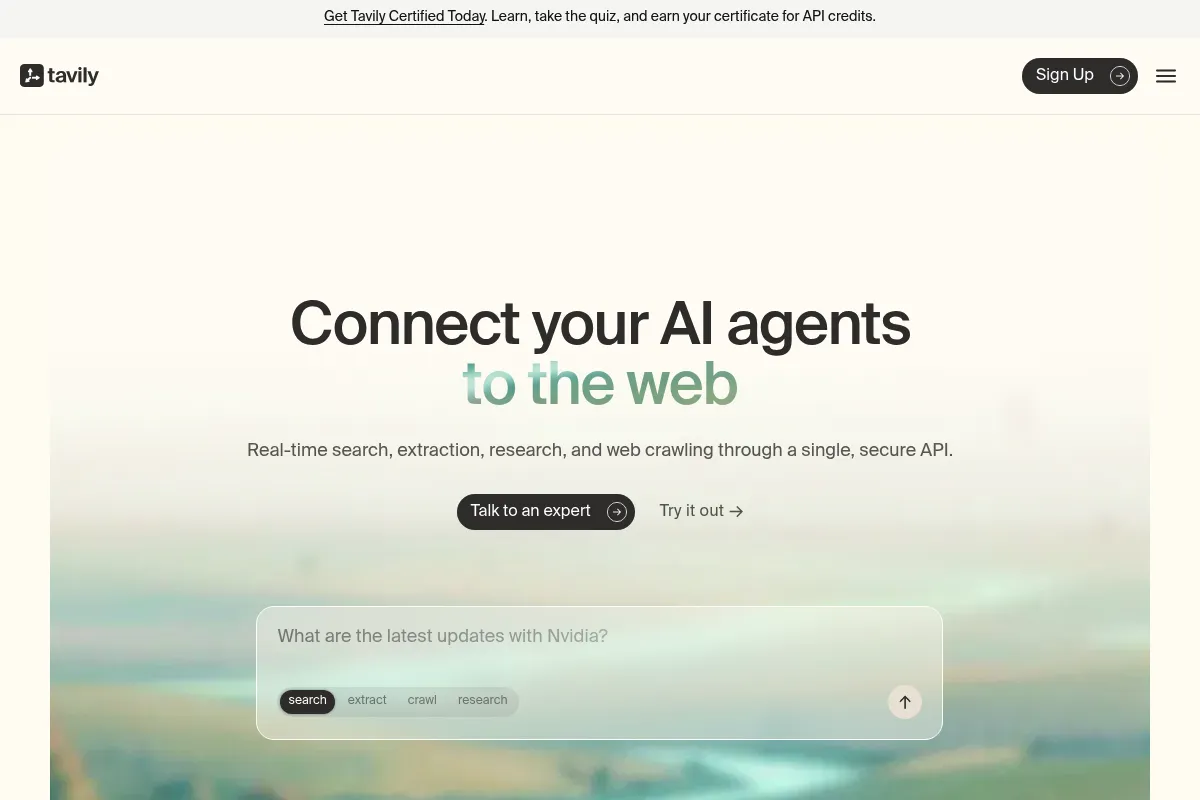
A specialized search engine that replaces the traditional search-scrape-clean pipeline with a single API call delivering LLM-ready markdown context.
Excellent for developers building RAG-based AI agents, weaker for high-volume applications where raw search costs must be minimized.
Analysis based on product data, pricing structure, traffic signals, and public user sentiment.
Who Should Use Tavily?
Typical users
AI engineers and software developers building autonomous agents, research tools, or RAG pipelines that require real-time web data.
Maturity fit
beginner to scaling
Choose this if…
- You want clean markdown content without managing your own scraping and proxy infrastructure
- Your priority is factual accuracy and relevance for LLM context windows over raw search volume
- You need to integrate web search into LangChain or LlamaIndex workflows with minimal boilerplate
Skip this if…
- You need a general-purpose search API for SEO or SERP tracking (use SerpApi or Serper instead)
- Your application requires massive search volume where the per-request cost of Tavily becomes prohibitive
- You only need to search a specific, static set of documents rather than the open web
About Tavily
Tavily is a search engine built specifically for AI agents and Retrieval-Augmented Generation (RAG). It optimizes the search process by filtering, sorting, and extracting the most relevant information from the web into a format that fits directly into an LLM's context window.
Official profiles
What it actually does
It executes web searches, scrapes the resulting pages, and returns structured data or cleaned markdown text. Instead of a list of URLs, it provides the actual content needed for an AI to answer a query or perform a task.
What makes it different
Unlike traditional search APIs that return metadata and links, Tavily performs the heavy lifting of content extraction and noise removal. It is architected to prioritize 'answer-ready' data, reducing the token overhead and latency associated with manual scraping and cleaning.
Key Features
Search Context
Returns a concatenated string of relevant snippets specifically formatted for RAG prompts.
Advanced Search Depth
Conducts a more thorough crawl for complex queries that require high factual density.
Clean Content Extraction
Strips ads, navigation bars, and scripts to return only the core text of a webpage.
Include/Exclude Domains
Restricts searches to trusted sources or blocks low-quality sites to improve output reliability.
LangChain/LlamaIndex Tools
Pre-built components that allow agents to use Tavily as a tool out of the box.
Image Search
Retrieves relevant images alongside text data for multi-modal agent capabilities.
Source Tracking
Provides citations and URLs for every piece of information retrieved to prevent hallucinations.
Pricing
Free
- 1,000 search credits
- API access
- Basic search depth
- Community support
Starter
- 5,000 search credits
- All Free features
- Advanced search depth
- Standard support
Basic
- 10,000 search credits
- All Starter features
- Higher rate limits
- Priority support
Pro
- 100,000 search credits
- All Basic features
- Highest rate limits
- Dedicated support
Pricing checked 6 months ago
Pricing guidance
- When you move from local testing to a live production environment
- When you need 'Advanced' search depth for more complex research tasks
- When you hit the 1,000-search monthly limit
- Credits do not roll over month-to-month
- Advanced search depth consumes more credits per request than basic search
- Rate limits are strictly enforced on lower tiers
Competitive for the value-add of scraping, but expensive if viewed strictly as a search API.
Pros & Cons
Strengths
-
Eliminates scraping infrastructure
Developers don't need to manage headless browsers, proxy rotation, or HTML parsing logic, which significantly reduces development time.
-
Optimized for token efficiency
By returning cleaned markdown instead of raw HTML, it minimizes the number of tokens sent to the LLM, lowering inference costs.
-
High relevance for RAG
The search algorithm is tuned to find factual information rather than SEO-optimized landing pages, leading to better agent performance.
Weaknesses
-
Higher cost per search than raw APIs
Compared to basic Google Search APIs, Tavily charges a premium for the integrated scraping and cleaning features.
Affects: High-volume consumer applications
-
Limited historical data
The tool is focused on real-time web data; it is not a replacement for deep historical archives or specialized academic databases.
Affects: Researchers needing archival data
-
Black-box ranking
Users have limited control over the underlying search algorithm compared to building a custom pipeline on top of raw search results.
Affects: Teams with highly specific information retrieval requirements
Real User Sentiment
Generally positive, with users praising the ease of setup and the quality of the markdown output.
Users tend to like
- The 'context' response format
- Ease of integration with LangChain
- Reliable scraping of modern JavaScript-heavy sites
- Speed of retrieval
Users commonly complain about
- Pricing jumps between tiers can be steep
- Occasional irrelevant results for very niche queries
- Lack of granular control over the scraping process
Recurring tradeoffs
- Users trade cost and control for speed and simplicity in the development process.
Happiest users
Developers building autonomous research agents who want to avoid the headache of managing a data extraction stack.
Often frustrated
Teams trying to build high-volume, low-margin search tools where the $0.0015+ per search cost eats their profit.
Use Cases
Autonomous Research
An agent that gathers facts from multiple sources to write a comprehensive report.
Real-time Customer Support
Grounding a chatbot in the latest product documentation or news.
Market Intelligence
Automatically tracking competitor mentions or industry trends across the web.
Fact-Checking
Verifying claims made by an LLM against live web data to reduce hallucinations.
Content Creation
Assisting writers by pulling relevant statistics and quotes from current articles.
Frequently Asked Questions
How does Tavily compare to Exa (formerly Metaphor)?
Exa uses a neural search approach (embeddings) to find links based on meaning, whereas Tavily is more focused on traditional keyword-based search optimized for factual retrieval and content extraction. Tavily is often preferred for direct RAG grounding, while Exa is strong for finding 'similar' high-quality resources.
Is there a free plan available?
Yes, Tavily offers a free tier that includes 1,000 search credits per month, which is ample for developers to prototype and test their AI applications without an upfront cost.
Can I use Tavily with LangChain?
Yes, Tavily is a first-class citizen in the LangChain ecosystem. There is a dedicated 'TavilySearchResults' tool that can be added to any LangChain agent with just a few lines of code.
What is the difference between 'basic' and 'advanced' search depth?
Basic search is faster and cheaper, suitable for simple queries. Advanced search performs a more comprehensive crawl and analysis of multiple pages to find deeper information, but it consumes more credits and takes slightly longer.
Does Tavily handle website proxies and CAPTCHAs?
Yes, Tavily manages all the underlying infrastructure, including proxy rotation and CAPTCHA solving, so you receive the cleaned content without having to handle the technical challenges of web scraping.
Can I limit searches to specific websites?
Yes, the API allows you to include or exclude specific domains, which is useful for ensuring your AI agent only retrieves information from trusted or relevant sources.
Why trust this page?
This evaluation combines product positioning, pricing analysis, traffic and market signals, and public user sentiment into a single decision-support page. Content is generated editorially — not copied from the vendor's website.
Funding & Company
Founded
2023
Stage
Acquired
Total Raised
$25M
Latest Round
Series A (Aug 2025)
Notable Investors
Tavily raised a total of $25 million across two rounds, including a $20 million Series A in August 2025 led by Insight Partners and Alpha Wave Global. This funding positioned the company for significant growth before its acquisition by Nebius Group in February 2026 for a reported $275 million.
Market Signals & Traffic
Estimated visits, global rank, geography, traffic sources, monthly visit trends, and organic search keywords (Similarweb)—on a dedicated page built for depth and search.
- Estimated visits
- 0
- Global rank
- —
- Snapshot
- May 2026
- Traffic trend
- Surging
Estimated monthly visits
Alternatives to Tavily
View all alternativesExa
AI Assistant, Developer Tools, Productivity

AI-powered search engine for developers and AI applications.
Firecrawl
Data Extraction, Developer Tools

An API to crawl and scrape any website, turning web data into a structured, LLM-ready format.
You.com
AI Assistant, Content Creation

AI-powered search engine and productivity platform for research and creation.
Similar Tools
Panopto
Education, Training & Onboarding, Communication

Video management platform for education and enterprise training.
Milvus
Developer Tools, Search

Open-source vector database for high-performance similarity search and RAG.
Turso
Developer Tools

Distributed database platform based on libSQL for edge computing.
Dust
AI Assistant, Automation & Agents, Productivity

Custom assistants that connect internal company data to language models.
Codegen
Developer Tools, Automation & Agents

Autonomous software engineering agent for automating complex coding tasks.
Ollama
Developer Tools, Privacy & Compliance

Run large language models locally on your machine.