
LiveX AI
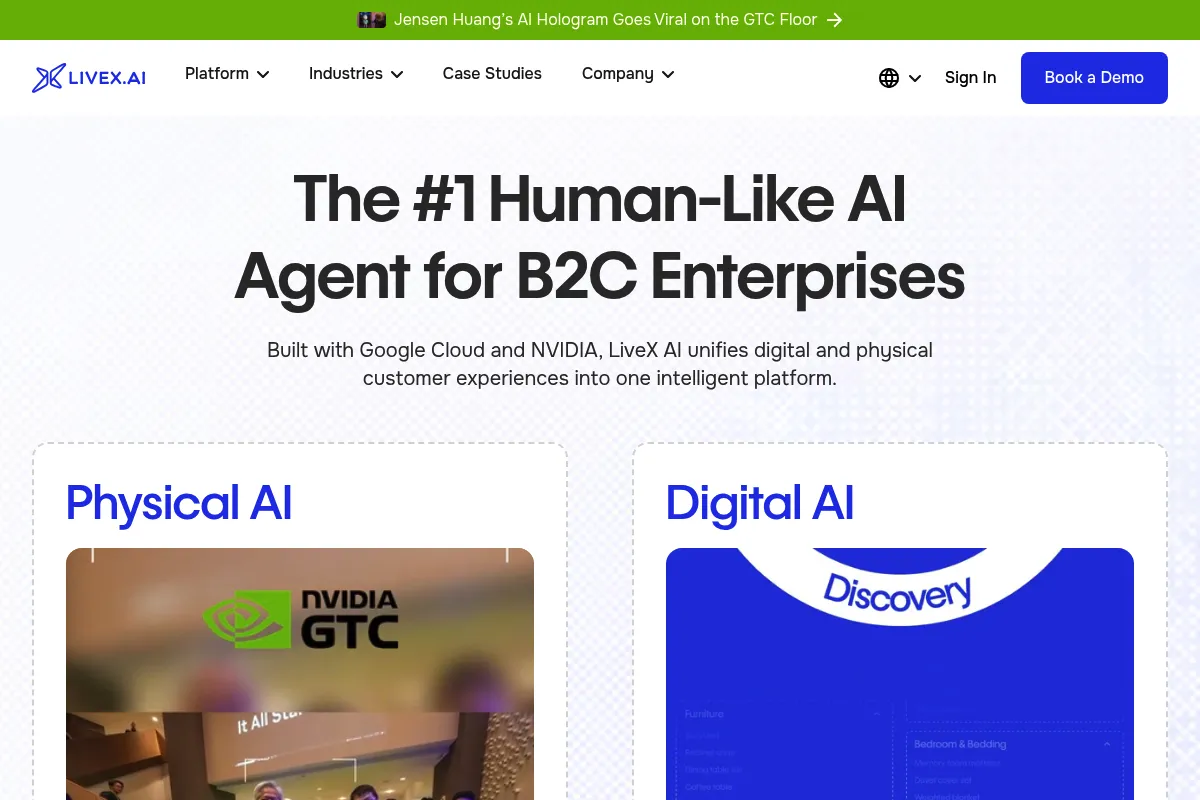
An omnichannel AI agent platform for B2C brands that prioritizes task execution—like processing returns and preventing churn—over simple chat responses.
Best for high-volume e-commerce brands needing to automate transactions across voice and chat, weaker for small teams looking for a low-cost, plug-and-play chatbot.
Analysis based on product data, pricing structure, traffic signals, and public user sentiment.
Who Should Use LiveX AI?
Typical users
Customer experience leaders and operations managers at mid-to-large B2C e-commerce or subscription-based companies.
Maturity fit
scaling to advanced
Choose this if…
- Your support volume requires agents to perform actions in Shopify or Stripe, not just answer FAQs.
- You want a single platform to handle both phone-based voice AI and text-based chat.
- Your priority is reducing churn through proactive outreach rather than just reactive support.
Skip this if…
- You are a small business with low ticket volume where a basic $20/month chatbot is sufficient.
- Your technical support requires deep, multi-step troubleshooting of complex software bugs.
- You require a self-serve setup with transparent, public per-seat pricing.
About LiveX AI
LiveX AI provides autonomous agents designed for B2C customer engagement across chat, voice, email, and SMS. It targets the gap between basic chatbots and human agents by integrating directly with commerce stacks to resolve issues independently. The platform focuses on high-stakes retail interactions like order modifications and proactive retention.
Official profiles
What it actually does
The platform deploys AI agents that ingest company documentation and connect to backend systems to handle customer queries. It processes transactions like refunds and exchanges, manages subscriptions, and can initiate outbound contact to recover abandoned carts or failed payments.
What makes it different
Unlike many competitors that focus solely on text, LiveX treats voice as a first-class citizen with low-latency agents. Its 'proactive' architecture is built to intervene in the customer journey based on behavioral triggers, moving the tool from a cost-center (support) to a revenue-generator (retention).
Key Features
Transaction Processing
Enables agents to edit orders, process refunds, and manage exchanges within the chat or voice interface.
Proactive Retention
Triggers automated outreach when the system detects signs of churn, such as failed payments or subscription cancellations.
Omnichannel Sync
Ensures that if a customer moves from an email thread to a phone call, the agent retains the full history of the interaction.
Voice AI
Low-latency, natural-sounding voice agents capable of handling complex inbound and outbound phone calls.
Knowledge Scraper
Automatically builds a response library by crawling existing help centers, PDFs, and website content.
Custom Integrations
Connects to Zendesk, Gorgias, Salesforce, and Kustomer to keep existing CRM data updated.
Sentiment Routing
Detects frustrated customers and automatically escalates them to a human supervisor with a full summary.
Pricing
Enterprise
- Full omnichannel deployment (Voice, Chat, Email)
- Custom integrations with Shopify/Stripe/CRMs
- Proactive retention workflows
- Dedicated account management
- Unlimited knowledge ingestion
Pricing checked 5 months ago
Pricing guidance
- When ticket volume exceeds human capacity
- When you need to automate phone support
- When manual churn management becomes inefficient
- Usage-based fees likely apply to voice minutes
- Integration depth may vary depending on your specific CRM setup
- Custom workflow development may involve professional services fees
Premium enterprise positioning with a focus on high-volume ROI.
Pros & Cons
Strengths
-
Action-oriented automation
It doesn't just point users to a help article; it can actually update a shipping address or process a return in Shopify, which significantly reduces ticket deflection rates.
-
Unified voice and text
Managing voice and chat through one provider reduces technical debt and ensures a consistent brand voice across all customer touchpoints.
-
Revenue-focused features
The focus on proactive retention and sales recovery means the tool can be measured by ROI and saved revenue, not just cost savings from reduced headcount.
Weaknesses
-
High barrier to entry
The lack of transparent pricing and the need for a sales demo suggests a higher price point that may be out of reach for early-stage startups.
Affects: Small businesses and solo founders
-
Implementation complexity
Setting up agents to safely execute transactions in your backend requires more rigorous testing and mapping than a standard Q&A bot.
Affects: Operations teams with limited technical bandwidth
-
B2C-specific design
The platform is heavily optimized for retail and e-commerce; companies in niche B2B sectors may find the pre-built workflows less relevant.
Affects: B2B SaaS and technical service providers
Real User Sentiment
Users generally view LiveX as a sophisticated alternative to basic chatbots, specifically praising its ability to handle actual tasks rather than just providing links.
Users tend to like
- The natural sounding voice AI
- Ability to handle complex returns without human intervention
- Reduction in support ticket backlog
- Proactive outreach capabilities
Users commonly complain about
- Lack of self-serve onboarding
- Opaque pricing structure
- Initial setup time for complex workflows
Recurring tradeoffs
- You trade a quick setup for a much deeper, more capable automation that requires more initial data mapping.
Happiest users
E-commerce brands with 50,000+ monthly visitors who are overwhelmed by repetitive support tasks.
Often frustrated
Small shop owners looking for a quick, cheap 'set it and forget it' chatbot.
Use Cases
E-commerce Support
Automating the entire 'Where is my order?' and return process without human agents.
Subscription Management
Handling cancellations and offering discounts or pauses to prevent churn proactively.
Voice Sales
Using AI agents to handle inbound sales inquiries and qualify leads over the phone.
Abandoned Cart Recovery
Initiating SMS or email follow-ups to customers who left items in their cart.
Multi-lingual Expansion
Deploying support in multiple languages without hiring native-speaking agents for every region.
Frequently Asked Questions
How much does LiveX AI cost?
LiveX AI does not publish pricing. It typically uses a custom enterprise model based on ticket volume, voice minutes, and the complexity of integrations. You must book a demo to get a quote.
Does it integrate with Shopify?
Yes, Shopify is a core integration. LiveX agents can look up order status, process refunds, and initiate exchanges directly within the Shopify ecosystem.
How does it compare to Gorgias or Zendesk?
Gorgias and Zendesk are primarily help desks for humans. While they have AI features, LiveX is an 'agent-first' platform designed to resolve tickets autonomously before they ever reach your help desk.
Can it handle phone calls?
Yes, LiveX includes native voice AI. It can answer inbound support calls and make outbound calls for retention or sales, using natural-sounding voices with low latency.
Is there a free trial?
There is no public self-serve free trial. Access is typically granted after a discovery call and a tailored demo of the platform's capabilities.
What languages does it support?
LiveX supports dozens of languages across both text and voice, allowing brands to provide 24/7 global support without a localized human team.
Why trust this page?
This evaluation combines product positioning, pricing analysis, traffic and market signals, and public user sentiment into a single decision-support page. Content is generated editorially — not copied from the vendor's website.
Funding & Company
Founded
2023
Stage
Seed
Total Raised
—
Latest Round
Undisclosed (Aug 2025)
Notable Investors
LiveX AI is a venture-backed company founded in 2023. While PitchBook data indicates it has completed two early-stage funding rounds and is backed by investors like S32 and Fellows Fund, the specific amounts raised have not been publicly disclosed, creating uncertainty about its total capitalization.
Market Signals & Traffic
Estimated visits, global rank, geography, traffic sources, monthly visit trends, and organic search keywords (Similarweb)—on a dedicated page built for depth and search.
- Estimated visits
- 0
- Global rank
- —
- Snapshot
- May 2026
- Traffic trend
- Falling
Estimated monthly visits
Similar Tools
Aisera
AI Assistant, Automation & Agents, Communication

Enterprise platform for automating IT, HR, and customer service workflows.
Amelia Platform
AI Assistant, Automation & Agents, Communication

Conversational digital employee for enterprise customer service and IT support.
Operator
AI Assistant, Automation & Agents, Communication

Autonomous agents for customer service and support workflows.
Bolna
AI Assistant, Automation & Agents, Communication

Conversational voice agents for automated phone support and sales calls.
Joyfun AI
Gaming, Communication

Immersive roleplay platform for chatting with customizable virtual characters.
You.ai
Automation & Agents, Developer Tools, Workflow

No-code platform for building and deploying custom AI agents.