
An orchestration layer for voice AI that provides granular control over the speech-to-text, LLM, and text-to-speech stack, making it a high-utility tool for developers building custom telephony workflows.
Excellent for developers who need to swap providers and manage complex call logic, weaker for non-technical teams seeking a turnkey, no-code call center.
Analysis based on product data, pricing structure, traffic signals, and public user sentiment.
Who Should Use Bolna?
Typical users
Product engineers, technical founders, and automation specialists at mid-sized companies or startups building custom voice interfaces.
Maturity fit
scaling
Choose this if…
- You need to mix and match different STT, LLM, and TTS providers for cost or quality optimization.
- Your workflow requires deep integration with CRMs like HubSpot or Salesforce via webhooks.
- Low latency is your primary technical requirement for voice interactions.
Skip this if…
- You are a non-technical business owner looking for a 'set it and forget it' outbound sales tool.
- You require a visual, drag-and-drop conversation designer without writing any code.
- Your use case is simple enough that a basic LLM with built-in voice (like OpenAI's Realtime API) suffices without an orchestration layer.
About Bolna
Bolna is a voice orchestration platform designed to simplify the deployment of conversational AI agents over phone lines. It acts as the 'glue' between various AI models and telephony providers, allowing developers to build agents that can handle inbound support or outbound lead qualification. The platform focuses on reducing the engineering overhead required to manage real-time audio streams and state management.
Official profiles
What it actually does
Bolna manages the full lifecycle of a voice call by coordinating speech-to-text (STT) transcription, processing the text through a Large Language Model (LLM), and converting the response back to audio via text-to-speech (TTS). It handles the complexities of interruptions, turn-taking, and latency optimization while providing a dashboard for monitoring and call logging.
What makes it different
Unlike 'black box' voice AI tools, Bolna is built on an open-source framework that emphasizes provider flexibility. It allows users to 'Bring Your Own Keys' (BYOK) for providers like Deepgram, OpenAI, and ElevenLabs, ensuring that businesses aren't locked into a single vendor's pricing or performance limitations. This architectural choice prioritizes transparency and developer control over proprietary simplicity.
Ratings across the web

Ratings aggregated from independent review platforms.
Key Features
Provider Agnostic Stack
Switch between Deepgram, Play.ht, ElevenLabs, or OpenAI to optimize for cost or voice quality.
Function Calling
Enables agents to perform real-world actions like booking appointments or checking order status during a live call.
Low Latency Architecture
Optimized processing pipelines designed to keep response times under 800ms for natural conversation flow.
Knowledge Base Upload
Allows agents to reference specific company documents or FAQs to ensure factual accuracy.
Batch Outbound Calling
Automates large-scale outreach campaigns for lead qualification or reminders.
Customizable Voice Personas
Fine-tune the tone, speed, and personality of the agent to match brand identity.
CRM Sync
Automatically pushes call summaries and data points to HubSpot, Salesforce, or custom endpoints.
Pricing
Free
- 10 minutes of free orchestration
- Access to all providers
- Standard support
- Basic API access
Pay as you go
- $0.15/minute orchestration fee
- Provider costs billed separately (BYOK)
- Unlimited agents
- Full API access
Pro
- $0.10/minute orchestration fee
- Priority support
- Advanced analytics
- Custom integration assistance
Enterprise
- Volume discounts
- SLA guarantees
- Dedicated account manager
- On-premise deployment options
Pricing checked 5 months ago
Pricing guidance
- When call volume exceeds 2,000 minutes per month (where the $0.05/min discount on Pro covers the $99 fee)
- When you need priority support for production-critical agents
- When you require custom security or compliance features
- Orchestration fees do not include telephony costs (e.g., Twilio or Vonage)
- Provider costs for LLMs and TTS can vary wildly and are billed separately
- Rate limits apply on the Free and Pay-as-you-go tiers
Competitive developer-centric pricing that rewards high-volume users through lower per-minute orchestration fees.
Pros & Cons
Strengths
-
High architectural flexibility
The ability to choose specific models for each part of the stack allows teams to optimize for specific regional accents or budget constraints.
-
Developer-first documentation
The API and open-source components make it easier for engineering teams to build custom logic compared to rigid SaaS competitors.
-
Transparent cost structure
By allowing BYOK, users pay the raw cost of providers plus a flat orchestration fee, which is often cheaper at scale than bundled pricing.
-
Strong interruption management
The platform handles users speaking over the AI effectively, a common failure point in simpler voice implementations.
Weaknesses
-
Technical barrier to entry
Setting up complex agents requires an understanding of APIs, webhooks, and prompt engineering, which may alienate non-technical users.
Affects: Small business owners and non-technical marketers
-
Fragmented billing
Using the BYOK model means managing multiple invoices from different providers (e.g., OpenAI, Deepgram, and Bolna) simultaneously.
Affects: Finance teams and solo operators
-
UI/UX is functional, not polished
The dashboard focuses on utility and logs rather than providing a high-end visual experience for managing large agent fleets.
Affects: Operations managers who prefer visual reporting
Real User Sentiment
Users generally appreciate Bolna for its flexibility and the 'open' nature of its framework, though some note it requires more setup time than turnkey competitors.
Users tend to like
- The ability to use any LLM or TTS provider
- Low latency performance
- Responsive developer support
- Open-source core components
Users commonly complain about
- Initial configuration can be complex
- Documentation could be more comprehensive for edge cases
- Dashboard UI feels a bit basic compared to competitors
Recurring tradeoffs
- You trade ease of setup for long-term flexibility and potentially lower costs.
Happiest users
Engineers building custom SaaS products that include a voice component.
Often frustrated
Non-technical users trying to set up a simple automated phone line without coding knowledge.
Use Cases
Customer Support
Automating the first line of inbound calls to resolve common FAQs using a knowledge base.
Lead Qualification
Outbound agents calling web leads instantly to qualify them before handing off to a human.
Appointment Scheduling
Integrating with calendars to book or reschedule appointments via voice.
Recruitment Screening
Conducting initial high-volume phone screens for hourly roles.
Debt Collection Reminders
Automated, polite outbound calls to remind customers of upcoming or past-due payments.
Frequently Asked Questions
How much does Bolna actually cost per minute?
The total cost is the sum of Bolna's orchestration fee ($0.10 - $0.15/min) plus the costs of your chosen providers (e.g., Deepgram for STT, OpenAI for LLM, ElevenLabs for TTS) and your telephony provider (e.g., Twilio). A typical high-quality call usually ends up costing between $0.25 and $0.50 per minute total.
How does Bolna compare to Vapi?
Bolna and Vapi are direct competitors. Bolna is often preferred by developers who want an open-source framework and more granular control over provider selection, while Vapi is often cited for having a slightly more polished dashboard and easier initial setup for beginners.
Can I use my own LLM with Bolna?
Yes, Bolna supports a 'Bring Your Own Key' (BYOK) model, allowing you to connect your own accounts for OpenAI, Anthropic, or other LLM providers, as well as custom endpoints.
Does Bolna support languages other than English?
Yes, Bolna supports over 50 languages. The quality of the interaction will depend on the specific STT and TTS providers you choose for that language (e.g., using Deepgram for transcription and ElevenLabs for localized voices).
What are the limitations of the free plan?
The free plan is limited to 10 minutes of total orchestration. It is intended solely for testing the API and ensuring your provider keys are connected correctly before moving to a paid usage model.
Do I need a Twilio account to use Bolna?
Yes, for telephony features, you typically need to connect a provider like Twilio, Vonage, or SignalWire to handle the actual phone numbers and carrier routing.
Why trust this page?
This evaluation combines product positioning, pricing analysis, traffic and market signals, and public user sentiment into a single decision-support page. Content is generated editorially — not copied from the vendor's website.
Funding & Company
Founded
2024
Stage
Seed
Total Raised
$6.43M
Latest Round
Seed (Jan 2026)
Notable Investors
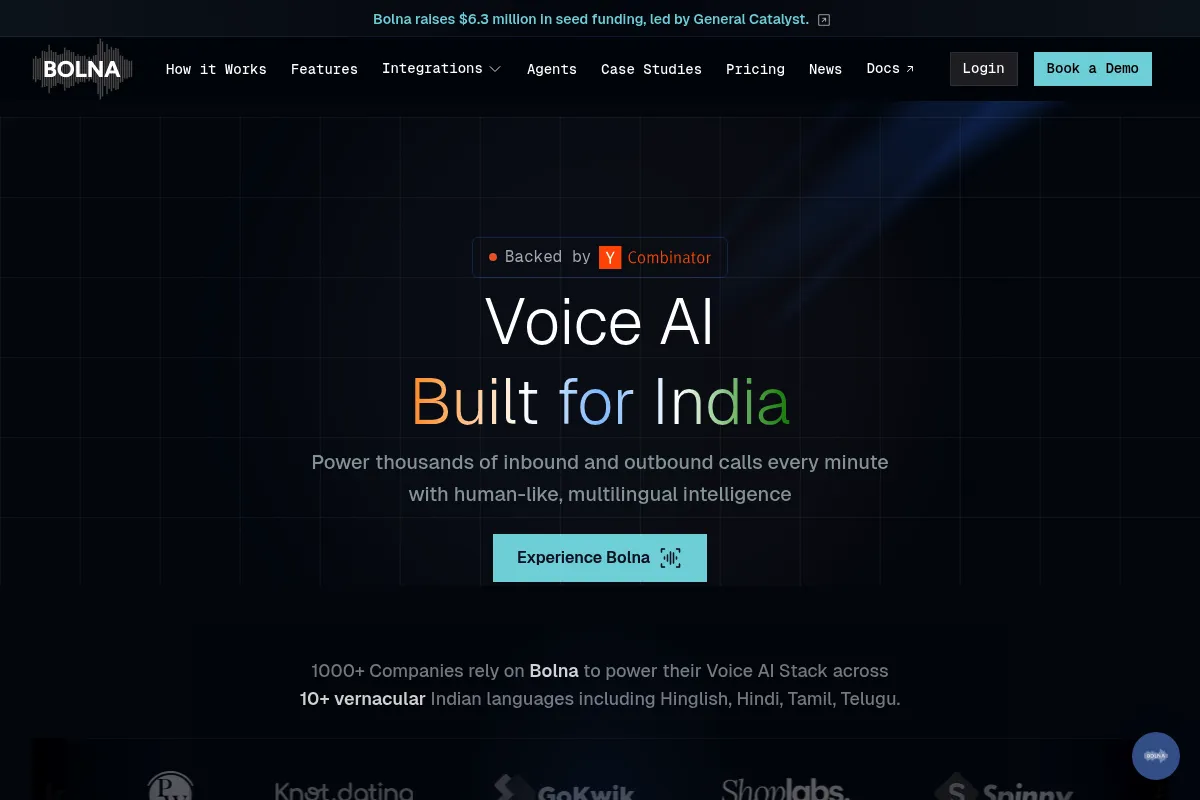
Bolna has raised a total of $6.43 million over two rounds, including a significant $6.3 million Seed round in January 2026 led by General Catalyst. This funding is aimed at expanding its engineering teams and enhancing its AI capabilities for the Indian market.
Market Signals & Traffic
Estimated visits, global rank, geography, traffic sources, monthly visit trends, and organic search keywords (Similarweb)—on a dedicated page built for depth and search.
- Estimated visits
- 76,326
- Global rank
- #422,072
- Snapshot
- Apr 2026
- Traffic trend
- Falling
Estimated monthly visits
Alternatives to Bolna
View all alternativesRetell AI
Communication, Automation & Agents, AI Assistant

Build and deploy human-like conversational voice agents for business.
Bland AI
AI Assistant, Automation

AI platform for automating inbound and outbound phone calls.
Similar Tools
Aisera
AI Assistant, Automation & Agents, Communication
Enterprise platform for automating IT, HR, and customer service workflows.
Amelia Platform
AI Assistant, Automation & Agents, Communication

Conversational digital employee for enterprise customer service and IT support.
LiveX AI
AI Assistant, Automation & Agents, Communication
Omnichannel customer engagement agents for support, sales, and retention.
Operator
AI Assistant, Automation & Agents, Communication

Autonomous agents for customer service and support workflows.
Fathom
Productivity, Video Creation, AI Assistant

AI notetaker that records, transcribes, and summarizes meetings.
Crushon.AI
Communication, AI Assistant

Unfiltered conversations and immersive roleplay with customizable virtual characters.