

A heavy-duty enterprise low-code platform that prioritizes governance and multi-cloud deployment over simple drag-and-drop ease.
Best for large organizations needing to scale complex internal applications across fusion teams, but too expensive and complex for simple CRUD apps.
Analysis based on product data, pricing structure, traffic signals, and public user sentiment.
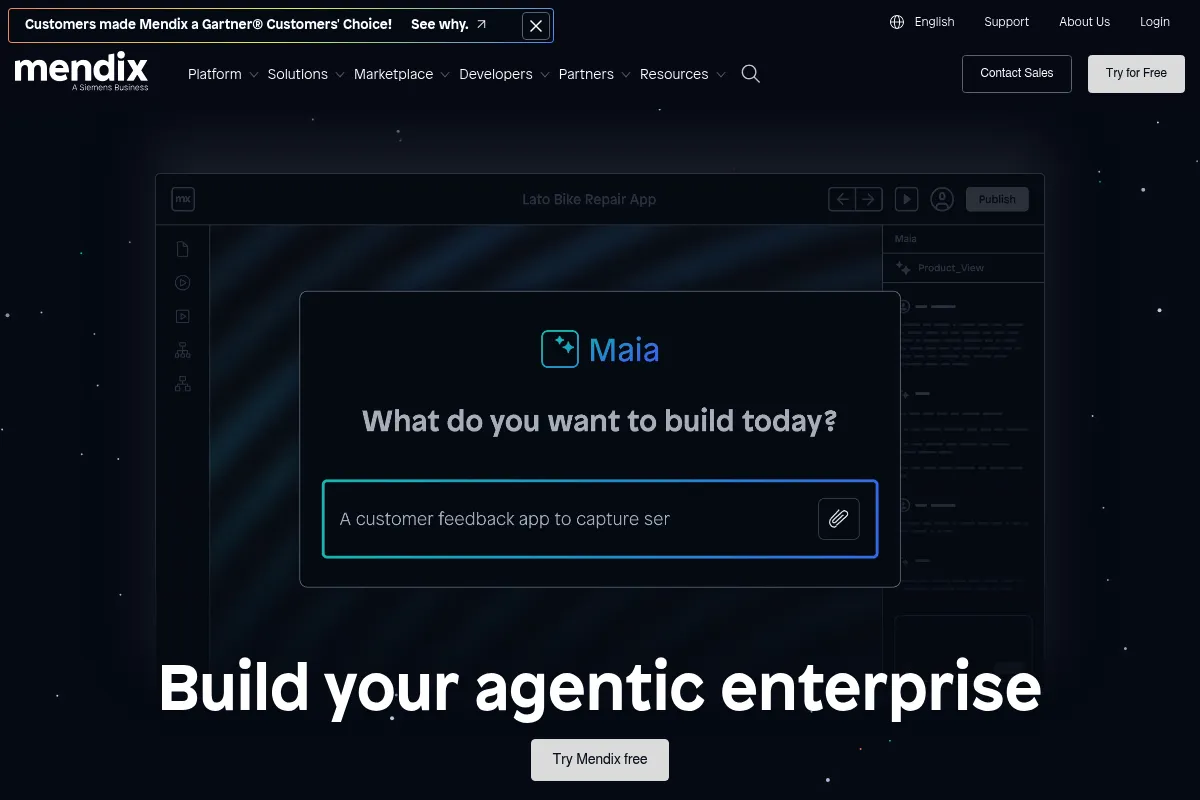
Who Should Use Mendix?
Typical users
Enterprise IT departments, business analysts, and professional developers working in 'fusion teams' within mid-to-large organizations.
Maturity fit
scaling to advanced
Choose this if…
- You need to deploy applications across multiple cloud environments (AWS, Azure, SAP, or On-prem).
- Your priority is enterprise-grade governance and security over rapid, simple prototyping.
- You have a mix of professional developers and business analysts who need to collaborate on the same logic.
Skip this if…
- You are a solo developer or a small startup with a limited budget.
- Your primary need is a simple internal database or basic workflow automation.
- You want to avoid proprietary vendor lock-in for your application logic.
About Mendix
Mendix is a Siemens-owned low-code development platform designed for building, deploying, and managing complex enterprise applications. It bridges the gap between business requirements and technical execution by providing visual modeling tools that generate production-ready code.
Official profiles
What it actually does
It allows teams to build web and mobile applications using visual 'Microflows' for logic and a drag-and-drop UI builder. The platform handles the underlying infrastructure, including database management, version control, and automated deployment pipelines.
What makes it different
Unlike many low-code tools that focus on simple front-ends, Mendix is built on a cloud-native architecture that allows for high-availability and horizontal scaling. Its 'Studio' (for business users) and 'Studio Pro' (for developers) share the same underlying model, allowing seamless collaboration without code handoffs.
Ratings across the web

Ratings aggregated from independent review platforms.
Key Features
Mendix Studio Pro
A desktop IDE for professional developers to handle complex logic and custom integrations.
Atlas UI Framework
A design system that ensures consistent enterprise styling across different applications.
Mendix Assist
An AI bot that suggests next steps in logic flows based on patterns from millions of anonymized apps.
Data Hub
A catalog that allows developers to discover and connect to enterprise data sources without manual API configuration.
One-Click Deployment
Automates the move from development to test and production environments.
Microflows
A visual way to represent complex business logic that would typically require hundreds of lines of code.
Native Mobile Builder
Compiles applications into true native binaries rather than just wrapping a web view.
Pricing
Free
- Unlimited users
- Mendix Studio & Studio Pro
- Community support
- Apps sleep after inactivity
- Mendix branding
Basic
- Up to 5 users included
- No app sleeping
- Standard support
- Deployment to Mendix Cloud
- €10 per additional user
Standard
- Full application lifecycle management
- Advanced governance tools
- Deployment to any cloud
- High availability options
- 1 Production app included
Premium
- Unlimited applications
- On-premises deployment
- Private cloud support
- 24/7 Premium support
- Custom security requirements
Pricing checked 5 months ago
Pricing guidance
- When you need to deploy to your own cloud infrastructure (AWS/Azure).
- When you exceed 5 users on a single application.
- When you need automated backup and high-availability features.
- The Basic plan is limited to Mendix's own cloud.
- Standard plan pricing is often 'per app', which can lead to massive costs if you need a suite of small tools.
- Support response times are tiered heavily by plan.
Premium enterprise positioning with a high barrier to entry for professional-grade features.
Pros & Cons
Strengths
-
True enterprise scalability
The platform is built for high-concurrency environments and handles complex data relationships better than lightweight competitors like Airtable or Glide.
-
Strong governance and security
Centralized administration allows IT teams to manage permissions, security patches, and deployment standards across dozens of apps simultaneously.
-
Cloud-native flexibility
The ability to deploy to any Kubernetes-based environment or specific clouds like SAP BTP makes it highly adaptable to existing corporate infrastructure.
-
Collaboration-first architecture
Business analysts can build the initial logic in the web-based Studio, and developers can refine it in Studio Pro without losing work or starting over.
Weaknesses
-
Opaque and aggressive pricing
The jump from the Basic plan to the Standard plan is massive, and the per-user/per-app pricing can become prohibitively expensive as you scale.
Affects: Mid-sized companies and scaling startups
-
Steep learning curve for 'no-code'
Despite the marketing, building anything beyond a basic app requires a solid understanding of database normalization and logic flows.
Affects: Non-technical business users
-
Proprietary lock-in
Logic is stored in a proprietary format (Microflows). If you decide to leave Mendix, you cannot simply export the code and run it elsewhere; you must rebuild.
Affects: CTOs and long-term product owners
Real User Sentiment
Users generally respect Mendix for its power and ability to handle complex logic, though they frequently complain about the cost and the difficulty of the 'no-code' promise.
Users tend to like
- Speed of development compared to traditional Java/C# stacks
- Robustness of the deployment pipeline
- Excellent integration with SAP and Siemens systems
- Visual debugging of Microflows
Users commonly complain about
- Pricing is confusing and scales too quickly
- The web-based Studio is too limited for real work
- Documentation can be fragmented for advanced use cases
- Vendor lock-in is a constant concern
Recurring tradeoffs
- You trade code portability for development speed and integrated governance.
Happiest users
Enterprise architects who need to standardize how business units build apps without losing control over the tech stack.
Often frustrated
Small business owners who find the pricing prohibitive and the learning curve steeper than expected.
Use Cases
Supply Chain Management
Building custom portals to track inventory across global warehouses.
Legacy Modernization
Replacing aging Lotus Notes or Excel-based processes with modern web apps.
Customer Portals
Creating secure, branded interfaces for clients to manage their accounts and service requests.
IoT Dashboards
Visualizing real-time data from Siemens industrial equipment.
Internal HR Tools
Developing custom onboarding and performance review systems that integrate with existing ERPs.
Frequently Asked Questions
How does Mendix pricing actually work?
Mendix uses a mix of per-user and per-app pricing. The Basic plan starts at €50/month for 5 users on one app. However, for enterprise features like multi-cloud deployment, you must move to the Standard plan (starting around €800/month) or Premium, which often requires a multi-year contract and custom negotiation.
Mendix vs OutSystems: Which is better?
Mendix is generally considered better for 'fusion teams' and cloud-native deployments due to its shared model architecture. OutSystems is often praised for having a more polished UI builder and faster 'time-to-first-app' for traditional developers, but it can feel more restrictive in how it handles underlying code.
Can I host Mendix on my own servers?
Yes, but only on the Premium plan. Mendix supports deployment to any Kubernetes-based environment, including OpenShift, AWS EKS, and Azure AKS, as well as traditional on-premises Windows or Linux servers.
Do I need to know how to code to use Mendix?
While you don't need to write syntax like Java, you must understand logic, variables, and database structures. Most successful Mendix implementations require at least one person with a developer mindset to handle complex integrations and performance optimization.
What happens if I want to stop using Mendix?
This is a major limitation. You cannot export your Mendix app as standard Java or C# code to run independently. You own your data, but the application logic is proprietary. Leaving Mendix usually means a complete rewrite of the application.
Does Mendix integrate with Salesforce and SAP?
Yes, Mendix has specialized connectors for both. It is particularly strong with SAP, as it is a preferred low-code partner for the SAP Business Technology Platform (BTP), allowing for deep OData integration.
Why trust this page?
This evaluation combines product positioning, pricing analysis, traffic and market signals, and public user sentiment into a single decision-support page. Content is generated editorially — not copied from the vendor's website.
Funding & Company
Founded
2005
Stage
Acquired
Total Raised
$38M
Latest Round
Series B (Jan 2014)
Notable Investors
Mendix raised a total of $38 million in venture capital before being acquired by Siemens in August 2018 for approximately $730 million. This acquisition provides the company with the substantial financial backing of a major industrial conglomerate, ensuring its long-term stability and resource availability.
Market Signals & Traffic
Estimated visits, global rank, geography, traffic sources, monthly visit trends, and organic search keywords (Similarweb)—on a dedicated page built for depth and search.
- Estimated visits
- 472,907
- Global rank
- #76,747
- Snapshot
- Apr 2026
- Traffic trend
- Rising
Estimated monthly visits
Similar Tools
Mirascope
Developer Tools, Automation & Agents, Workflow

Pythonic library for building LLM applications with structured outputs.
Back4App
Developer Tools, Automation & Agents, Workflow

Backend-as-a-Service platform for building and scaling applications.
Phidata
Developer Tools, Automation & Agents, Workflow

Framework for building multi-modal agents with memory and tools.
Mastra
Developer Tools, Automation & Agents, Workflow

TypeScript framework for building and deploying production-ready agents.
Duckie
Developer Tools, Automation & Agents, Workflow

Autonomous software engineer that resolves technical tickets and bugs.
SGLang
Developer Tools, Automation & Agents, Workflow

High-performance framework for structured and efficient model inference.