

Mirascope
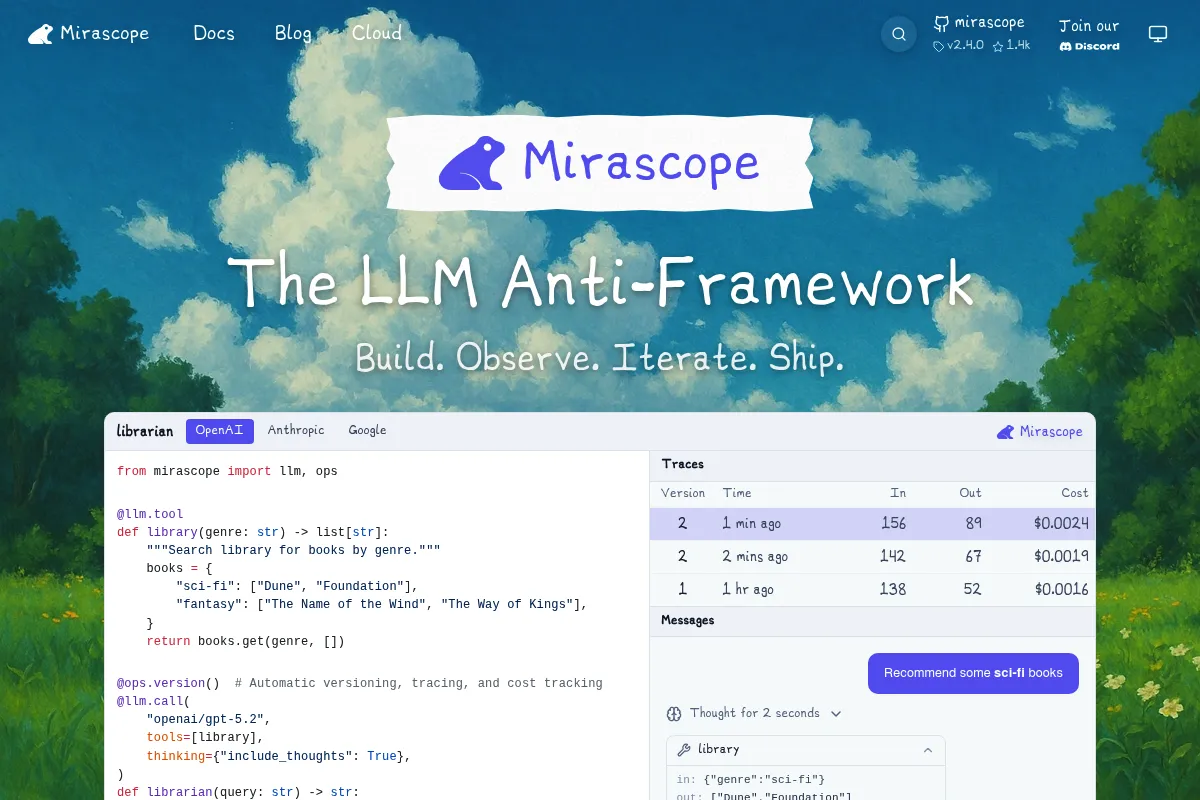
A developer-centric Python library that treats LLM prompts as standard code, prioritizing Pydantic-driven type safety and structured outputs over the heavy abstractions found in larger frameworks.
Best for Python developers who want production-grade structured data without the bloat of LangChain or the 'magic' of high-level AI wrappers.
Analysis based on product data, pricing structure, traffic signals, and public user sentiment.
Who Should Use Mirascope?
Typical users
Python developers and AI engineers building production-grade LLM applications, RAG systems, or agents.
Maturity fit
scaling
Choose this if…
- You prefer writing standard Python code over learning complex, proprietary framework abstractions.
- Your workflow relies heavily on Pydantic for data validation and structured outputs.
- You need to maintain full control over the underlying provider clients while keeping prompts organized.
- You want to switch between LLM providers (OpenAI, Anthropic, Gemini) with minimal code changes.
Skip this if…
- You are looking for a no-code or low-code drag-and-drop interface.
- You need a massive library of pre-built, 'black-box' agents and tools ready out of the box.
- You are not comfortable with Python or Pydantic.
About Mirascope
Mirascope is an open-source Python library designed to bridge the gap between prompt engineering and software engineering. It provides a structured way to interact with LLMs by leveraging Pydantic for data extraction and validation, ensuring that LLM responses adhere to specific schemas.
Official profiles
What it actually does
It allows developers to define LLM calls as Python functions or classes, where prompts are treated as code rather than just strings. The library handles the boilerplate of connecting to various providers, managing chat history, and extracting structured data into Pydantic models.
What makes it different
Unlike frameworks that hide the LLM behind complex 'Chain' objects, Mirascope stays close to the original provider's API. It focuses on 'colocation,' keeping the prompt, model parameters, and output schema in a single, readable Python class, which simplifies debugging and versioning.
Key Features
BasePrompt Class
Organizes prompts, model settings, and input variables into a single, reusable unit.
call Decorator
Transforms standard Python functions into LLM calls with minimal boilerplate.
Pydantic Integration
Validates LLM outputs against a schema, ensuring the data is usable in downstream code.
Provider Agnostic API
Allows switching from OpenAI to Anthropic by changing a single import or class name.
Lilypad Support
Provides a dedicated environment for versioning prompts and tracking performance over time.
Dynamic Tool Calling
Automatically converts Python functions into tools the LLM can use during execution.
Stream Support
Handles partial responses and real-time data processing for low-latency applications.
Pricing
Open Source
- Full access to the Python library
- All provider integrations
- MIT License
- Community support
Lilypad (Beta)
- Prompt versioning
- Performance tracing
- Collaborative prompt engineering
- Managed hosting for prompt logic
Pricing checked 4 months ago
Pricing guidance
- When you need to track prompt performance over time
- When you need a collaborative UI for non-technical team members to edit prompts
- When you need hosted versioning for prompt logic
- No usage limits on the library itself
- Provider costs (OpenAI, etc.) are billed separately by the providers
Developer-friendly open-source core with a value-add managed service for enterprise features.
Pros & Cons
Strengths
-
Minimalist and Pythonic
It feels like writing standard Python code, which reduces the learning curve for experienced developers and makes the codebase easier to maintain.
-
Strong Type Safety
By leveraging Pydantic and Python type hints, it catches errors during development rather than at runtime, which is critical for production stability.
-
Excellent Documentation
The docs focus on clear examples and migration paths from other libraries, making it easy to get started or switch.
-
No Vendor Lock-in
The unified interface makes it trivial to benchmark different models against the same prompt without rewriting the entire logic.
Weaknesses
-
Smaller Ecosystem
Compared to LangChain, there are fewer community-contributed templates, integrations, and third-party tutorials.
Affects: Developers looking for 'plug-and-play' solutions for niche use cases.
-
Manual Orchestration
It does not provide the high-level 'pre-built' agents found in other frameworks; you have to write the logic for complex multi-step loops yourself.
Affects: Teams wanting to deploy complex agents with zero custom logic.
-
Lilypad Dependency for Versioning
While the core library is standalone, the most advanced versioning and tracking features require using their Lilypad tool.
Affects: Teams with strict requirements against adding new external dependencies for monitoring.
Real User Sentiment
Highly positive among its target audience, who praise its simplicity and adherence to Python best practices.
Users tend to like
- The lack of 'magic' abstractions
- Seamless Pydantic V2 integration
- Clean syntax for multi-modal calls
- Fast execution with minimal overhead
Users commonly complain about
- Lack of built-in memory management features
- Fewer pre-built 'tools' compared to competitors
- Documentation can be dense for beginners
Recurring tradeoffs
- You trade 'out-of-the-box' features for better code maintainability and control.
Happiest users
Senior Python developers who value clean code and type safety over rapid, low-code prototyping.
Often frustrated
Beginners who want a framework to tell them exactly how to build an agent step-by-step.
Use Cases
Data Extraction
Converting messy customer support emails into structured JSON for a CRM.
RAG Pipelines
Building custom retrieval-augmented generation workflows with specific validation steps.
Multi-Model Benchmarking
Testing the same prompt across GPT-4, Claude 3, and Llama 3 to compare costs and quality.
Agentic Workflows
Creating custom autonomous agents that use Python functions as tools to perform tasks.
Chatbots
Developing stateful chat applications with validated, type-safe responses.
Frequently Asked Questions
Is Mirascope free to use?
Yes, the Mirascope library is open-source under the MIT license and is completely free. You only pay for the API usage of the LLM providers (like OpenAI or Anthropic) that you connect to the library.
How does Mirascope compare to LangChain?
Mirascope is significantly more lightweight. While LangChain provides high-level abstractions and 'batteries-included' agents, Mirascope focuses on being a thin, type-safe wrapper that stays close to standard Python. Choose Mirascope if you find LangChain too complex or difficult to debug.
Does Mirascope support Pydantic V2?
Yes, Mirascope is built from the ground up to support Pydantic V2, taking advantage of its performance improvements and stricter validation features.
Can I use Mirascope with local models?
Yes, Mirascope supports providers like Groq and Mistral, and can be used with local models via integrations like LiteLLM or by pointing the OpenAI-compatible client to a local server like Ollama.
What is Lilypad in the Mirascope ecosystem?
Lilypad is a companion tool (currently in beta) designed for prompt engineering management. It allows you to version prompts independently of your application code and trace LLM calls for debugging and optimization.
Does Mirascope handle chat history?
Mirascope provides utilities for managing chat history, but unlike some frameworks, it doesn't force a specific database or storage method on you. You have full control over how messages are stored and passed to the model.
Why trust this page?
This evaluation combines product positioning, pricing analysis, traffic and market signals, and public user sentiment into a single decision-support page. Content is generated editorially — not copied from the vendor's website.
Funding & Company
Founded
2023
Stage
Bootstrapped
Total Raised
Bootstrapped
Latest Round
—
Mirascope, Inc. appears to be a bootstrapped company with no publicly disclosed venture capital funding. The company is focused on developing its open-source Python library for LLM applications, suggesting a product-led growth strategy.
Market Signals & Traffic
Estimated visits, global rank, geography, traffic sources, monthly visit trends, and organic search keywords (Similarweb)—on a dedicated page built for depth and search.
- Estimated visits
- 0
- Global rank
- —
- Snapshot
- Apr 2026
- Traffic trend
- —
Estimated monthly visits
Alternatives to Mirascope
View all alternatives
Similar Tools
Back4App
Developer Tools, Automation & Agents, Workflow

Backend-as-a-Service platform for building and scaling applications.
Wordware
Developer Tools, Automation & Agents, Workflow

IDE for building and deploying complex LLM applications
Duckie
Developer Tools, Automation & Agents, Workflow

Autonomous software engineer that resolves technical tickets and bugs.
Mendix
Developer Tools, Automation & Agents, Workflow

Low-code platform for building and deploying enterprise applications.
Abacus.ai
Developer Tools, Automation & Agents, Workflow

Platform for building and deploying enterprise-scale machine learning models.
Phidata
Developer Tools, Automation & Agents, Workflow

Framework for building multi-modal agents with memory and tools.