
Glama
A unified AI chat interface that aggregates top-tier models like Claude 3.5 Sonnet, GPT-4o, and Llama 3 into a single subscription, prioritizing a clean UI and model flexibility over deep ecosystem integration.
Best for power users who need to switch between Claude and GPT-4o daily without paying for multiple $20/month subscriptions.
Analysis based on product data, pricing structure, traffic signals, and public user sentiment.
Who Should Use Glama?
Typical users
Individual developers, writers, and researchers who frequently hit rate limits on official web interfaces or want to compare model outputs side-by-side.
Maturity fit
beginner to scaling
Choose this if…
- You want access to Claude 3.5 Sonnet and GPT-4o in one interface
- Your priority is a distraction-free, fast-loading chat UI
- You need to generate images using Flux or DALL-E 3 alongside text chat
- You prefer a pay-as-you-go or single-subscription model over multiple vendor accounts
Skip this if…
- You require deep integration with Google Workspace or Microsoft 365
- You need advanced 'Canvas' or 'Artifacts' features found in native apps
- Your workflow depends on custom GPTs or specialized OpenAI-only plugins
About Glama
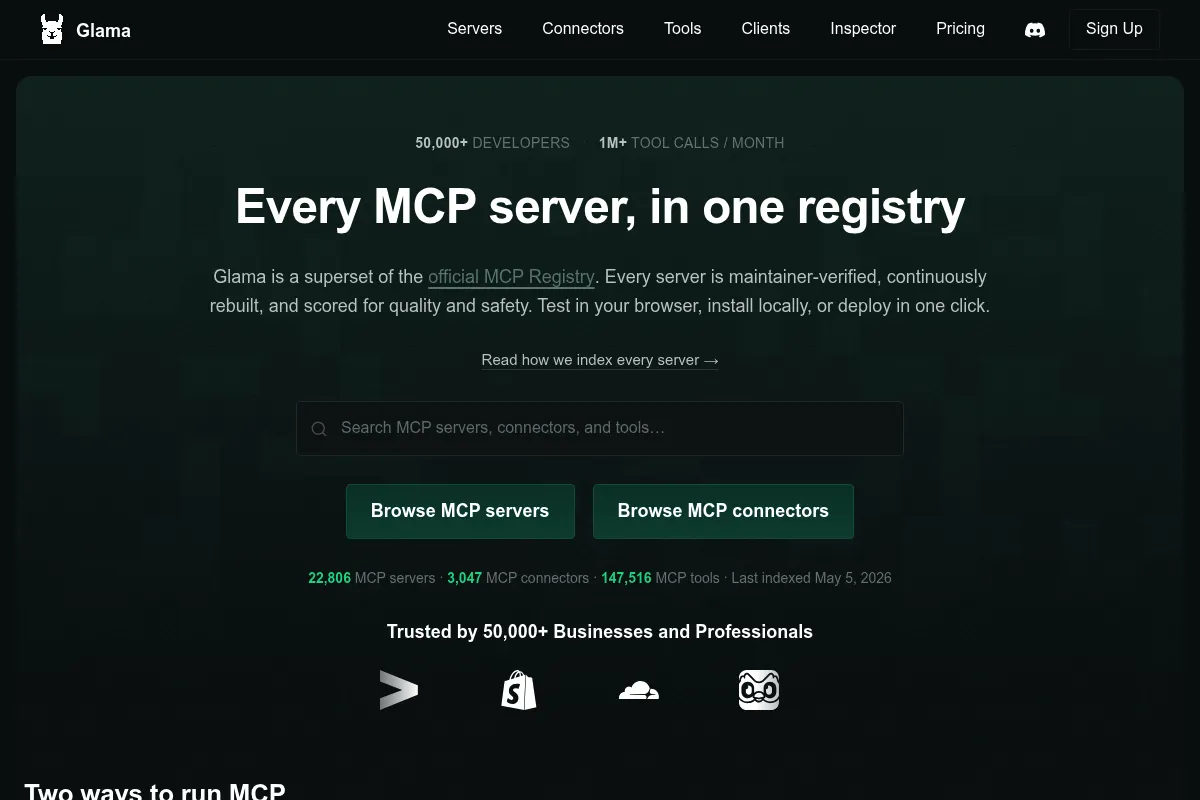
Glama is a multi-model AI aggregator designed to simplify access to the world's most capable LLMs. It removes the friction of managing separate accounts for Anthropic, OpenAI, and Google by providing a centralized dashboard for chat, image generation, and file analysis.
Official profiles
What it actually does
Users can toggle between different models within the same conversation thread to see how different LLMs handle the same prompt. It supports text-to-image generation, document uploads for RAG-based analysis, and provides a library of community-shared prompts.
What makes it different
Unlike Poe, which focuses on social bot creation, Glama emphasizes a professional, minimalist workspace. It offers a more transparent 'credits' system on its paid tiers, allowing users to see exactly how much each model costs to run.
Key Features
Model Comparison
Toggle between Claude, GPT, and Llama to find the best response for a specific task.
Flux.1 Integration
Access high-quality image generation that rivals Midjourney directly in the chat.
Credit-Based Usage
Provides a clear view of usage costs across different model tiers.
No-Tracking Privacy
Offers a more private alternative to native interfaces that use data for training by default.
Prompt Library
Save and organize frequently used system instructions for consistent outputs.
File Attachments
Upload documents to summarize or query long-form data using large context windows.
Pricing
Free
- Limited daily messages
- Access to basic models
- Standard response speeds
- Basic file uploads
Pro
- Access to GPT-4o, Claude 3.5 Sonnet, and Flux
- Higher message limits via credit system
- Priority processing speeds
- Advanced file analysis
- Early access to new models
Pricing checked 4 months ago
Pricing guidance
- When you need Claude 3.5 Sonnet's coding capabilities
- When you want to generate images without a separate Midjourney sub
- When you hit the daily cap on the free version
- Credit-based system means 'unlimited' is not truly infinite for high-cost models
- Image generation consumes significantly more credits than text chat
Competitive with industry standards, effectively offering a 'buy two, get five free' value proposition compared to individual subs.
Pros & Cons
Strengths
-
Consolidated subscription costs
Saves $40-$60 per month by replacing individual Pro subscriptions for ChatGPT, Claude, and Perplexity.
-
Superior UI/UX
The interface is faster and less cluttered than the official OpenAI or Anthropic web apps, focusing purely on the chat experience.
-
Access to open-source models
Allows users to test Llama 3 and Mistral models without setting up local environments or complex API integrations.
Weaknesses
-
Lacks native feature parity
Does not support OpenAI's 'Advanced Voice Mode' or Anthropic's 'Artifacts' UI, which can be dealbreakers for specific workflows.
Affects: Power users of specific native features
-
Credit exhaustion
Heavy users of GPT-4o or Claude 3.5 Opus may find the monthly credit allotment runs out faster than the 'unlimited' tiers of native apps.
Affects: High-volume researchers and developers
-
Third-party dependency
If Glama's API keys or services go down, you lose access to all models simultaneously.
Affects: Users requiring 100% uptime for critical tasks
Real User Sentiment
Generally positive, with users praising the aesthetic and the convenience of having multiple models in one tab.
Users tend to like
- Clean, dark-mode optimized interface
- Fast switching between models
- Reliable uptime compared to other aggregators
- Inclusion of Flux for image generation
Users commonly complain about
- Lack of a dedicated mobile app
- Occasional delays in adding the very latest model versions
- Credit system can be confusing to track
Recurring tradeoffs
- You trade native ecosystem features (like GPTs) for model variety and a better UI.
Happiest users
Freelance developers and content creators who need the best model for the specific task at hand.
Often frustrated
Users who want a 'set it and forget it' unlimited experience without watching a credit balance.
Use Cases
Coding
Using Claude 3.5 Sonnet for logic and GPT-4o for documentation in one thread.
Content Creation
Generating blog outlines with LLMs and matching header images with Flux.
Research
Uploading multiple PDFs to summarize key findings using large context models.
Model Benchmarking
Comparing how different models interpret the same complex prompt.
Privacy-Conscious Chat
Using a third-party interface to avoid direct data training by primary labs.
Frequently Asked Questions
How does Glama.ai pricing compare to ChatGPT Plus?
Both cost $20/month, but Glama provides access to Claude 3.5 Sonnet, Llama 3, and Flux.1 in addition to GPT-4o. While ChatGPT Plus offers 'unlimited' use of its own model, Glama uses a credit system that covers a wider variety of providers.
Is there a free version of Glama.ai?
Yes, Glama offers a free tier with limited daily credits. It is sufficient for basic tasks and testing the interface, but professional users will likely exhaust the credits within an hour of heavy use.
Does Glama.ai have a mobile app?
Currently, Glama does not have a native iOS or Android app. However, the website is highly optimized for mobile browsers and can be added to the home screen as a PWA (Progressive Web App).
Can I use my own API keys with Glama?
Glama primarily operates as a managed service where they provide the API access. This differs from tools like TypingMind, which are 'bring your own key' (BYOK) platforms. Glama is designed for users who want a managed subscription.
What are the main limitations compared to using Claude.ai directly?
The biggest limitation is the lack of 'Artifacts,' which allows users to view and edit code or documents in a side-by-side window. If your workflow relies on that interactive preview, the native Claude interface is superior.
Which image generation models are supported?
Glama currently supports Flux.1 (Pro and Schnell versions) and DALL-E 3. This makes it a strong choice for users who need high-quality prompt adherence and text-in-image capabilities.
Why trust this page?
This evaluation combines product positioning, pricing analysis, traffic and market signals, and public user sentiment into a single decision-support page. Content is generated editorially — not copied from the vendor's website.
Funding & Company
Founded
2024
Stage
Pre seed
Total Raised
Bootstrapped
Latest Round
—
Glama.ai appears to be a bootstrapped company, as there is no public record of any external funding rounds. The company, founded in 2024, is in its early stages and is likely relying on revenue from its freemium subscription model for growth.
Market Signals & Traffic
Estimated visits, global rank, geography, traffic sources, monthly visit trends, and organic search keywords (Similarweb)—on a dedicated page built for depth and search.
- Estimated visits
- 0
- Global rank
- —
- Snapshot
- May 2026
- Traffic trend
- Falling
Estimated monthly visits
Alternatives to Glama
View all alternatives
Similar Tools
Continue
AI Assistant, Developer Tools, Productivity

Open-source coding assistant for VS Code and JetBrains IDEs
LobeChat
AI Assistant, Developer Tools, Productivity

Open-source chatbot framework supporting multiple large language models and plugins.
Chatbox AI
AI Assistant, Developer Tools, Productivity

Cross-platform desktop and mobile client for multiple language models
DeepSeek
AI Assistant, Developer Tools, Productivity

Advanced AI models for coding, content creation, and business automation.
10Web
AI Assistant, Developer Tools, Productivity

AI-powered WordPress website builder, hosting, and management platform.
Exa
AI Assistant, Developer Tools, Productivity

AI-powered search engine for developers and AI applications.