

Replicate offers a vast library of open-source AI models accessible via API, simplifying deployment for developers but with potential cost and latency considerations for production.
Best for developers prototyping AI features or needing quick access to diverse models, weaker for predictable, high-volume production workloads.
Analysis based on product data, pricing structure, traffic signals, and public user sentiment.
Who Should Use Replicate?
Typical users
Software developers, AI engineers, and researchers looking to integrate or experiment with various open-source AI models without managing infrastructure. Startups and small teams can use it for rapid prototyping.
Maturity fit
beginner to scaling
Choose this if…
- You need to quickly test and integrate various open-source AI models.
- You want to avoid managing complex AI infrastructure.
- Your priority is rapid prototyping and experimentation.
- You need access to a wide variety of generative AI models for creative tasks.
Skip this if…
- You require guaranteed low latency and zero cold starts for user-facing applications.
- Your budget is highly constrained for unpredictable, high-volume inference.
- You need deep control over infrastructure and autoscaling configurations.
- Your workflow involves training large models extensively.
About Replicate
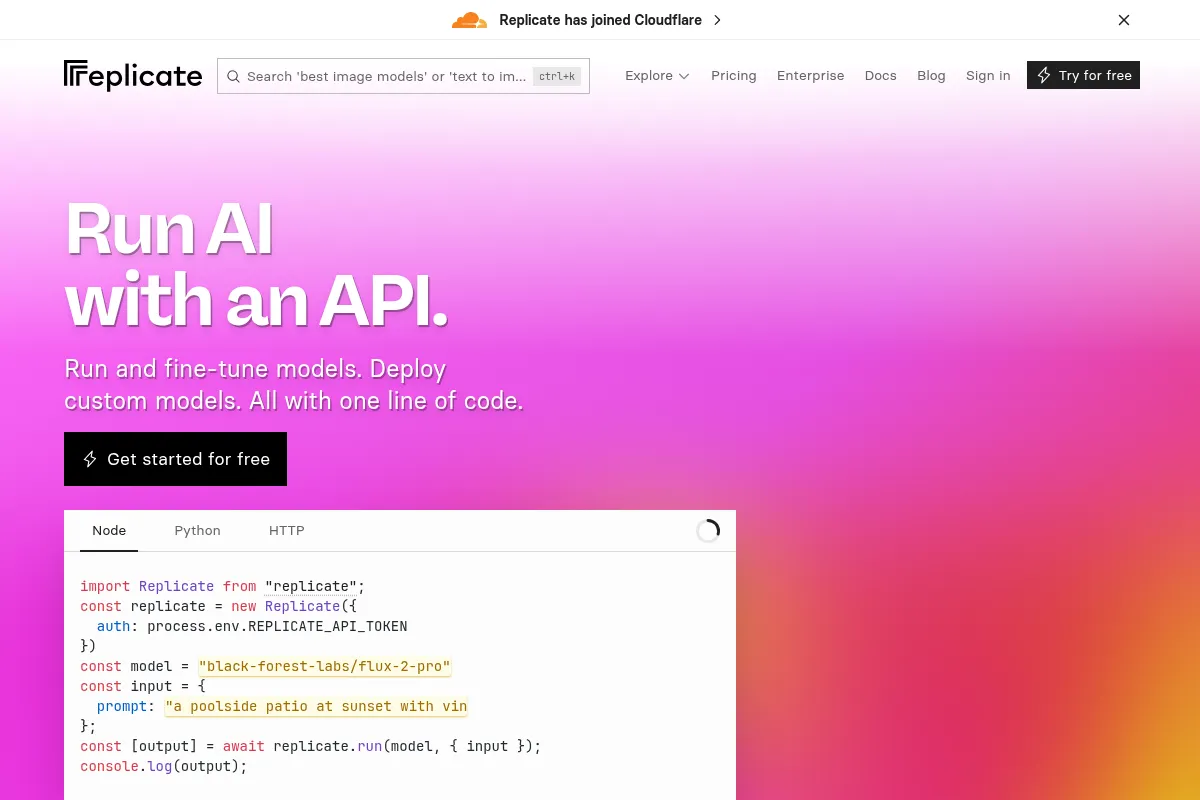
Replicate is a cloud platform that provides API access to a vast collection of open-source AI models. It aims to democratize AI by allowing developers to run, fine-tune, and deploy models without managing complex infrastructure. It's designed for ease of use, offering a streamlined way to integrate AI capabilities into applications.
Official profiles
What it actually does
Replicate allows users to run thousands of pre-trained open-source AI models through a simple API. It handles the underlying infrastructure, scaling, and compute resources, enabling users to integrate AI functionalities like image generation, text processing, and speech synthesis into their applications. Users can also deploy their own custom models.
What makes it different
Replicate differentiates itself by offering a curated marketplace of open-source AI models with a focus on ease of use and rapid deployment via API. It abstracts away infrastructure complexities, allowing developers to focus on integration rather than management. Its community-driven model library is a key differentiator.
Ratings across the web

Ratings aggregated from independent review platforms.
Key Features
Run Open-Source Models
Access thousands of community-contributed models for immediate use with a single API call.
Deploy Custom Models
Package and deploy your own models using Cog, Replicate's open-source tool, with automatic scaling.
Fine-Tune Models
Adapt existing models with your own data for more specialized tasks.
Production-Ready APIs
Models are ready for real-world application with accessible APIs.
Usage-Based Pricing
Pay only for the compute time used, offering cost-effectiveness for varying project sizes.
Model Marketplace
Browse and discover a wide variety of AI models for different tasks.
Pricing
Pay-as-you-go
- Usage-based billing for compute time
- Access to public and custom models
- Automatic scaling
- Various hardware options (CPU, GPU)
Pricing checked 6 months ago
Pricing guidance
- When you exceed free tier limits and require consistent access.
- When your application demands predictable performance and low latency (requiring warm instances).
- When you need to deploy and run your own custom models at scale.
- When your inference costs become significant and require optimization or predictable budgeting.
- Rate limits on API requests (e.g., 600 requests/minute for predictions).
- Potential for cold starts on shared hardware for public models.
- Custom model deployments incur costs for all uptime, not just active inference.
- Community model quality and maintenance are not guaranteed.
Usage-based pricing that is cost-effective for experimentation but can become unpredictable and expensive at scale for production workloads.
Pros & Cons
Strengths
-
Extensive Model Library
Offers access to thousands of diverse open-source AI models, making it easy to find and experiment with different functionalities without individual setup. This is particularly valuable for creative and generative AI tasks.
-
Ease of Use and Integration
Simplifies the process of running and deploying AI models through a straightforward API, reducing the need for deep AI expertise or infrastructure management. This allows developers to integrate AI features quickly.
-
Scalability
Automatically scales compute resources to handle varying demand, ensuring that applications can manage traffic spikes without manual intervention. This is crucial for production environments.
-
Cost-Effective for Experimentation
The pay-per-use pricing model makes it affordable for testing and prototyping AI models, as users only pay for the compute time consumed. Free credits are available for initial testing.
Weaknesses
-
Cold Start Latency
Custom model deployments can experience significant cold-start times (over 60 seconds) when scaling from zero, impacting real-time application performance. This can be mitigated by paying to keep instances warm, adding to costs.
Affects: Real-time applications requiring low latency
-
Unpredictable Pricing at Scale
While pay-per-second billing is transparent, predicting costs for high-volume or long-running models can be difficult, especially with varying GPU usage and potential failed runs. Deploying private models incurs costs for all uptime.
Affects: Production workloads with high or variable inference needs
-
Community Model Quality Variability
The vast majority of models are community-maintained, leading to potential inconsistencies in quality, outdated versions, or models becoming deprecated without warning. Only a small fraction are officially maintained.
Affects: Users relying on specific community models for critical applications
-
Limited Control Over Infrastructure
Replicate abstracts away infrastructure management, which simplifies use but offers less flexibility for fine-tuning autoscaling, queue times, or specific hardware configurations compared to self-hosted solutions.
Affects: Advanced users needing granular control over deployment environments
Real User Sentiment
Generally positive, with users appreciating its ease of use and extensive model library, though some express concerns about production-level performance and cost predictability.
Users tend to like
- Ease of use for running and integrating AI models.
- Vast library of open-source and community models.
- Simplified infrastructure management.
- API accessibility for developers.
- Good for prototyping and experimentation.
Users commonly complain about
- Cold start latency for custom models.
- Unpredictable pricing at scale.
- Inconsistent quality of community-maintained models.
- Limited control over infrastructure.
- Potential for high costs with private model deployments.
Recurring tradeoffs
- Ease of use vs. control over infrastructure.
- Access to many models vs. quality assurance of community models.
- Pay-per-use flexibility vs. predictable costs at scale.
Happiest users
Developers and researchers using Replicate for prototyping, experimentation, and accessing a wide range of generative AI models.
Often frustrated
Teams requiring guaranteed low latency, predictable costs for high-volume production inference, or deep control over their deployment environment.
Use Cases
Generating marketing visuals for ad campaigns
Using image generation models to create eye-catching creatives.
Prototyping AI features in applications
Quickly integrating AI capabilities like text generation or image analysis into new software.
Creating custom avatars or product visualizations
Fine-tuning models with specific data for branded content.
Automating code generation or documentation
Utilizing language models for developer productivity tasks.
Experimenting with cutting-edge generative AI models
Accessing and testing new models for creative projects.
Building AI-powered content creation tools
Providing users with API access to various AI models for media generation.
Frequently Asked Questions
What is Replicate and how does it work?
Replicate is a cloud platform that allows developers to run, fine-tune, and deploy open-source AI models via a simple API. It handles the underlying infrastructure, scaling, and compute resources. Users can access a vast library of pre-trained models or deploy their own custom models using Replicate's tool, Cog. The platform abstracts away the complexity of managing AI infrastructure, making it easier to integrate AI capabilities into applications.
How does Replicate pricing work?
Replicate uses a pay-as-you-go pricing model, charging per second of compute time used. The cost varies depending on the hardware (CPU, GPU type) and the specific model being run. Public models are billed only for active processing time, while custom model deployments incur charges for all uptime. Users can monitor costs in real-time via the dashboard. Free credits are available for initial testing.
What are the main limitations of Replicate?
Key limitations include potential cold start latency for custom models when scaling from zero, which can impact real-time applications. Pricing can become unpredictable and expensive at scale, especially for private model deployments that charge for all uptime. The quality of community-contributed models can also be inconsistent, and users have limited control over the underlying infrastructure compared to self-hosted solutions.
What are some alternatives to Replicate?
Alternatives to Replicate include platforms like Hugging Face Inference Endpoints (for quick deployment of Hub models), Beam (for fast serverless GPUs with pre-second pricing), RunPod (for affordable raw GPU compute), Baseten (for purpose-built model serving), and cloud provider services like Google Vertex AI, AWS SageMaker, and Azure ML endpoints, which offer more integrated enterprise solutions. Each alternative has different strengths in terms of performance, pricing, and control.
Can I deploy my own custom models on Replicate?
Yes, Replicate allows you to deploy your own custom models using Cog, their open-source tool for packaging machine learning models. Cog handles the creation of an API server and deployment on Replicate's cloud infrastructure, which then scales automatically to meet demand. You pay for the compute time used by your custom model.
Is Replicate suitable for production workloads?
Replicate is suitable for some production workloads, especially for prototyping, experimentation, and applications where occasional cold starts are acceptable or can be managed (e.g., by keeping instances warm). However, for applications requiring guaranteed low latency, predictable costs at high volume, or deep infrastructure control, alternatives like Beam, WaveSpeedAI, or enterprise cloud solutions might be more appropriate due to Replicate's potential for cold starts and unpredictable pricing at scale.
What kind of AI models are available on Replicate?
Replicate hosts a vast library of open-source AI models contributed by the community, covering a wide range of tasks including image generation (e.g., Stable Diffusion, Flux), video creation, speech transcription (e.g., Whisper), text generation (e.g., Llama, Mistral), audio synthesis, and more. They also host some proprietary models. The library is constantly growing.
How does Replicate handle scaling?
Replicate automatically scales compute resources up and down to handle demand for both public and custom models. This means that if your application experiences a surge in traffic, Replicate's infrastructure will adjust to accommodate the load without manual intervention. For custom models, this scaling is managed on dedicated instances, while public models share a hardware pool.
Why trust this page?
This evaluation combines product positioning, pricing analysis, traffic and market signals, and public user sentiment into a single decision-support page. Content is generated editorially — not copied from the vendor's website.
Funding & Company
Founded
2019
Stage
Acquired
Total Raised
$57.8M
Latest Round
Series B (Dec 2023)
Notable Investors
Replicate raised a total of $57.8 million across three rounds, culminating in a $40 million Series B in late 2023. This strong venture backing from top-tier investors like Andreessen Horowitz and Sequoia Capital signaled significant confidence in its developer-focused AI platform. The funding trajectory led to its acquisition by Cloudflare in early 2026, providing substantial long-term stability.
Market Signals & Traffic
Estimated visits, global rank, geography, traffic sources, monthly visit trends, and organic search keywords (Similarweb)—on a dedicated page built for depth and search.
- Estimated visits
- 1,344,492
- Global rank
- #30,313
- Snapshot
- Apr 2026
- Traffic trend
- Steady
Estimated monthly visits
Alternatives to Replicate
View all alternativesHugging Face
Developer Tools, Productivity

Open-source platform for machine learning models, datasets, and tools.
Together AI
AI Assistant, Developer Tools, Productivity

AI Acceleration Cloud for building and deploying generative AI models.
Fal.ai
Content Creation, Developer Tools, AI Assistant

Generative media platform for developers with fast AI model inference.
Similar Tools
Spider
Data Extraction, Developer Tools, Search

High-performance web crawler for data extraction and LLM training.
Designs.ai
Content Creation, Video Creation, AI Assistant

Unified AI platform for creating communication assets like copy, visuals, and video.
100ms
Communication, Developer Tools

Infrastructure for building real-time video and audio communication experiences.
Elyos AI
AI Assistant, Automation & Agents, Workflow

Autonomous agents for trades and field service business operations.
Wonder Studio
Video Creation, Content Creation

Automatically animates and composes CG characters into live-action footage.
Personal AI
AI Assistant, Communication, Productivity

Create a digital twin that learns from your personal knowledge.