

Modular
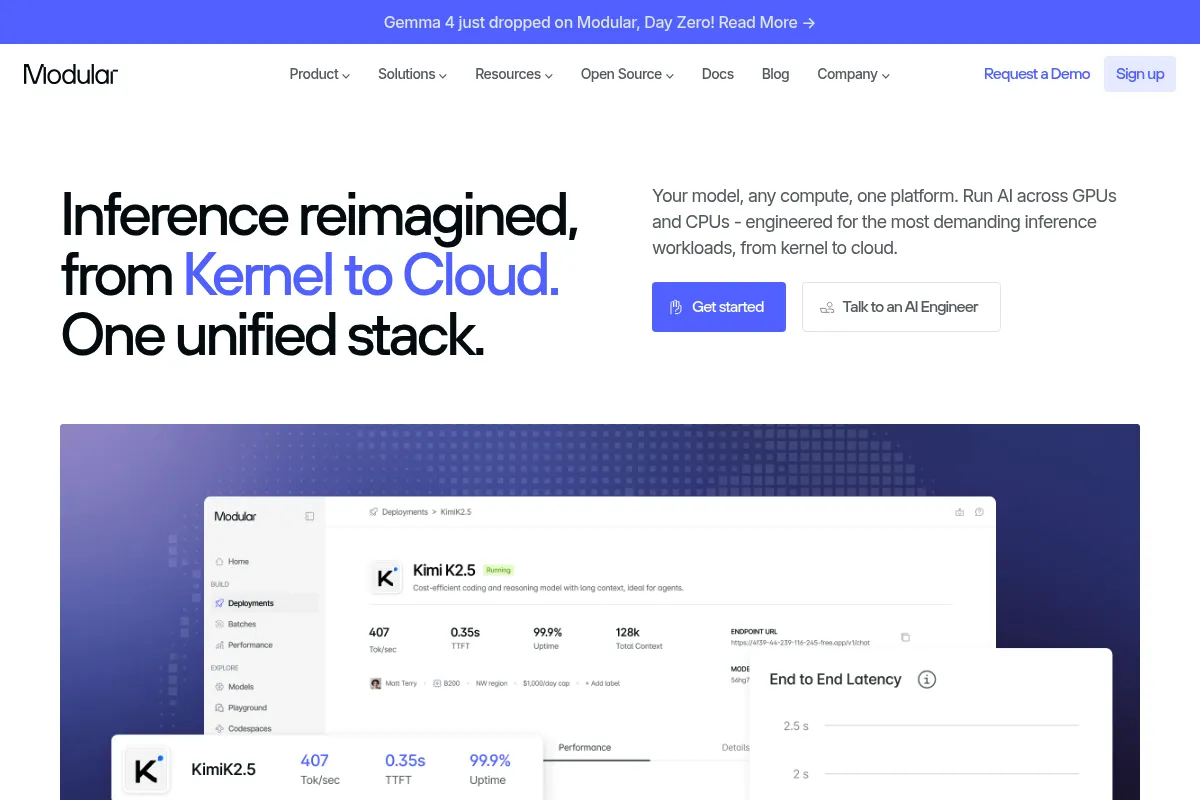
A high-performance AI infrastructure stack that combines a Python-compatible language (Mojo) with a unified inference engine (MAX) to simplify and accelerate model deployment.
Best for teams needing C-level performance without leaving the Python ecosystem, weaker for projects requiring a mature, decade-old library ecosystem.
Analysis based on product data, pricing structure, traffic signals, and public user sentiment.
Who Should Use Modular?
Typical users
AI engineers, ML infrastructure teams, and performance-focused developers at scaling startups or enterprises.
Maturity fit
scaling to advanced
Choose this if…
- Your Python-based AI inference is too slow for production
- You want to avoid writing C++ or CUDA kernels for hardware acceleration
- You need a unified engine to run models across different CPU and GPU architectures
Skip this if…
- Your project relies heavily on niche Python libraries not yet compatible with Mojo
- You require a fully open-source inference engine (MAX is currently proprietary)
- Standard PyTorch or ONNX Runtime performance meets your current latency requirements
About Modular
Modular provides a unified platform for AI development, centered around the Mojo programming language and the MAX (Modular Accelerated Xecution) engine. It was founded by Chris Lattner (creator of LLVM and Swift) to fix the fragmentation in AI hardware and software stacks.
Official profiles
What it actually does
It provides a toolchain to write, optimize, and deploy AI models. Developers use Mojo to write high-performance code with Python-like syntax and the MAX engine to execute models with lower latency than standard runtimes.
What makes it different
Unlike traditional stacks that require Python for research and C++/CUDA for production, Modular uses a single language (Mojo) that is a superset of Python but compiles to machine code. This eliminates the 'two-language problem' in AI development.
Key Features
Mojo Language
Combines Python's usability with C-level performance and memory safety.
MAX Engine
A unified inference runtime that outperforms standard PyTorch and TensorFlow executors.
Python Interoperability
Allows importing and using any existing Python library (like NumPy or Pandas) within Mojo code.
Hardware Abstraction
Write code once and run it across different hardware types without manual kernel tuning.
MAX Graph
Tools to visualize and optimize model computational graphs for better throughput.
Parallelism Primitives
Built-in support for tiling, vectorization, and multi-core execution.
MAX Serving
A high-performance serving container for deploying models into production environments.
Pricing
MAX Free
- Access to Mojo language
- MAX Engine for local development
- Community support
- Standard performance optimizations
MAX Pro
- Everything in Free
- Commercial deployment rights
- Priority support
- Advanced performance features
- 10 deployment instances included
MAX Enterprise
- Unlimited deployment instances
- Custom hardware support
- Dedicated engineering support
- SLA guarantees
Pricing checked 5 months ago
Pricing guidance
- When moving from local testing to production deployment
- When you need commercial usage rights
- When you require priority technical support from the Modular team
- The Pro plan limits the number of production instances
- Cloud-based Mojo playground has time limits
- MAX Engine usage is restricted by the EULA on the free tier
Premium positioning targeting high-value AI infrastructure where performance gains translate directly to cloud cost savings.
Pros & Cons
Strengths
-
Significant performance gains
Mojo can be orders of magnitude faster than standard Python for compute-heavy tasks by utilizing low-level hardware features.
-
Reduced tech stack complexity
Eliminates the need to rewrite Python prototypes into C++ for production, saving engineering time and reducing bugs.
-
Hardware flexibility
The MAX engine optimizes models for the specific hardware they run on, reducing the need for manual hardware-specific tuning.
-
Strong leadership and vision
Led by industry veterans who built LLVM and Swift, ensuring the underlying compiler technology is architecturally sound.
Weaknesses
-
Immature ecosystem
Mojo is a new language; it lacks the vast library ecosystem and community-driven StackOverflow answers that Python has built over decades.
Affects: Early-stage developers and small teams
-
Proprietary components
While Mojo is moving toward open source, the MAX engine remains closed-source, creating potential vendor lock-in concerns.
Affects: Enterprise architects and open-source purists
-
Rapidly evolving API
The platform is changing quickly, meaning code written today may require updates as the language and engine stabilize.
Affects: Teams looking for long-term stability
Real User Sentiment
High technical excitement tempered by caution regarding the proprietary nature of the engine and the youth of the language.
Users tend to like
- Mojo's speed benchmarks
- Python-like syntax for high-performance code
- The pedigree of the founding team
- Ease of hardware portability
Users commonly complain about
- MAX engine is not open source
- Mojo standard library is still sparse
- Installation and setup can be finicky on some systems
Recurring tradeoffs
- Performance vs. Ecosystem: You get massive speed but lose access to some mature Python library behaviors.
Happiest users
Infrastructure engineers who are tired of managing complex C++/Python hybrid codebases.
Often frustrated
Developers expecting a 1:1 replacement for Python that 'just works' with every obscure legacy library.
Use Cases
Low-latency LLM inference
Reducing the time-to-first-token for large language models.
Edge deployment
Optimizing models to run on resource-constrained hardware without manual C++ rewrites.
Replacing CUDA kernels
Writing custom GPU operations in Mojo instead of complex CUDA C++.
Cost reduction
Increasing throughput per server to reduce the total number of GPUs needed for inference.
Real-time computer vision
Processing high-frame-rate video feeds where Python latency is a bottleneck.
Frequently Asked Questions
Is Mojo a replacement for Python?
Mojo is designed as a superset of Python. It aims to be fully compatible with Python code while adding features for systems programming and hardware acceleration. You don't have to choose one; you can use Mojo to speed up the performance-critical parts of your Python application.
How much does Modular MAX cost for production?
For production use, the MAX Pro plan starts at $450 per month. This plan includes commercial deployment rights and support. For large-scale enterprise needs with unlimited instances, you must contact Modular for custom pricing.
How does MAX compare to NVIDIA TensorRT?
While TensorRT is highly optimized for NVIDIA GPUs, MAX is designed to be hardware-agnostic, providing high performance across CPUs and GPUs from different vendors. MAX also integrates more tightly with the Mojo language for custom operator development.
Is the MAX engine open source?
No, the MAX engine is currently proprietary. While Modular has begun open-sourcing parts of the Mojo standard library and core components, the inference engine remains a commercial product.
Can I use my existing PyTorch models with Modular?
Yes, the MAX engine supports loading models from PyTorch (via TorchScript or ONNX) and TensorFlow. It then applies its own graph-level optimizations to improve execution speed on your target hardware.
What hardware does Modular support?
Modular currently supports x86 and ARM CPUs, as well as NVIDIA GPUs. Support for other accelerators, including Apple Silicon and various NPUs, is actively being developed and expanded.
Why trust this page?
This evaluation combines product positioning, pricing analysis, traffic and market signals, and public user sentiment into a single decision-support page. Content is generated editorially — not copied from the vendor's website.
Funding & Company
Founded
2022
Stage
Series c
Total Raised
$380M
Latest Round
Series C (Sep 2025)
Notable Investors
Modular has raised a total of $380 million across three funding rounds, culminating in a $250 million Series C in late 2025 that valued the company at $1.6 billion. This substantial backing from top-tier investors like GV, General Catalyst, and Greylock indicates strong market confidence in its mission to unify AI infrastructure.
Market Signals & Traffic
Estimated visits, global rank, geography, traffic sources, monthly visit trends, and organic search keywords (Similarweb)—on a dedicated page built for depth and search.
- Estimated visits
- 192,893
- Global rank
- #232,520
- Snapshot
- Apr 2026
- Traffic trend
- Falling
Estimated monthly visits
Alternatives to Modular
View all alternatives
Similar Tools
OpenRouter
Developer Tools

Unified API gateway for accessing and comparing large language models.
Amazon CodeWhisperer
Developer Tools

AI-powered coding companion that generates code recommendations.
Nebius
Developer Tools

Cloud infrastructure for training and deploying machine learning models.
AskCodi
Developer Tools
AI coding assistant and unified LLM API gateway for developers.
Wavespeed
Developer Tools

Serverless GPU infrastructure for high-speed AI model inference
Neon
Developer Tools

Serverless Postgres database with instant branching and automatic scaling.