

A high-performance, usage-based SDK suite for global real-time video and audio, best for high-scale applications but requires significant developer effort to implement.
Excellent for global-scale interactive streaming and AI voice agents, weaker for teams wanting a plug-and-play UI.
Analysis based on product data, pricing structure, traffic signals, and public user sentiment.
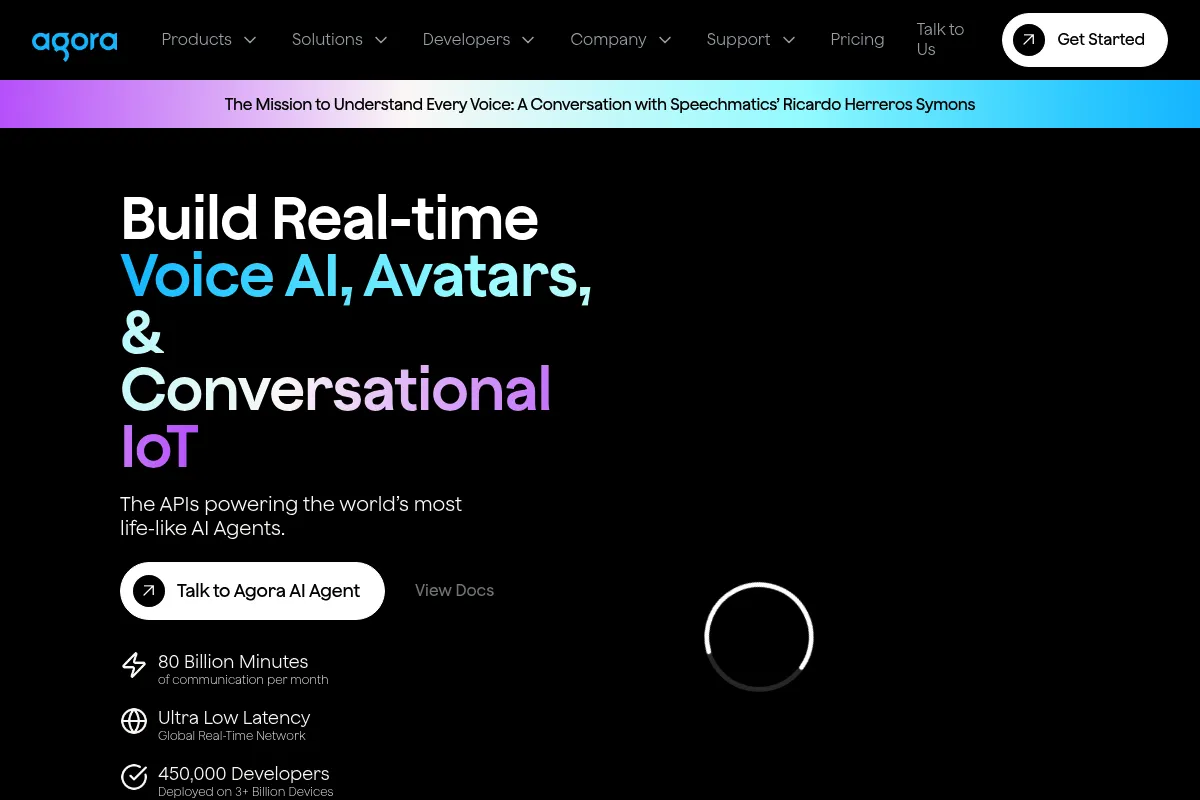
Who Should Use Agora.io?
Typical users
Product engineers and technical founders building custom communication features for social, edtech, or gaming apps.
Maturity fit
scaling to advanced
Choose this if…
- You need sub-400ms latency for a global user base
- Your priority is granular control over audio and video streams
- You want to pay strictly for usage rather than per-seat licenses
Skip this if…
- You need a pre-built, 'no-code' video conferencing interface
- You lack dedicated engineering resources to manage SDK integration
- Your workflow requires a simple Zoom-like embed with zero configuration
About Agora.io
Agora provides the infrastructure for real-time engagement, bypassing standard public internet congestion using a proprietary global network. It is designed for developers who need to embed low-latency voice, video, and messaging directly into their own applications.
What it actually does
It provides a set of SDKs and APIs that handle the complex routing, packet loss recovery, and device compatibility required for live communication. Users get access to a global network (SD-RTN) that ensures stable connections even in regions with poor internet infrastructure.
What makes it different
Unlike competitors that rely purely on standard WebRTC over the public internet, Agora uses its Software Defined Real-time Network (SD-RTN) to optimize routing at the network layer. This results in significantly better performance in emerging markets and high-jitter environments.
Ratings across the web

Ratings aggregated from independent review platforms.
Key Features
SD-RTN
Proprietary network overlay that ensures sub-400ms latency globally.
AI Noise Suppression
Filters non-human sounds like keyboard clicks or sirens at the edge.
Conversational AI SDK
Connects real-time voice streams directly to LLMs for low-latency AI agents.
Interactive Live Streaming
Allows viewers to become 'co-hosts' with minimal delay compared to HLS.
Spatial Audio
Simulates 3D sound environments for virtual offices or gaming.
Analytics Dashboard
Provides real-time monitoring of call quality, bitrates, and packet loss.
App Builder
A low-code tool to generate basic UI code for faster prototyping.
Pricing
Free Tier
- 10,000 free minutes every month
- Access to all core SDKs
- Community support
- Standard analytics
Standard Usage
- Voice-only calls
- Global SD-RTN access
- Encrypted streams
Video HD
- Video up to 720p
- Interactive live streaming
- Screen sharing
Video Full HD
- Video up to 1080p
- Highest quality presets
- Advanced noise cancellation
Pricing checked 6 months ago
Pricing guidance
- Exceeding 10,000 minutes per month
- Requiring HIPAA compliance features
- Needing enterprise-grade support SLAs
- Recording is billed as a separate service per minute
- Analytics data retention is limited on lower tiers
- AI features (noise suppression, transcription) incur additional per-minute fees
Competitive usage-based pricing that is affordable for small teams but requires careful monitoring at enterprise scale.
Pros & Cons
Strengths
-
Superior Global Reliability
The dedicated network backbone provides more stable connections in regions like Southeast Asia and Latin America compared to standard WebRTC providers.
-
Generous Free Tier
The first 10,000 minutes every month are free, which is sufficient for most startups to build, test, and launch without upfront costs.
-
Deep AI Integration
Recent updates make it one of the fastest ways to build voice-to-voice AI agents by bridging audio streams directly to GPT-4o or similar models.
Weaknesses
-
Fragmented Documentation
Developers frequently report that guides are outdated, poorly translated, or inconsistent between different SDK versions.
Affects: Engineering teams during initial integration
-
Complex Billing Structure
Usage is billed by participant minutes and resolution; high-resolution video or extra features like recording can lead to unexpected costs.
Affects: Finance teams and bootstrapped startups
-
High Integration Effort
Because it is a low-level SDK, building a polished, bug-free user interface requires significant frontend development time.
Affects: Teams with tight deadlines or limited frontend resources
Real User Sentiment
Generally positive regarding technical performance and reliability, but negative regarding developer experience and support quality.
Users tend to like
- Extremely low latency
- Reliability in poor network conditions
- Flexibility of the API
- Generous free minutes
Users commonly complain about
- Difficult to navigate documentation
- Slow customer support response
- Complex billing dashboard
- Steep learning curve
Recurring tradeoffs
- You trade ease of implementation for superior global performance and lower-level control.
Happiest users
Developers building high-traffic social apps or global education platforms where connection stability is the top priority.
Often frustrated
Solo developers trying to quickly add a simple video chat to a website without deep networking knowledge.
Use Cases
Virtual Classrooms
Building interactive education tools with whiteboards and low-latency video.
Social Gaming
Adding spatial voice chat to multiplayer mobile games for immersive experiences.
Telehealth
Secure, HIPAA-compliant video consultations between doctors and patients.
Live Shopping
E-commerce streams where hosts interact with thousands of viewers in real-time.
AI Voice Agents
Creating low-latency, natural-sounding AI customer service bots.
Frequently Asked Questions
Is Agora really free?
Yes, Agora provides 10,000 minutes for free every month. This includes both voice and video minutes. Once you exceed this limit, you are billed according to their standard usage rates (e.g., $3.99 per 1,000 HD video minutes).
How does Agora compare to Twilio Video?
Since Twilio has sunset its Video product, Agora is the most common migration target. Agora offers a more robust global network (SD-RTN) and lower latency, though Twilio's documentation was generally considered more developer-friendly.
Is Agora HIPAA compliant?
Yes, Agora can be used for HIPAA-compliant applications. However, this requires signing a Business Associate Agreement (BAA) with them and ensuring your implementation uses their encryption and secure storage features.
What is the difference between RTC and RTM?
RTC (Real-Time Communication) is for voice and video streams. RTM (Real-Time Messaging) is for text-based chat, signaling, and metadata exchange. They are often used together but are separate SDKs with different pricing.
Does Agora support WebRTC?
Yes, Agora is compatible with WebRTC, allowing users to join calls from standard web browsers without plugins. However, it uses its own proprietary protocol for the backend transmission to improve performance.
Can I record calls with Agora?
Yes, Agora offers both Cloud Recording and On-Premise Recording. Cloud Recording is the most common, allowing you to save streams directly to S3 or other cloud storage, billed per minute of recorded content.
Why trust this page?
This evaluation combines product positioning, pricing analysis, traffic and market signals, and public user sentiment into a single decision-support page. Content is generated editorially — not copied from the vendor's website.
Funding & Company
Founded
2014
Stage
Public
Total Raised
$180M
Latest Round
Post-IPO Equity (Jun 2020)
Notable Investors
Agora, Inc. was venture-backed by prominent investors like Coatue Management and SIG before going public in June 2020. The company raised a total of $125 million in private funding and an additional $402.5 million in its IPO. This substantial capital base supports its global infrastructure and ongoing product development.
Market Signals & Traffic
Estimated visits, global rank, geography, traffic sources, monthly visit trends, and organic search keywords (Similarweb)—on a dedicated page built for depth and search.
- Estimated visits
- 292,085
- Global rank
- #134,462
- Snapshot
- Apr 2026
- Traffic trend
- Falling
Estimated monthly visits
Similar Tools
100ms
Communication, Developer Tools

Infrastructure for building real-time video and audio communication experiences.
Joyland AI
AI Assistant, Communication, Content Creation

Immersive platform for chatting and role-playing with virtual characters.
Multi
Communication, Developer Tools, Productivity

Collaborative screen sharing and multiplayer desktop for remote teams.
Myinstants
Content Creation, Music Generation

Instant soundboard for memes, sound effects, and audio clips.
AgentOpus
Automation & Agents, Workflow, Developer Tools

Visual builder for creating and deploying autonomous agent workflows
Defog
Developer Tools, Search, Automation

Natural language interface for querying structured data and databases