

A developer-first video infrastructure provider that prioritizes speed-to-market through high-level SDKs and pre-built UI components, offering a modern alternative to legacy CPaaS providers.
Excellent for startups needing to launch custom video features quickly via pre-built components, weaker for teams requiring deep, low-level media engine manipulation.
Analysis based on product data, pricing structure, traffic signals, and public user sentiment.
Who Should Use 100ms?
Typical users
Product engineers and full-stack developers at startups or mid-market companies building edtech, telehealth, or social platforms.
Maturity fit
beginner to scaling
Choose this if…
- You want to avoid building complex video UI from scratch
- Your priority is developer experience and clear documentation over the lowest possible per-minute cost
- You are migrating from Twilio Video and need a similar high-level abstraction
- You need reliable cross-platform support for React Native or Flutter
Skip this if…
- You require ultra-low-level C++ access to the media pipeline
- Your application must function in regions with heavy internet censorship where only legacy providers have established gateways
- You have a strictly fixed budget that cannot accommodate usage-based spikes
About 100ms
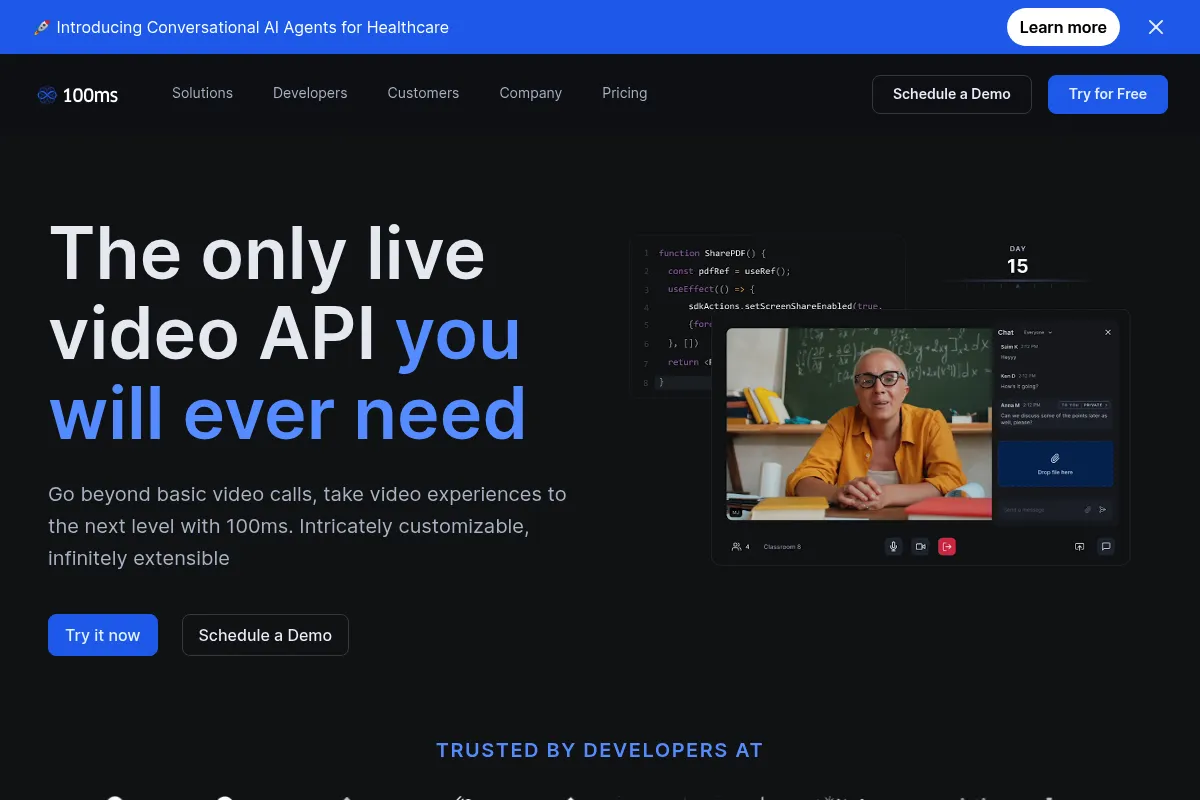
100ms is a live video and audio infrastructure platform designed to simplify WebRTC implementation. It provides the backend servers and frontend SDKs necessary to embed real-time communication into web and mobile applications without managing global infrastructure.
Official profiles
What it actually does
The platform handles signaling, media routing, and recording for live interactions. Developers use its SDKs to create video conferences, interactive webinars, and audio-only rooms, with options for server-side recording and RTMP/HLS streaming to larger audiences.
What makes it different
100ms distinguishes itself with 'Prebuilt,' a fully functional, customizable video room component that reduces integration time from weeks to hours. Unlike older competitors that provide raw media streams, 100ms manages the state of the room, including roles, permissions, and UI states, out of the box.
Ratings across the web

Ratings aggregated from independent review platforms.
Key Features
100ms Prebuilt
A ready-to-use video UI that handles device setup, chat, and participant lists with minimal code.
Adaptive Bitrate Switching
Automatically adjusts video quality based on individual user network conditions to prevent drops.
Server-side Plugins
Enables features like transcription and noise removal without taxing the user's local CPU.
Role-based Access Control
Define specific permissions for hosts, speakers, and listeners directly in the dashboard.
HLS Interactive Live Streaming
Allows viewers to interact with the stream (polls, chat) with sub-second latency.
Webhooks and Analytics
Real-time alerts for session events and detailed post-call quality metrics.
Recording Templates
Configure how composite recordings look, including grid views or specific active speaker layouts.
Pricing
Free Tier
- 10,000 free minutes every month
- Access to all SDKs and Prebuilt UI
- Community support
- Standard video and audio features
Pay As You Go
- Video: $0.004 per participant/min
- Audio: $0.001 per participant/min
- HLS: $0.001 per viewer/min
- Recording: $0.015 per min
- Email support
Enterprise
- Volume discounts
- Dedicated support engineer
- HIPAA compliance and BAA
- Custom deployment options
Pricing checked 5 months ago
Pricing guidance
- When you exceed 10,000 minutes per month
- When you require HIPAA compliance for healthcare apps
- When you need dedicated technical support for high-stakes live events
- Recording is billed separately from the live session minutes
- RTMP streaming to YouTube/Twitch incurs additional costs per minute
- Storage for recordings is charged monthly if not moved to your own S3 bucket
Competitive and transparent compared to legacy providers, though costs scale linearly with audience size.
Pros & Cons
Strengths
-
Superior Developer Experience
The documentation is modern, searchable, and includes functional starter kits, which significantly lowers the barrier to entry compared to Agora.
-
Rapid UI Deployment
The Prebuilt component allows teams to ship a production-ready video interface in a single afternoon, bypassing months of UI/UX development.
-
Predictable State Management
The SDK handles the complex logic of who is speaking, who is muted, and who has joined, which is traditionally the hardest part of WebRTC apps.
-
Generous Free Tier
10,000 free minutes every month allows for extensive prototyping and small-scale production use without upfront costs.
Weaknesses
-
Usage-based cost complexity
Pricing is calculated per participant minute and varies by resolution; high-definition video or large rooms can lead to unexpected billing spikes.
Affects: Bootstrapped startups and apps with unpredictable traffic
-
Dashboard Latency
The management console can occasionally be slow to update session data or reflect configuration changes.
Affects: Operations teams monitoring live events
-
Limited Legacy Browser Support
As a modern WebRTC provider, performance on very old browser versions or obscure mobile browsers can be inconsistent.
Affects: Applications targeting users in developing markets with older hardware
Real User Sentiment
Users generally praise the platform for its ease of integration and high-quality documentation, though some express caution regarding the cost of scaling large rooms.
Users tend to like
- The 'Prebuilt' UI saves massive amounts of development time
- React hooks make state management intuitive
- Responsive technical support on Discord and Slack
- Clear and modern documentation
Users commonly complain about
- Pricing for HLS and recording can add up quickly
- Occasional bugs in the Flutter SDK
- The dashboard UI can be unintuitive for non-technical users
Recurring tradeoffs
- You trade granular control over the media stack for significantly faster development speed.
Happiest users
React and Flutter developers building MVPs or specialized communication tools like virtual classrooms.
Often frustrated
Developers trying to build ultra-low-cost apps for massive audiences where every fraction of a cent in usage fees matters.
Use Cases
Virtual Classrooms
Using the whiteboard and gallery view to facilitate online learning.
Telehealth
Secure, encrypted video calls between doctors and patients with HIPAA compliance.
Social Gaming
Adding 'proximity audio' or small group video chat to interactive web experiences.
Live Commerce
Hosting shoppable livestreams with low-latency HLS for thousands of viewers.
Internal Tools
Adding quick video sync capabilities to a company's proprietary project management software.
Frequently Asked Questions
How does 100ms compare to Agora?
100ms offers a much better developer experience with modern SDKs and a 'Prebuilt' UI that Agora lacks. While Agora has a larger global footprint and more legacy features, 100ms is typically faster to implement for web and mobile developers using React or Flutter.
Is 100ms a good alternative to Twilio Video?
Yes, 100ms is one of the primary recommendations for Twilio Video migrators. It offers a similar high-level API approach and has published specific migration guides to help Twilio users transition their infrastructure.
What are the limitations of the free plan?
The free plan includes 10,000 minutes per month. Once you hit this limit, your service will be suspended unless you add a credit card to move to the Pay As You Go tier. It includes all core features but lacks enterprise-grade support.
Does 100ms support HIPAA compliance?
Yes, 100ms supports HIPAA compliance and will sign a Business Associate Agreement (BAA), but this is typically reserved for customers on the Enterprise or higher-tier growth plans.
Can I record my video calls?
Yes, 100ms supports server-side recording. You can record the entire room as a single composite file or record individual participant streams. These can be stored by 100ms or automatically uploaded to your own AWS S3 bucket.
How many participants can join a single 100ms room?
For standard real-time video calls, 100ms supports up to 100 participants with low latency. For larger audiences, you should use their interactive HLS streaming, which can scale to 10,000+ viewers.
Why trust this page?
This evaluation combines product positioning, pricing analysis, traffic and market signals, and public user sentiment into a single decision-support page. Content is generated editorially — not copied from the vendor's website.
Funding & Company
Founded
2020
Stage
Series a
Total Raised
$24.5M
Latest Round
Series A (Mar 2022)
Notable Investors
100ms has raised a total of $24.5 million over two rounds, a Seed and a Series A. The funding, with its most recent round in March 2022, is aimed at expanding its video engineering team and enhancing product capabilities.
Market Signals & Traffic
Estimated visits, global rank, geography, traffic sources, monthly visit trends, and organic search keywords (Similarweb)—on a dedicated page built for depth and search.
- Estimated visits
- 72,251
- Global rank
- #421,547
- Snapshot
- Apr 2026
- Traffic trend
- Cooling
Estimated monthly visits
Alternatives to 100ms
View all alternativesSimilar Tools
Agora.io
Communication, Developer Tools

Real-time engagement platform for voice, video, and live streaming.
Activepieces
Automation, Developer Tools, Marketing Automation

Open-source workflow automation platform for connecting apps and tasks.
E2B
Developer Tools, Automation & Agents

Secure cloud sandboxes for running code and AI agents
Monity
Automation & Agents, Data Extraction, SEO

Monitor website changes and automate browser tasks using natural language.
Retell AI
Communication, Automation & Agents, AI Assistant

Build and deploy human-like conversational voice agents for business.
Zep
Developer Tools, Automation & Agents
Long-term memory and data persistence layer for LLM applications.