

An open-source automation engine that balances Zapier-style simplicity with the data sovereignty of self-hosting, making it the go-to for privacy-conscious teams and AI-first developers.
Excellent for teams needing self-hosted control and AI agent orchestration, weaker for those requiring thousands of niche SaaS integrations.
Analysis based on product data, pricing structure, traffic signals, and public user sentiment.
Who Should Use Activepieces?
Typical users
Developers, IT operations managers, and digital agencies who want to avoid the 'task tax' of proprietary platforms.
Maturity fit
scaling
Choose this if…
- You need to keep sensitive data within your own infrastructure via self-hosting
- Your workflows involve high-volume tasks that would be cost-prohibitive on Zapier
- You want to build custom integrations using standard TypeScript instead of proprietary SDKs
- You are building AI-driven agents that require native LLM orchestration
Skip this if…
- You rely on obscure, niche SaaS tools not yet supported in their 600+ app library
- You have zero technical resources to manage a Docker-based self-hosted instance
- You require the extreme visual complexity and advanced mapping logic found in Make
About Activepieces
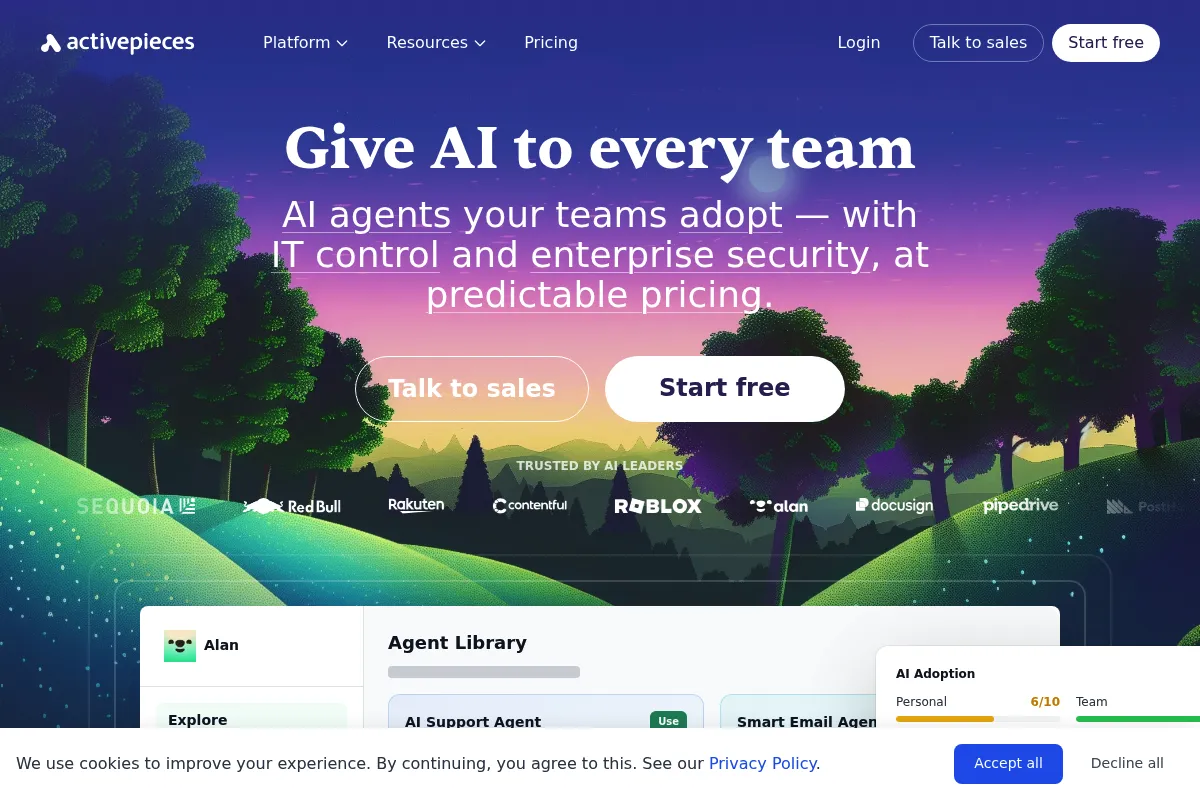
Activepieces is an open-source, MIT-licensed automation platform designed as a more flexible and affordable alternative to Zapier. It allows users to build workflows through a polished no-code interface while offering developers the ability to extend the platform with custom code and self-hosted deployments.
What it actually does
It connects disparate business applications to automate data transfer and repetitive tasks. Users create 'flows' triggered by events—like a new CRM lead or a webhook—which then execute a series of actions across other apps, including AI processing steps.
What makes it different
Unlike its competitors, Activepieces uses a 'pieces' architecture where every integration is an open-source TypeScript module. It is uniquely positioned as 'AI-first,' featuring native support for the Model Context Protocol (MCP) and multi-agent orchestration that goes beyond simple prompt-response steps.
Ratings across the web

Ratings aggregated from independent review platforms.
Key Features
Self-Hosted Community Edition
Run unlimited tasks on your own hardware for free.
TypeScript Pieces
Build and maintain custom connectors using standard web development tools.
AI Agent Steps
Orchestrate complex LLM tasks like data extraction and categorization natively.
Unlimited Tasks (Paid Plans)
Move away from per-execution billing to a more predictable flow-based model.
Visual Debugger
Identify failures by inspecting the exact data passed between steps in real-time.
Human-in-the-loop
Pause flows for manual approval or input before proceeding to the next action.
Git Sync
Manage your automation workflows using version control for enterprise-grade deployments.
Embedded Framework
Developers can embed the Activepieces builder directly into their own SaaS products.
Pricing
Cloud Free
- 1,000 tasks/month
- Unlimited flows
- AI steps included
- Custom code steps
Cloud Plus
- Unlimited tasks
- 10 active flows
- AI Agent orchestration
- Unlimited tables
- 500 AI credits
Cloud Business
- Unlimited tasks
- 50 active flows
- 10 projects
- Custom RBAC
- Audit logs
Self-Hosted Community
- Unlimited tasks
- Unlimited flows
- Full data control
- MIT Licensed
Pricing checked 6 months ago
Pricing guidance
- When you exceed 1,000 tasks on the free cloud tier
- When you need more than 10 active flows on the Plus plan
- When you require enterprise features like SSO or Audit Logs
- The $25 Plus plan limits you to 10 active flows
- AI credits are consumed for native AI steps and may require top-ups
- Self-hosted Community edition lacks team collaboration and project management features
Aggressively competitive, aiming to disrupt the high-margin usage-based pricing of established players.
Pros & Cons
Strengths
-
Predictable pricing model
By offering unlimited tasks on paid plans, it eliminates the 'success penalty' where growing businesses are punished with massive overage fees.
-
Superior data privacy
The ability to self-host ensures that credentials and sensitive customer data never leave your private network, a requirement for HIPAA or GDPR compliance.
-
Developer-centric extensibility
Because it's open-source and uses TypeScript, developers can fix bugs in integrations themselves rather than waiting for a vendor's roadmap.
-
Modern AI integration
Native support for AI agents and MCP makes it easier to build 'intelligent' workflows compared to the bolted-on AI features of older platforms.
Weaknesses
-
Smaller integration ecosystem
With roughly 600 integrations, it significantly trails Zapier’s 7,000+, meaning you may still need webhooks for niche tools.
Affects: Users of specialized or legacy industry software
-
Self-hosting maintenance
While the software is free to self-host, the 'hidden' cost is the engineering time required for server maintenance, updates, and troubleshooting.
Affects: Small teams without dedicated DevOps support
-
Younger platform maturity
Users report occasional UI bugs and less comprehensive documentation for complex edge cases compared to Make or Zapier.
Affects: Enterprise users requiring 99.99% platform stability
Real User Sentiment
Generally enthusiastic, with users praising the clean UI and the freedom of the open-source model.
Users tend to like
- Ease of self-hosting with Docker
- Clean, modern interface that mimics Zapier's simplicity
- Predictable flat-rate pricing
- Active community and responsive developers
Users commonly complain about
- Missing specific app integrations
- Occasional bugs in community-contributed pieces
- Documentation can be sparse for advanced self-hosting configurations
Recurring tradeoffs
- Users trade a massive app library (Zapier) for lower costs and better data control.
Happiest users
Developers and tech-savvy agencies who prioritize privacy and extensibility over a massive integration count.
Often frustrated
Non-technical marketers who need a specific, obscure tool to work out-of-the-box without using webhooks.
Use Cases
Privacy-First Lead Routing
Syncing healthcare or financial leads from forms to a CRM without data leaving your server.
High-Volume Content Distribution
Automatically cross-posting thousands of social media updates without per-task fees.
AI-Powered Support
Using LLMs to categorize incoming support tickets and draft replies directly in Slack.
Custom Internal Tooling
Building bespoke integrations for internal databases using the TypeScript piece framework.
Automated Data Archiving
Moving large volumes of logs or records between cloud storage and local databases.
Frequently Asked Questions
How does Activepieces compare to Zapier?
Activepieces is open-source and can be self-hosted, whereas Zapier is proprietary and cloud-only. While Zapier has 7,000+ integrations, Activepieces offers a more affordable flat-rate pricing model and is easier for developers to extend with custom code.
Is Activepieces really free to self-host?
Yes, the Community Edition is MIT-licensed and free to run on your own servers with unlimited tasks. However, you are responsible for your own server costs and maintenance.
Can I build my own integrations?
Yes. Activepieces is built on a TypeScript framework that allows developers to create custom 'pieces' (connectors). These can be kept private or contributed back to the community.
Does it support AI and LLMs?
Activepieces is 'AI-first,' featuring native steps for OpenAI, Anthropic, and others. It also supports the Model Context Protocol (MCP), allowing you to use your automations as tools for AI agents.
What are the limitations of the free cloud plan?
The free cloud plan is limited to 1,000 tasks per month. If you need more, you must upgrade to a paid plan or switch to the self-hosted version.
Is it secure for enterprise use?
Yes, it is SOC 2 Type II compliant. For maximum security, the self-hosted version allows you to run the platform entirely within your own firewall, ensuring no data is shared with Activepieces.
Why trust this page?
This evaluation combines product positioning, pricing analysis, traffic and market signals, and public user sentiment into a single decision-support page. Content is generated editorially — not copied from the vendor's website.
Funding & Company
Founded
2022
Stage
Seed
Total Raised
$500K
Latest Round
Seed (Jul 2022)
Notable Investors
Activepieces has raised a total of $500,000 in a single Seed round from Y Combinator in 2022. This initial funding supports the development of its open-source, no-code automation platform.
Market Signals & Traffic
Estimated visits, global rank, geography, traffic sources, monthly visit trends, and organic search keywords (Similarweb)—on a dedicated page built for depth and search.
- Estimated visits
- 223,629
- Global rank
- #167,024
- Snapshot
- Apr 2026
- Traffic trend
- Surging
Estimated monthly visits
Alternatives to Activepieces
View all alternativesZapier AI
Productivity, Automation

Automate tasks and workflows between your favorite apps without code.
Make AI
Automation & Agents, Developer Tools

Visual platform to connect apps and automate workflows without code.
n8n
Automation, Automation & Agents, Developer Tools

Workflow automation platform for connecting apps and building complex sequences.
Similar Tools
Alby
AI Assistant, Automation & Agents, Marketing Automation

Shopping agent for e-commerce product discovery and customer support
Granola
AI Assistant, Documentation

An AI notepad that automatically transcribes and summarizes your meetings.
Sanctuary AI
Automation & Agents, Research

General-purpose humanoid robots designed to perform diverse physical tasks.
Simplai
Automation & Agents, Productivity, Workflow

Automate business workflows and manage communications with intelligent agents.
Obviously AI
Automation, Developer Tools, Research

No-code platform for building and deploying predictive machine learning models.
Mammouth AI
Automation & Agents, Workflow, Productivity

Build and deploy autonomous agents for complex workflow automation