

Sanctuary AI
A high-dexterity humanoid robotics platform focused on general-purpose labor, currently best suited for enterprise R&D and pilot programs rather than immediate off-the-shelf deployment.
Excellent for complex manipulation tasks in controlled industrial environments, weaker for organizations seeking a plug-and-play automation solution.
Analysis based on product data, pricing structure, traffic signals, and public user sentiment.
Who Should Use Sanctuary AI?
Typical users
Enterprise innovation leads, logistics R&D teams, and robotics researchers at large-scale manufacturing or retail firms.
Maturity fit
advanced
Choose this if…
- You need a robot with human-like hand dexterity for fine motor tasks
- Your priority is testing the future of general-purpose labor over specific fixed-arm automation
- You have the infrastructure to support pilot-stage hardware and teleoperation training
Skip this if…
- You need an immediate ROI on a specific, simple picking task
- You lack a dedicated engineering team to manage complex robotics integration
- Your budget is restricted to proven, commercially available industrial cobots
About Sanctuary AI
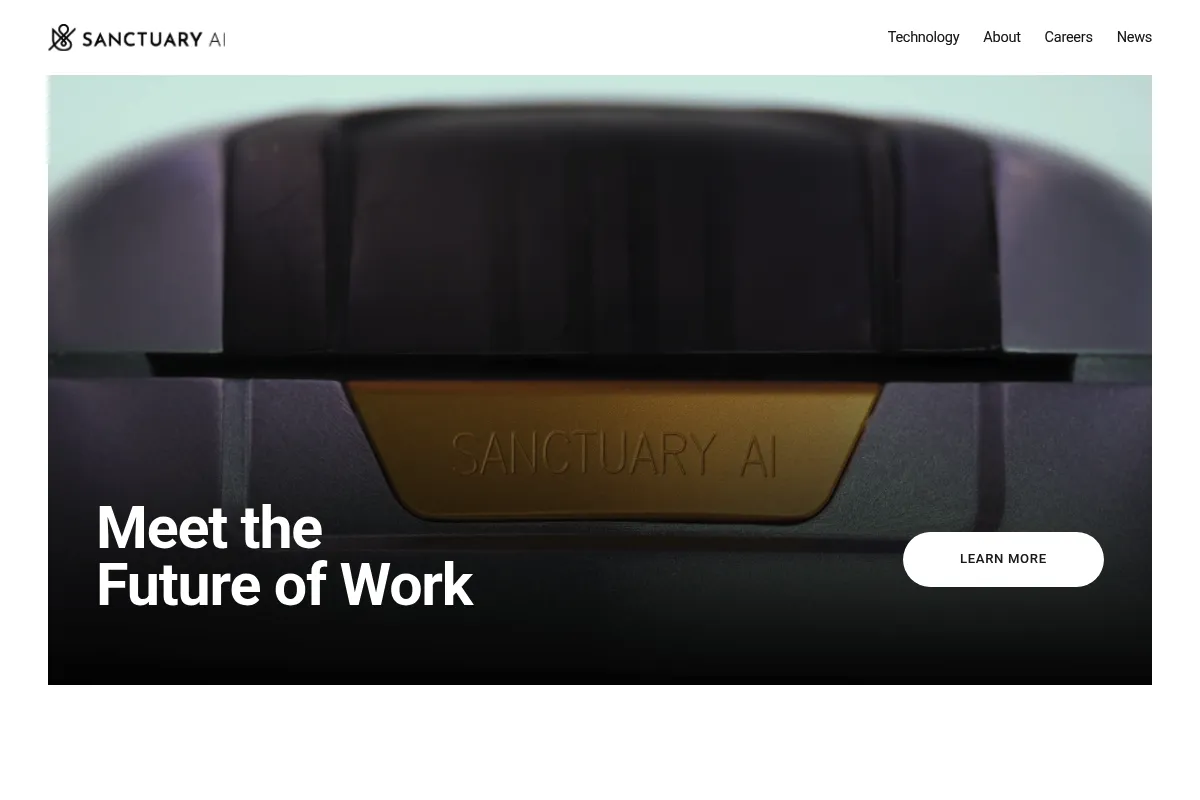
Sanctuary AI develops Phoenix, a humanoid robot designed to perform a wide array of physical tasks. The company focuses on creating a 'General Purpose' machine that can be trained for various roles rather than being hard-coded for a single function.
Official profiles
What it actually does
The platform combines a humanoid hardware frame with the Carbon AI control system to execute physical labor. It uses a mix of teleoperation—where humans teach the robot via VR—and autonomous reinforcement learning to master specific industrial workflows.
What makes it different
Sanctuary AI prioritizes hand dexterity and 'Large Behavior Models' over simple mobility. While competitors often focus on walking, Sanctuary’s Phoenix is engineered specifically to match the 20 degrees of freedom found in human hands, making it more capable of intricate manipulation.
Key Features
Carbon AI Control System
Translates high-level goals into precise physical movements and reasoning.
High-Dexterity Hands
Mimics human grip and finger movement for handling varied objects.
Teleoperation Training
Enables human operators to teach the robot new tasks in real-time using VR.
Modular Hardware Design
Simplifies maintenance and allows for faster hardware iterations.
Large Behavior Models (LBM)
Uses data from human demonstrations to build a library of physical actions.
Industrial Integration
Designed to fit into existing human-centric workspaces without major modifications.
Pricing
Enterprise Pilot
- Phoenix humanoid hardware
- Carbon AI software license
- On-site deployment support
- Custom task training and optimization
- Teleoperation hardware kit
Pricing checked 6 months ago
Pricing guidance
- Moving from R&D testing to multi-unit facility deployment
- Requiring 24/7 autonomous operation support
- Hardware maintenance costs are likely high due to the complexity of humanoid joints
- Connectivity requirements for teleoperation and cloud-based AI processing
Premium enterprise positioning with pricing tailored to large-scale industrial innovation budgets.
Pros & Cons
Strengths
-
Superior hand dexterity
The focus on fine motor skills allows Phoenix to handle tasks like folding clothes or sorting small parts that traditional industrial robots struggle with.
-
Human-in-the-loop training
The teleoperation system allows for rapid data collection, meaning the robot can be 'taught' a new task in days rather than months of coding.
-
General-purpose potential
Unlike a fixed-arm robot, the humanoid form factor allows it to use tools and navigate spaces designed for people.
Weaknesses
-
Not commercially available for SMBs
Current deployment is limited to strategic enterprise partners and pilot programs, making it inaccessible for smaller operations.
Affects: Small to medium-sized businesses
-
High technical overhead
Operating and maintaining a humanoid fleet requires significant specialized engineering talent on-site.
Affects: Operations teams
-
Autonomy is still task-specific
While the robot is 'general purpose,' it still requires individual training for each specific workflow to reach high reliability.
Affects: Scaling speed
Real User Sentiment
Generally positive among the robotics community for their engineering-first approach, though some skepticism remains regarding the timeline for full autonomy.
Users tend to like
- Exceptional hand and finger movement
- Practical focus on industrial tasks over 'stunt' movements
- Strong partnership network with established manufacturers
Users commonly complain about
- Lack of public technical documentation
- Limited information on battery life and duty cycles
- High barrier to entry for non-enterprise users
Recurring tradeoffs
- Choosing hydraulic power (in older models) for strength vs. electric for ease of maintenance
- Prioritizing manipulation over walking speed
Happiest users
Innovation labs at Fortune 500 companies looking to future-proof their labor strategy.
Often frustrated
Robotics hobbyists and small business owners who cannot access the technology.
Use Cases
Retail Logistics
Sorting and packing varied merchandise in a warehouse setting.
Manufacturing
Performing repetitive assembly tasks that require human-like dexterity.
Quality Inspection
Using vision and touch to identify defects in complex parts.
Hazardous Environments
Using teleoperation to perform tasks in areas unsafe for humans.
Research & Development
Testing the limits of Large Behavior Models in physical environments.
Frequently Asked Questions
How much does a Sanctuary AI robot cost?
Pricing is not public. Sanctuary AI currently operates via enterprise partnerships and pilot programs. Expect costs to be in the high six-figure range per unit for early-stage deployment, including support and software.
How does Phoenix compare to Tesla Optimus?
While Optimus is designed for mass-market production and general mobility, Sanctuary’s Phoenix focuses more heavily on hand dexterity and industrial manipulation. Sanctuary has also been more active in real-world retail pilot programs.
Is the robot fully autonomous?
Not entirely. It uses a 'human-in-the-loop' model where humans train the robot via teleoperation. Once a task is mastered, the Carbon AI system can execute it autonomously, but it is not yet a 'general intelligence' that can perform any task without prior training.
What is the Carbon AI system?
Carbon is the proprietary software platform that acts as the robot's brain. It integrates sensing, reasoning, and acting, using reinforcement learning and human demonstrations to build a library of physical behaviors.
Can I buy one for my small business?
No. Sanctuary AI is currently focused on large-scale enterprise deployments. There is no consumer or small-business version of the Phoenix robot available at this time.
What are the power requirements and battery life?
Specific battery specs for the 7th generation Phoenix are not public, but humanoid robots in this class typically target 4–8 hours of operational time depending on the intensity of the physical tasks.
Why trust this page?
This evaluation combines product positioning, pricing analysis, traffic and market signals, and public user sentiment into a single decision-support page. Content is generated editorially — not copied from the vendor's website.
Funding & Company
Founded
2018
Stage
Late stage
Total Raised
$119M
Latest Round
Undisclosed (Jul 2024)
Notable Investors
Sanctuary AI has raised approximately $119 million USD from a mix of corporate venture arms, strategic partners, and government funds. Its funding is characterized by strong backing from industry leaders like Magna and Bell, as well as significant non-dilutive government grants, indicating strong national and industrial strategic alignment.
Market Signals & Traffic
Estimated visits, global rank, geography, traffic sources, monthly visit trends, and organic search keywords (Similarweb)—on a dedicated page built for depth and search.
- Estimated visits
- 30,592
- Global rank
- #944,000
- Snapshot
- Apr 2026
- Traffic trend
- Steady
Estimated monthly visits
Alternatives to Sanctuary AI
View all alternativesFigure
Automation & Agents, Workflow

General-purpose humanoid robots designed for manual labor and automation.
1X
Automation & Agents, Productivity

Humanoid robots designed to work alongside people in everyday environments.
Similar Tools
Anduril
Automation & Agents, Research

Autonomous defense systems and software for national security operations.
adaptAI
AI Assistant, Automation & Agents, Developer Tools
Consulting and development platform for mid-sized business automation solutions.
Simplex
Automation & Agents, Developer Tools, Workflow

Platform for building and deploying autonomous task-oriented agents
DSPy
Developer Tools, Research, Automation

Framework for programming and optimizing language model pipelines.
Cerebras
Developer Tools, Automation & Agents

High-speed infrastructure for large-scale model inference and training
Upstage
Developer Tools, Data Extraction, AI Assistant

Enterprise large language models and intelligent document processing solutions.