

Cerebras
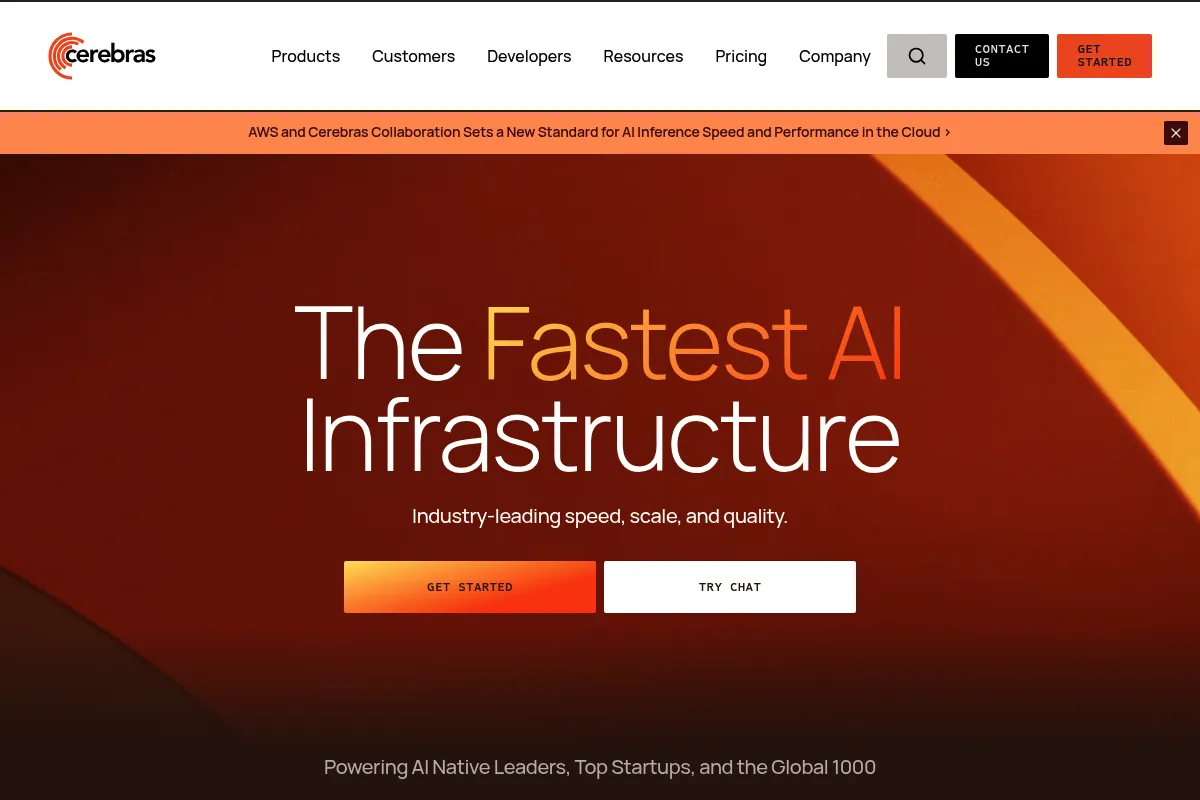
High-speed inference infrastructure built on proprietary wafer-scale hardware, optimized for developers needing sub-second latency for large language models.
Excellent for real-time interactive agents requiring extreme token throughput, weaker for teams requiring deep CUDA-level customization or niche model support.
Analysis based on product data, pricing structure, traffic signals, and public user sentiment.
Who Should Use Cerebras?
Typical users
ML engineers and backend developers building voice assistants, real-time translation tools, or high-throughput RAG pipelines.
Maturity fit
scaling to advanced
Choose this if…
- Your application requires instantaneous responses (1,000+ tokens/sec).
- You want an OpenAI-compatible API to replace slow GPU providers.
- Your priority is minimizing time-to-first-token for interactive UX.
Skip this if…
- You need to run highly customized model architectures not yet supported by their compiler.
- Your workflow is strictly dependent on the NVIDIA/CUDA ecosystem for specific kernels.
- You require a wide variety of niche, fine-tuned models beyond the Llama and Mistral families.
About Cerebras
Cerebras is a hardware and software company that manufactures the Wafer-Scale Engine (WSE-3), the world's largest single silicon chip designed specifically for AI. It provides a cloud-based inference service and physical supercomputing clusters to bypass the memory and communication bottlenecks inherent in traditional GPU clusters.
Official profiles
What it actually does
The platform offers a serverless API for running frontier LLMs like Llama 3.1 at speeds significantly faster than standard H100 clusters. Developers get instant access to high-throughput inference without managing hardware, while enterprises can purchase CS-3 systems for massive-scale model training.
What makes it different
Unlike NVIDIA GPUs that link thousands of small chips via cables, Cerebras puts the entire processing power on a single wafer-sized chip. This architecture eliminates the 'memory wall,' allowing data to move between cores and memory at speeds that traditional interconnects cannot match.
Key Features
Wafer-Scale Engine (WSE-3)
Provides 4 trillion transistors on one chip to eliminate data bottlenecks.
Cerebras Inference API
Delivers up to 20x the speed of traditional GPU clouds for Llama models.
CSoft Software Stack
Compiles standard PyTorch and TensorFlow code for wafer-scale execution.
MemoryX Technology
Enables the system to support models with up to 120 trillion parameters.
SwarmX Interconnect
Scales multiple CS-3 systems into a single logical supercomputer.
Instant Model Switching
Allows the cloud API to handle multiple model versions without cold starts.
Predictable Latency
Maintains high throughput even under heavy concurrent user loads.
Pricing
Free Tier
- Limited rate limits
- Access to Llama 3.1 8B and 70B
- Community support
- Standard API access
Developer (Pay-as-you-go)
- Llama 3.1 8B at $0.10/1M tokens
- Llama 3.1 70B at $0.60/1M tokens
- Higher rate limits
- Standard support
Enterprise
- Dedicated CS-3 hardware instances
- Custom model training support
- SLA-backed uptime
- VPC and on-premise deployment options
Pricing checked 5 months ago
Pricing guidance
- When your application moves from prototype to production traffic.
- When you require guaranteed throughput for high-concurrency events.
- When you need to train custom models on private datasets using CS-3 hardware.
- Rate limits are strictly enforced on the API to maintain speed for all users.
- Pricing for the 405B model is significantly higher and may require specific approval.
Aggressively competitive pricing designed to undercut traditional GPU cloud providers while offering superior speed.
Pros & Cons
Strengths
-
Industry-leading inference speed
Achieving over 1,800 tokens per second on Llama 3.1 8B makes real-time voice and complex agentic workflows viable.
-
Drop-in API compatibility
The API follows the OpenAI format, meaning developers can switch from slower providers by changing a single base URL and API key.
-
Superior price-to-performance
By utilizing more efficient hardware, they offer lower costs per million tokens compared to many premium GPU-based providers.
-
Elimination of GPU cluster complexity
For training, the single-node architecture removes the need for complex distributed programming and manual model sharding.
Weaknesses
-
Limited model library
While they support the most popular open models, they lack the breadth of providers like Together AI or Fireworks which host hundreds of fine-tuned variants.
Affects: Developers using niche or highly specialized open-source models.
-
Proprietary hardware lock-in
Optimizing for Cerebras means moving away from the standard CUDA ecosystem, which can make migrating back to GPUs difficult if specific optimizations are used.
Affects: Infrastructure teams prioritizing multi-cloud or hardware-agnostic stacks.
-
Early-stage cloud ecosystem
The developer dashboard and monitoring tools are functional but less mature than established giants like AWS or Azure.
Affects: Enterprise DevOps teams requiring deep observability and integrated billing.
Real User Sentiment
Users are generally impressed by the 'instant' feel of the inference, though some remain cautious about the long-term viability of non-NVIDIA hardware.
Users tend to like
- Unprecedented token generation speed
- Ease of switching from OpenAI API
- Low latency for 70B parameter models
Users commonly complain about
- Limited selection of models compared to competitors
- Occasional rate-limiting during peak demand
- Lack of extensive documentation for custom kernel development
Recurring tradeoffs
- You trade the flexibility of the CUDA ecosystem for raw performance on supported models.
Happiest users
Developers building voice-to-voice agents or real-time search interfaces where every millisecond counts.
Often frustrated
Researchers trying to run experimental model architectures that haven't been optimized for the wafer-scale compiler.
Use Cases
Voice AI
Reducing lag in conversational agents to make interactions feel human.
Real-time Translation
Processing large blocks of text instantly for live streaming or meetings.
High-Throughput RAG
Scanning massive document sets and generating summaries in seconds.
Agentic Workflows
Running multiple LLM calls in sequence without the cumulative latency killing the UX.
Large-Scale Training
Training frontier-scale models without the networking headaches of GPU clusters.
Frequently Asked Questions
How much does Cerebras inference cost?
Cerebras uses a pay-as-you-go model. Llama 3.1 8B is priced at approximately $0.10 per 1 million tokens, and Llama 3.1 70B is priced at $0.60 per 1 million tokens. This is highly competitive with other fast inference providers like Groq and Together AI.
Is Cerebras faster than Groq?
Both are significantly faster than traditional GPUs. While benchmarks fluctuate, Cerebras currently leads in raw throughput for Llama 3.1 70B and 405B models due to the massive on-chip memory of the Wafer-Scale Engine, which handles larger models more efficiently than Groq's LPU clusters.
Can I run my own fine-tuned model on Cerebras?
Currently, Cerebras Cloud focuses on popular frontier models like Llama 3.1. Support for custom fine-tuned weights is rolling out, but it is not as 'self-serve' as providers like Fireworks.ai. For massive custom training, you would typically use their CS-3 hardware.
Does Cerebras support OpenAI's API format?
Yes, the Cerebras Cloud API is designed to be a drop-in replacement for OpenAI. You can use the standard OpenAI Python or Node.js libraries by simply changing the `base_url` to point to Cerebras and using your Cerebras API key.
What are the main limitations of Cerebras?
The primary limitation is model variety. Because their hardware requires a specific compilation step to run at peak speed, they cannot instantly support every new model that drops on Hugging Face. You are limited to the models they have officially optimized.
Do I need to learn a new programming language to use it?
No. For inference, you use standard REST APIs. For training, their CSoft stack integrates with PyTorch and TensorFlow, allowing you to use familiar frameworks while the compiler handles the hardware-specific optimizations.
Why trust this page?
This evaluation combines product positioning, pricing analysis, traffic and market signals, and public user sentiment into a single decision-support page. Content is generated editorially — not copied from the vendor's website.
Funding & Company
Founded
2015
Stage
Public
Total Raised
$8.37B
Latest Round
IPO (May 2026)
Notable Investors
Cerebras Systems has raised a significant total of over $2.8 billion in equity funding before going public in May 2026 with a successful IPO that raised an additional $5.5 billion. This substantial capital from top-tier investors like Benchmark, Coatue, and Fidelity underscores strong market confidence in its specialized AI hardware. The consistent and large funding rounds, culminating in a public offering, provide a very strong foundation for long-term stability and product development.
Market Signals & Traffic
Estimated visits, global rank, geography, traffic sources, monthly visit trends, and organic search keywords (Similarweb)—on a dedicated page built for depth and search.
- Estimated visits
- 0
- Global rank
- —
- Snapshot
- May 2026
- Traffic trend
- Cooling
Estimated monthly visits
Alternatives to Cerebras
View all alternativesGroq
Developer Tools, AI Assistant

AI inference acceleration platform with specialized LPU chips.
SambaNova
Developer Tools, Automation & Agents

Full-stack platform for high-speed AI inference and model deployment.
Amazon CodeWhisperer
Developer Tools

AI-powered coding companion that generates code recommendations.
Similar Tools
AgentOps
Developer Tools, Automation & Agents

Observability and monitoring platform for developers building autonomous agents
Cohere
Developer Tools, Automation & Agents

Enterprise large language models for search, discovery, and generation.
Zep
Developer Tools, Automation & Agents

Long-term memory and data persistence layer for LLM applications.
E2B
Developer Tools, Automation & Agents

Secure cloud sandboxes for running code and AI agents
Plandex
Developer Tools, Automation & Agents

Terminal-based coding engine for complex multi-file development tasks
Algolia
Developer Tools, Automation & Agents

API-first search and discovery platform for websites and apps.