
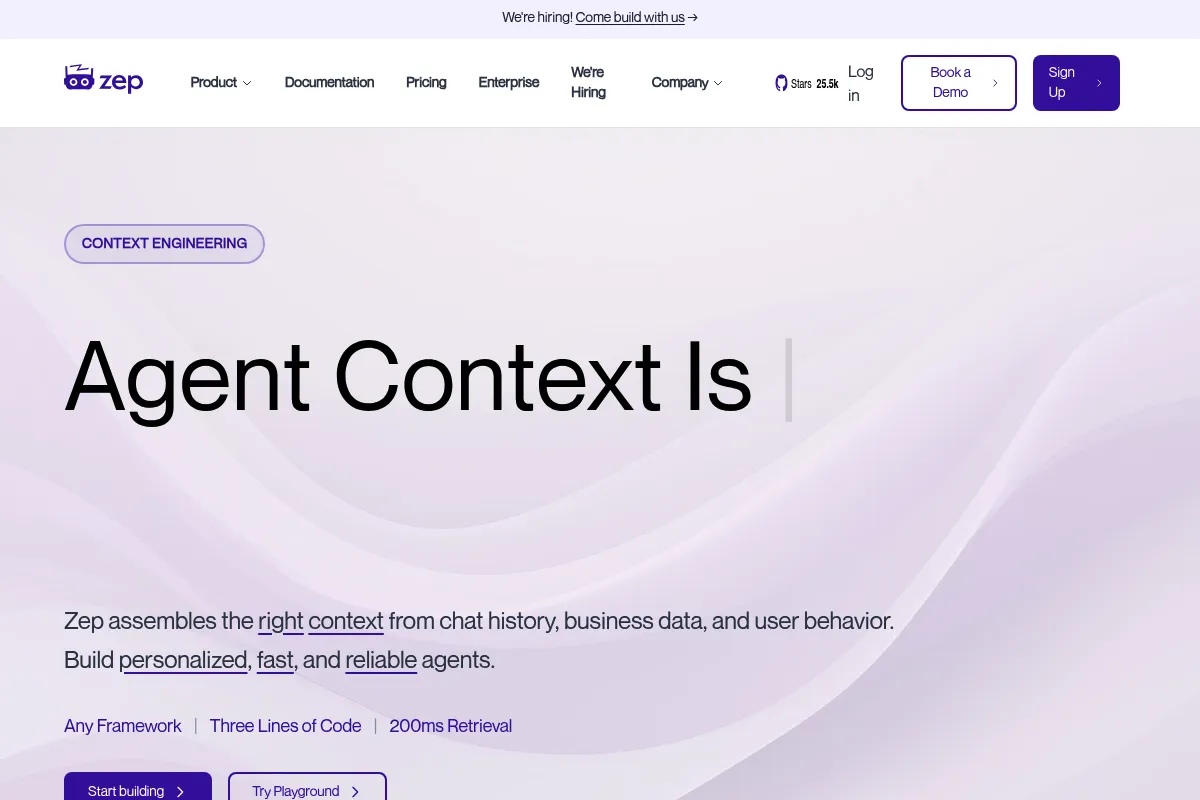
Zep is a specialized memory and data persistence layer that automates the heavy lifting of managing LLM chat histories, summarization, and long-term context retrieval.
Excellent for developers building production-grade agents that require persistent user memory, weaker for simple RAG apps where basic vector search suffices.
Analysis based on product data, pricing structure, traffic signals, and public user sentiment.
Who Should Use Zep?
Typical users
Software engineers and AI architects building multi-turn chat applications or autonomous agents that need to 'remember' users across sessions.
Maturity fit
scaling to advanced
Choose this if…
- You need to maintain long-term user context without manually managing database schemas for chat history
- Your application requires automated summarization of old conversations to save on token costs
- You want a managed service to handle message embedding and vector retrieval specifically for chat
Skip this if…
- You are building a simple one-off Q&A bot that doesn't need to remember past interactions
- You prefer to build your own memory logic using a standard database like Postgres or Redis
- Your data privacy requirements forbid using a third-party cloud provider for chat logs
About Zep
Zep is a long-term memory service for LLM applications that handles the storage, enrichment, and retrieval of chat histories. It exists to solve the 'context window' problem by automatically summarizing old messages and providing a searchable memory bank for agents.
Official profiles
What it actually does
It captures chat messages via API, automatically generates summaries of past interactions, extracts entities, and stores everything in a searchable vector database. When a user returns, the application queries Zep to retrieve relevant past context to inform the LLM's next response.
What makes it different
Unlike general-purpose vector databases, Zep is purpose-built for chat. It treats memory as a temporal sequence, automatically handling the 'forgetting' of irrelevant details through summarization while keeping important facts accessible via hybrid search.
Key Features
Message Window Management
Automatically manages which messages stay in the immediate context and which get summarized.
Entity Extraction
Identifies and stores specific names, places, and facts mentioned in chat for structured retrieval.
Hybrid Search
Combines semantic meaning with exact keyword matching to find specific past interactions accurately.
Auto-Summarization
Reduces token usage by condensing long histories into concise summaries without losing core intent.
Session Management
Groups messages by user session out of the box, removing the need for custom database logic.
Async Enrichment
Processes embeddings and summaries in the background to prevent latency in the user-facing chat loop.
Pricing
Starter
- Up to 1,000 messages/month
- Basic summarization
- Community support
- Standard search
Pro
- Up to 10,000 messages/month
- Advanced entity extraction
- Priority support
- Custom metadata filtering
Team
- Up to 100,000 messages/month
- Dedicated infrastructure options
- SLA guarantees
- Advanced analytics
Pricing checked 5 months ago
Pricing guidance
- When you exceed 1,000 messages per month
- When you need entity extraction to personalize agent behavior
- When you require faster support response times
- Message retention periods may vary by plan
- Rate limits apply to API calls regardless of total monthly volume
Competitively priced for the value of managed infrastructure, though enterprise users will likely negotiate custom contracts.
Pros & Cons
Strengths
-
Reduces token overhead
By summarizing old conversations and only injecting relevant snippets, it prevents the 'context stuffing' that leads to high API bills.
-
Developer velocity
Replaces weeks of custom work building chat persistence, summarization pipelines, and vector indexing with a single API.
-
Low latency retrieval
The architecture is optimized for fast lookups, ensuring that adding memory doesn't noticeably slow down the agent's response time.
Weaknesses
-
Vendor lock-in risk
Moving your entire application's memory layer out of Zep Cloud back to a custom solution requires significant migration effort.
Affects: Teams planning for long-term infrastructure independence
-
Limited to chat-centric use cases
While powerful for agents, it is less flexible than a general vector DB for non-conversational RAG tasks.
Affects: Developers building document-heavy search engines
-
Cloud costs at scale
As message volume grows, the per-message or per-user pricing can become a significant line item compared to self-hosting a database.
Affects: High-traffic B2C applications
Real User Sentiment
Generally positive among developers who find LangChain's built-in memory insufficient for production.
Users tend to like
- Ease of integration with existing LLM frameworks
- Reliability of the auto-summarization feature
- The fact that it handles both vector and relational data for chat
Users commonly complain about
- Documentation can sometimes lag behind rapid feature releases
- Initial setup for the self-hosted version can be complex
Recurring tradeoffs
- Users trade control over the underlying database for the convenience of a managed memory API.
Happiest users
Developers building personalized AI companions or customer support agents that need to remember user preferences over weeks or months.
Often frustrated
Developers who want deep control over the embedding models or the specific summarization prompts used.
Use Cases
Personalized AI Tutors
Remembering a student's past mistakes and progress to tailor new lessons.
Customer Support Bots
Recalling previous issues a customer had to provide continuity without the user repeating themselves.
Sales Agents
Tracking lead interests and previous objections across multiple chat sessions.
Role-playing Games
Maintaining world state and character history in AI-driven narratives.
Executive Assistants
Storing preferences for scheduling, travel, and communication styles.
Frequently Asked Questions
How does Zep compare to Mem0?
Zep focuses heavily on the infrastructure and persistence layer for chat history, including automated summarization and hybrid search. Mem0 (formerly Embedchain/MemGPT concepts) often focuses more on the high-level 'memory' logic and graph-based relationships. Zep is generally seen as more of a 'database-plus' for chat, while Mem0 is an orchestration layer.
Is there a free version of Zep?
Yes, Zep offers a Cloud Free tier with a 1,000-message limit. Additionally, Zep has an Open Source version available on GitHub that you can self-host for free, though you are responsible for managing the infrastructure and associated costs like storage and compute.
Does Zep store my data securely?
Zep Cloud encrypts data at rest and in transit. However, because it stores chat logs to provide memory, teams with strict PII or HIPAA requirements should evaluate the self-hosted Open Source version to keep data within their own VPC.
Can I use Zep with LangChain?
Yes, Zep has first-class integrations with LangChain (both Python and JS/TS). It can be used as a drop-in replacement for LangChain's default memory components, providing a more scalable and persistent backend.
What are the limitations of Zep's summarization?
Zep uses LLMs to generate summaries. While highly effective, the summaries are subject to the same limitations as any LLM output, including potential hallucinations or the omission of very fine-grained details if the conversation is extremely long.
Does Zep support multiple languages?
Yes, because Zep relies on underlying embedding models and LLMs, it supports any language that those models support. The entity extraction and summarization capabilities work across most major languages.
Why trust this page?
This evaluation combines product positioning, pricing analysis, traffic and market signals, and public user sentiment into a single decision-support page. Content is generated editorially — not copied from the vendor's website.
Funding & Company
Founded
2023
Stage
Seed
Total Raised
$2.3M
Latest Round
Pre-Seed (Jan 2024)
Notable Investors
Zep has raised a total of $2.3 million over two rounds, a Seed round in late 2023 followed by participation in Y Combinator's Winter 2024 batch. This funding provides the company with a solid initial runway to develop its core product and establish a foothold in the growing market for AI developer infrastructure.
Market Signals & Traffic
Estimated visits, global rank, geography, traffic sources, monthly visit trends, and organic search keywords (Similarweb)—on a dedicated page built for depth and search.
- Estimated visits
- 137,792
- Global rank
- #232,282
- Snapshot
- Apr 2026
- Traffic trend
- Surging
Estimated monthly visits
Alternatives to Zep
View all alternativesMem0
Developer Tools, Automation & Agents, Productivity

Persistent memory layer for personalized agents and applications.
Pinecone
Developer Tools, Search

Managed vector database for building scalable search and RAG applications
Weaviate
Developer Tools, Search

Open-source vector database for building scalable semantic search applications.
Similar Tools
Agenta
Developer Tools, Automation & Agents

Open-source platform for building, evaluating, and deploying LLM applications.
E2B
Developer Tools, Automation & Agents

Secure cloud sandboxes for running code and AI agents
Cognition
Developer Tools, Automation & Agents

Autonomous software engineer that plans and executes complex coding tasks.
All Hands AI
Developer Tools, Automation & Agents

Open-source platform for autonomous software engineering agents.
Nexa AI
Developer Tools, Automation & Agents

On-device model deployment and optimization for edge computing
Tessl
Developer Tools, Automation & Agents

Package manager for agent skills and development context