

All Hands AI
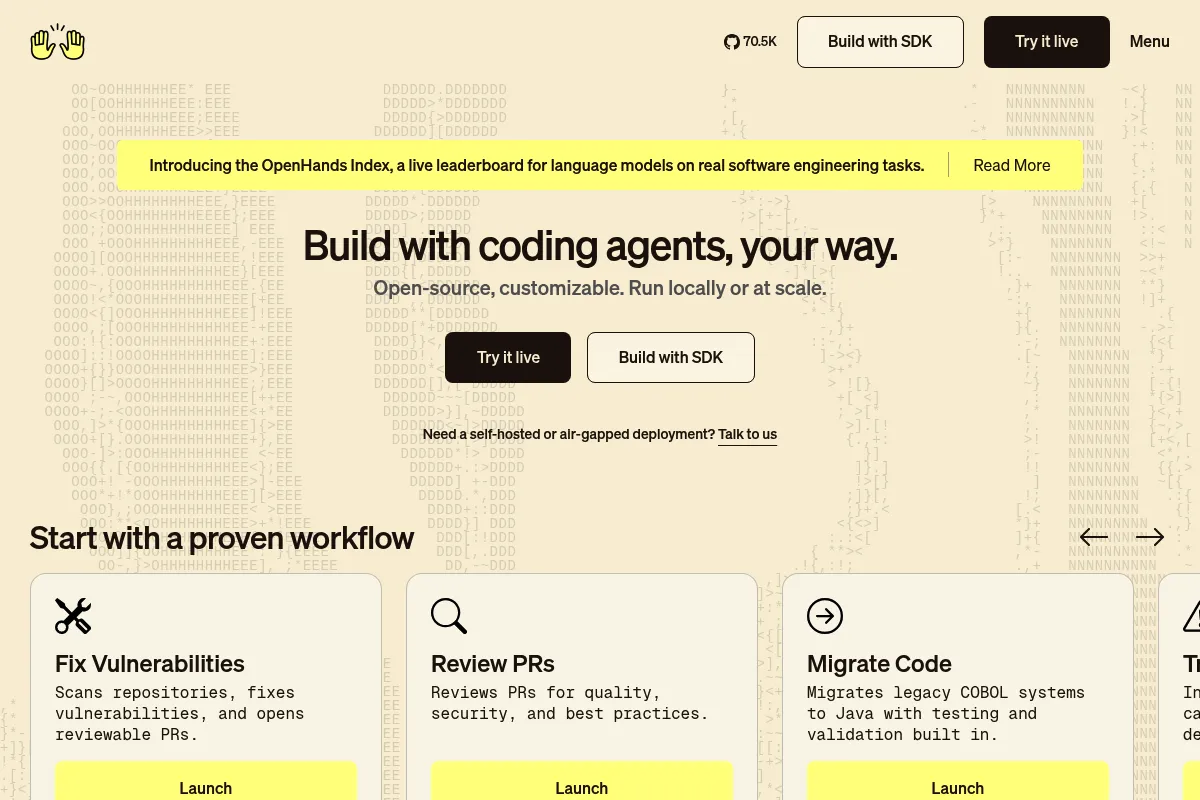
A hosted autonomous AI software engineer built on the open-source OpenHands project, designed to execute coding tasks in a sandboxed environment rather than just suggesting text.
Excellent for developers who want an agent to handle PRs and bug fixes autonomously, but weaker for high-level architectural decisions that require deep business context.
Analysis based on product data, pricing structure, traffic signals, and public user sentiment.
Who Should Use All Hands AI?
Typical users
Software engineers, DevOps teams, and open-source maintainers looking to automate routine coding chores.
Maturity fit
scaling
Choose this if…
- You want an AI that can actually run code and tests in a sandbox
- You prefer an open-source foundation over proprietary 'black box' agents
- Your priority is automating repetitive maintenance tasks like dependency updates or documentation
Skip this if…
- You need 100% accuracy on complex, multi-service architectural changes
- Your security policy prohibits third-party agents from accessing your internal repositories
- You only want simple code completion (stick to GitHub Copilot for that)
About All Hands AI
All-Hands is the commercial entity behind OpenHands (formerly OpenDevin). It provides a managed, cloud-based environment for AI agents to perform end-to-end software engineering tasks including coding, testing, and debugging.
Official profiles
What it actually does
The tool takes natural language prompts and translates them into a series of actions: writing code, executing terminal commands, and browsing the web for documentation. It operates in a secure Docker sandbox to verify that the code it writes actually works before presenting it to the user.
What makes it different
Unlike standard LLM chat interfaces, All-Hands is an 'agentic' system that uses a feedback loop. It sees the errors in its own terminal output and iterates on the solution until the task is successful, rather than just providing a single static response.
Key Features
Event-based Architecture
Allows the agent to react to real-time terminal feedback and browser states.
Sandboxed Runtime
Ensures code execution happens in an isolated environment to protect your local machine.
Browser Tooling
Enables the agent to search the live web for the latest API documentation, reducing hallucinations.
Open-Source Core
Built on OpenHands, allowing users to inspect the underlying logic and contribute to its development.
Task Tracking
Provides a visual timeline of the agent's thoughts, actions, and code changes.
GitHub Action Integration
Can be triggered automatically to respond to issues or pull requests.
Pricing
Open Source (Self-Hosted)
- Full access to OpenHands core
- Self-managed Docker environment
- Use your own LLM API keys
- Community support
Cloud Beta / Early Access
- Managed sandboxed environment
- Priority compute access
- Simplified GitHub integration
- Team collaboration tools
Pricing checked 6 months ago
Pricing guidance
- When you need a managed environment for a team
- When you want to avoid the overhead of self-hosting Docker runtimes
- When you need enterprise-grade security and access controls
- Token costs are usually separate if self-hosting
- Cloud version may have task-per-month limits during beta
Positioned as an open-source alternative to Devin, focusing on accessibility and transparency.
Pros & Cons
Strengths
-
Autonomous execution
It doesn't just write code; it runs tests and fixes its own bugs, which saves developers from the manual 'copy-paste-test' cycle.
-
Open-source transparency
Because it is built on OpenHands, there is no vendor lock-in and the community-driven development ensures rapid feature updates.
-
Reduced hallucinations
By using a web browser to look up current documentation, it avoids the common AI pitfall of using outdated or non-existent library methods.
Weaknesses
-
High token consumption
Agentic loops involve multiple calls to LLMs, which can lead to high API costs if not managed carefully.
Affects: Individual developers on tight budgets
-
Latency
Complex tasks can take several minutes to complete as the agent iterates through different solutions.
Affects: Users expecting instant code completions
-
Reliability in large repos
The agent can sometimes get 'lost' or enter infinite loops when navigating massive, poorly documented codebases.
Affects: Enterprise teams with legacy monoliths
Real User Sentiment
Generally positive, with users praising the transparency and the 'agentic' approach, though some note it is still early-stage software.
Users tend to like
- The ability to run and verify code
- Open-source nature
- Active development community
- Clean UI for tracking agent progress
Users commonly complain about
- Occasional infinite loops
- High cost of running GPT-4o/Claude 3.5 Sonnet in loops
- Setup can be tricky for non-Docker users
Recurring tradeoffs
- Users trade speed for autonomy; it is slower than a human but works in the background.
Happiest users
Developers who use it to knock out 'boring' tasks like writing unit tests or refactoring small modules.
Often frustrated
Users who expect it to build entire complex applications from a single prompt without any intervention.
Use Cases
Bug Fixing
Provide an issue description and let the agent find the file, write the fix, and run tests.
Unit Test Generation
Automatically generate test suites for existing functions to increase code coverage.
Dependency Updates
Let the agent handle breaking changes when upgrading libraries.
Documentation
Have the agent read the code and update README files or API docs.
Feature Prototyping
Quickly scaffold a new feature based on a high-level description.
Frequently Asked Questions
What is the difference between OpenHands and All-Hands?
OpenHands is the open-source project (formerly OpenDevin) that anyone can download and run. All-Hands is the company that contributes to the project and provides a managed cloud platform for teams who don't want to manage their own infrastructure.
How does All-Hands compare to Cognition's Devin?
Devin is a proprietary, closed-source platform. All-Hands is built on an open-source core (OpenHands), allowing for more transparency, customizability, and the ability to run it locally or in your own VPC.
Is there a free version of All-Hands?
Yes, the core OpenHands project is free and open-source. You can run it locally using Docker. The All-Hands cloud platform typically offers a limited free tier or early access for testing.
Which LLMs does All-Hands support?
It supports a wide range of models including OpenAI's GPT-4o, Anthropic's Claude 3.5 Sonnet, and various open-source models via providers like Ollama or LiteLLM.
Is it safe to give All-Hands access to my code?
All-Hands runs code in a sandboxed Docker container, which isolates the execution from your host machine. However, you should still exercise caution when granting it write access to sensitive production repositories.
Can All-Hands browse the internet?
Yes, it has a built-in browser tool that allows it to search for documentation, read blog posts, and find solutions to errors on sites like StackOverflow.
Why trust this page?
This evaluation combines product positioning, pricing analysis, traffic and market signals, and public user sentiment into a single decision-support page. Content is generated editorially — not copied from the vendor's website.
Funding & Company
Founded
2024
Stage
Seed
Total Raised
$5M
Latest Round
Seed (Sep 2024)
Notable Investors
All Hands AI secured a $5 million seed round in September 2024, led by Menlo Ventures. This initial funding is aimed at developing its open-source platform, OpenHands, which provides AI agents to automate software development tasks.
Market Signals & Traffic
Estimated visits, global rank, geography, traffic sources, monthly visit trends, and organic search keywords (Similarweb)—on a dedicated page built for depth and search.
- Estimated visits
- 0
- Global rank
- —
- Snapshot
- Jun 2026
- Traffic trend
- Surging
Estimated monthly visits
Alternatives to All Hands AI
View all alternativesGitHub Copilot
Developer Tools, AI Assistant

AI-powered coding assistant that suggests and generates code.
Replit
Developer Tools, AI Assistant

An AI-powered platform for building and deploying software applications directly from a browser.
Cursor
AI Assistant

An AI-powered code editor designed to help developers build software faster.
Similar Tools
Cohere
Developer Tools, Automation & Agents

Enterprise large language models for search, discovery, and generation.
Nexa AI
Developer Tools, Automation & Agents

On-device model deployment and optimization for edge computing
Plandex
Developer Tools, Automation & Agents

Terminal-based coding engine for complex multi-file development tasks
PydanticAI
Developer Tools, Automation & Agents

Python agent framework for building production-grade applications with structured data.
SambaNova
Developer Tools, Automation & Agents

Full-stack platform for high-speed AI inference and model deployment.
Tessl
Developer Tools, Automation & Agents

Package manager for agent skills and development context