

An autonomous engineering agent that handles multi-file technical debt and migrations at the repository level rather than just providing IDE-based code completions.
Excellent for large-scale codebase migrations and repetitive refactoring, weaker for high-level architectural design or greenfield feature conceptualization.
Analysis based on product data, pricing structure, traffic signals, and public user sentiment.
Who Should Use Codegen?
Typical users
Engineering managers and senior developers at mid-to-large scale companies managing legacy codebases or complex microservice architectures.
Maturity fit
scaling to advanced
Choose this if…
- You need to migrate a large codebase from one framework or version to another
- Your team is bogged down by repetitive technical debt tasks that span dozens of files
- You want an agent that can autonomously open PRs based on Jira tickets or GitHub issues
Skip this if…
- You are a solo developer looking for simple autocomplete (use GitHub Copilot instead)
- Your codebase lacks comprehensive test coverage to validate autonomous changes
- You have strict security policies that forbid third-party agents from indexing your entire repository
About Codegen
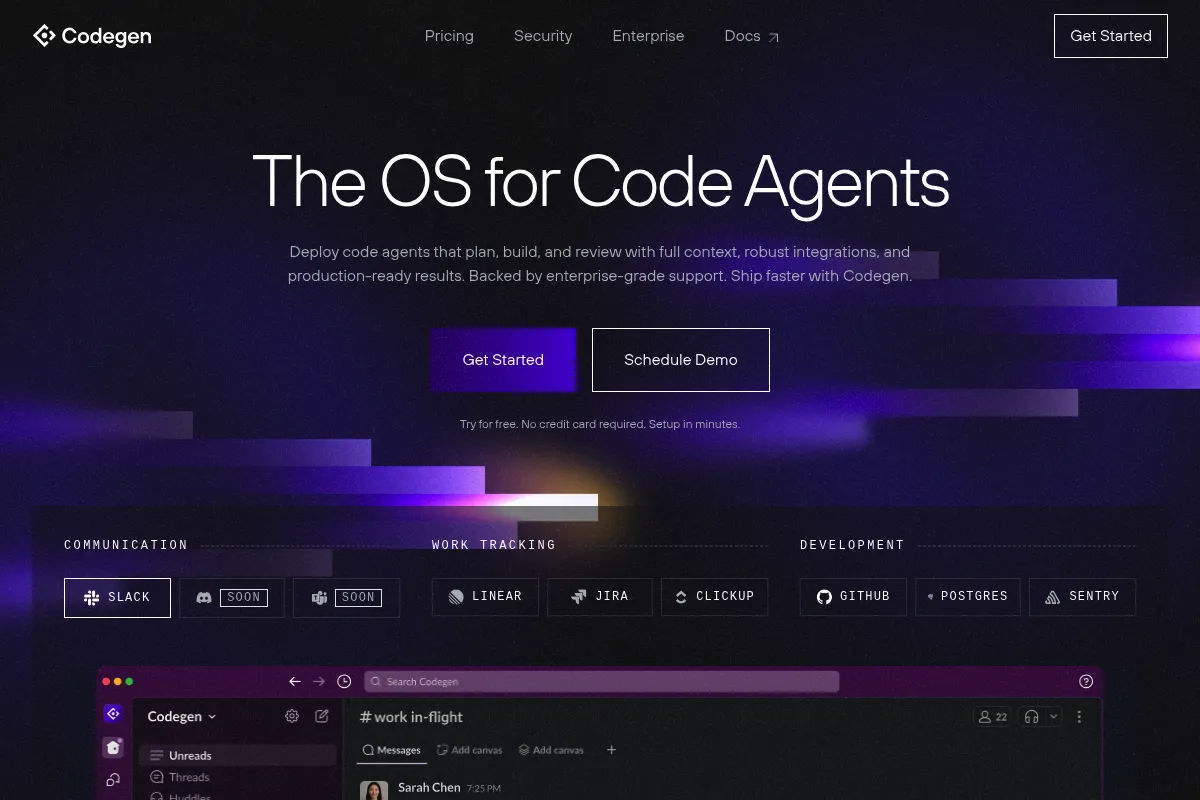
Codegen is an agentic AI platform designed to function as a virtual software engineer. It focuses on end-to-end task completion by indexing entire repositories to understand context, dependencies, and logic across multiple files.
Official profiles
What it actually does
The tool takes high-level instructions—such as 'migrate this library to the latest version' or 'refactor these API calls'—and autonomously writes the code, runs tests, and submits a pull request. It operates as a background worker that interacts directly with version control systems and issue trackers.
What makes it different
Unlike IDE extensions that focus on the current file, Codegen is built for repository-wide changes. It uses a specialized reasoning engine to plan multi-step migrations and can self-correct by analyzing test failures during the PR generation process.
Ratings across the web

Ratings aggregated from independent review platforms.
Key Features
Context-Aware Reasoning
Analyzes the entire codebase to ensure changes in one file don't break dependencies in another.
Jira-to-PR Workflow
Automatically picks up assigned tickets and generates a corresponding code solution.
Migration Engine
Specialized workflows for upgrading languages (e.g., Python 2 to 3) or swapping libraries across thousands of files.
Self-Healing Code
Runs your existing CI/CD pipeline and iterates on the code if tests fail before you ever see the PR.
Custom Knowledge Base
Learns your team's specific coding standards and internal library patterns over time.
Agentic Planning
Breaks down complex tasks into a sequence of smaller, verifiable code changes.
Pricing
Free / Open Source
- Access for open source projects
- Basic repository indexing
- Community support
Enterprise
- Full private repository access
- Custom security and compliance (SOC2)
- Dedicated support and onboarding
- Unlimited agentic tasks
Pricing checked 5 months ago
Pricing guidance
- When you need to use the agent on private company repositories
- When you require integration with Jira or internal CI/CD tools
- When you need SOC2 compliance for AI data handling
- Usage limits on the number of autonomous tasks per month may apply depending on the contract
- Repository size limits can affect indexing performance
Premium enterprise positioning targeting high-value engineering hours.
Pros & Cons
Strengths
-
Handles 'grunt work' at scale
Excels at the tedious, high-volume changes that human engineers find draining, such as renaming variables across a monolith or updating boilerplate.
-
Deep contextual understanding
Because it indexes the whole repo, it avoids the 'hallucinations' common in tools that only see the last 500 lines of code.
-
Reduces PR review time
By running tests and linting before submission, it ensures that the PRs it generates are syntactically correct and functional.
Weaknesses
-
High setup overhead
Requires significant initial effort to index large repos and configure CI/CD integrations correctly.
Affects: DevOps and Platform Engineers
-
Trust and verification requirements
Autonomous agents still require human oversight; reviewing a 50-file automated PR can be as mentally taxing as writing it.
Affects: Senior Reviewers
-
Opaque pricing
Lack of public self-serve pricing makes it difficult for small teams to evaluate the ROI without a sales call.
Affects: Startups and small teams
Real User Sentiment
Users are generally impressed by the tool's ability to handle complex, multi-file tasks that leave standard LLMs confused, though skepticism remains regarding total autonomy.
Users tend to like
- Ability to handle massive refactors
- Integration with existing developer workflows (GitHub/Jira)
- The 'set it and forget it' nature of the agent
Users commonly complain about
- Difficulty in reviewing very large automated PRs
- Occasional logic errors in complex business rules
- Lack of transparent pricing for smaller teams
Recurring tradeoffs
- Speed of generation vs. time spent in rigorous PR review
- Automation of tech debt vs. the risk of introducing new, subtle bugs
Happiest users
Engineering leaders at companies with 50+ developers who are drowning in legacy migrations.
Often frustrated
Developers in highly regulated industries with strict 'no-AI' code policies or those working on extremely small, simple projects.
Use Cases
Library Upgrades
Automatically updating a codebase from React 17 to 18 across hundreds of components.
API Refactoring
Changing an internal API signature and updating all call sites throughout the repository.
Test Generation
Analyzing existing code to write comprehensive unit tests for uncovered modules.
Documentation Sync
Updating READMEs and internal docs whenever code logic changes.
Tech Debt Cleanup
Identifying and removing dead code or deprecated functions autonomously.
Frequently Asked Questions
How much does Codegen cost?
Codegen does not publish a standard price list for commercial use. It is primarily an enterprise-grade tool that requires a demo and a custom quote based on team size and repository volume. Expect pricing to be significantly higher than standard IDE tools like Copilot.
How does Codegen compare to GitHub Copilot?
Copilot is an autocomplete tool that lives in your IDE and helps you write the next line of code. Codegen is an agent that lives in your workflow; it takes a task, thinks through the solution, and submits a complete Pull Request across multiple files without you having to open your editor.
Is my code used to train their models?
For Enterprise customers, Codegen typically offers data privacy guarantees where your code is not used to train their global models. However, you should verify the specific terms in your service agreement as these can vary.
Can Codegen work with private repositories?
Yes, Codegen is designed to integrate with private GitHub, GitLab, and Bitbucket repositories. It requires a service account or OAuth app permissions to index the code and submit PRs.
Does it support all programming languages?
It has the strongest support for widely used languages like Python, JavaScript, TypeScript, and Go. Support for niche or legacy languages (like COBOL or Fortran) may be limited by the underlying LLM's training data.
What happens if the AI writes bad code?
Codegen is designed to run your existing test suite. If the tests fail, the agent attempts to fix the code based on the error logs. Ultimately, a human must still review and merge the Pull Request, serving as the final safety check.
Why trust this page?
This evaluation combines product positioning, pricing analysis, traffic and market signals, and public user sentiment into a single decision-support page. Content is generated editorially — not copied from the vendor's website.
Funding & Company
Founded
2023
Stage
Acquired
Total Raised
$16.2M
Latest Round
Seed (Nov 2023)
Notable Investors
Codegen raised a single $16.2 million Seed round led by Thrive Capital before being acquired by ClickUp in December 2025. This substantial early-stage funding from high-profile investors indicates strong initial confidence in its autonomous coding agent technology.
Market Signals & Traffic
Estimated visits, global rank, geography, traffic sources, monthly visit trends, and organic search keywords (Similarweb)—on a dedicated page built for depth and search.
- Estimated visits
- 67,895
- Global rank
- #572,124
- Snapshot
- May 2026
- Traffic trend
- Surging
Estimated monthly visits
Alternatives to Codegen
View all alternativesGitHub Copilot
Developer Tools, AI Assistant

AI-powered coding assistant that suggests and generates code.
Claude
AI Assistant

A conversational AI assistant for writing, analysis, coding, and more.
Cursor
AI Assistant

An AI-powered code editor designed to help developers build software faster.
Similar Tools
Algolia
Developer Tools, Automation & Agents

API-first search and discovery platform for websites and apps.
All Hands AI
Developer Tools, Automation & Agents

Open-source platform for autonomous software engineering agents.
E2B
Developer Tools, Automation & Agents

Secure cloud sandboxes for running code and AI agents
Cognition
Developer Tools, Automation & Agents

Autonomous software engineer that plans and executes complex coding tasks.
Letta
Developer Tools, Automation & Agents

Build stateful agents with persistent long-term memory and context.
Cerebras
Developer Tools, Automation & Agents

High-speed infrastructure for large-scale model inference and training