

Tessl
A spec-driven platform for AI-native software development that shifts the developer's role from writing code to defining requirements for agents to implement.
Best fit for engineering teams moving toward agentic workflows who need to manage specs and agent context at scale, rather than just using IDE autocomplete.
Analysis based on product data, pricing structure, traffic signals, and public user sentiment.
Who Should Use Tessl?
Typical users
Engineering leaders, platform engineers, and senior developers at AI-forward companies transitioning to agent-led development.
Maturity fit
advanced
Choose this if…
- Your priority is maintaining a single source of truth (the spec) over manual code reviews.
- You want to manage reusable 'skills' and context for AI agents across multiple projects.
- You are building complex systems where standard LLM hallucinations cause significant regression risks.
Skip this if…
- You only need a basic AI autocomplete tool like GitHub Copilot or Cursor.
- Your team is not ready to adopt a spec-first development methodology.
- You are working on legacy systems with zero documentation and high technical debt that agents cannot easily parse.
About Tessl
Tessl is an AI-native development platform founded by Guy Podjarny (founder of Snyk) to redefine the software development lifecycle. It centers on 'The Spec' as the primary artifact, allowing developers to define what software should do while AI agents handle the implementation and maintenance.
Official profiles
What it actually does
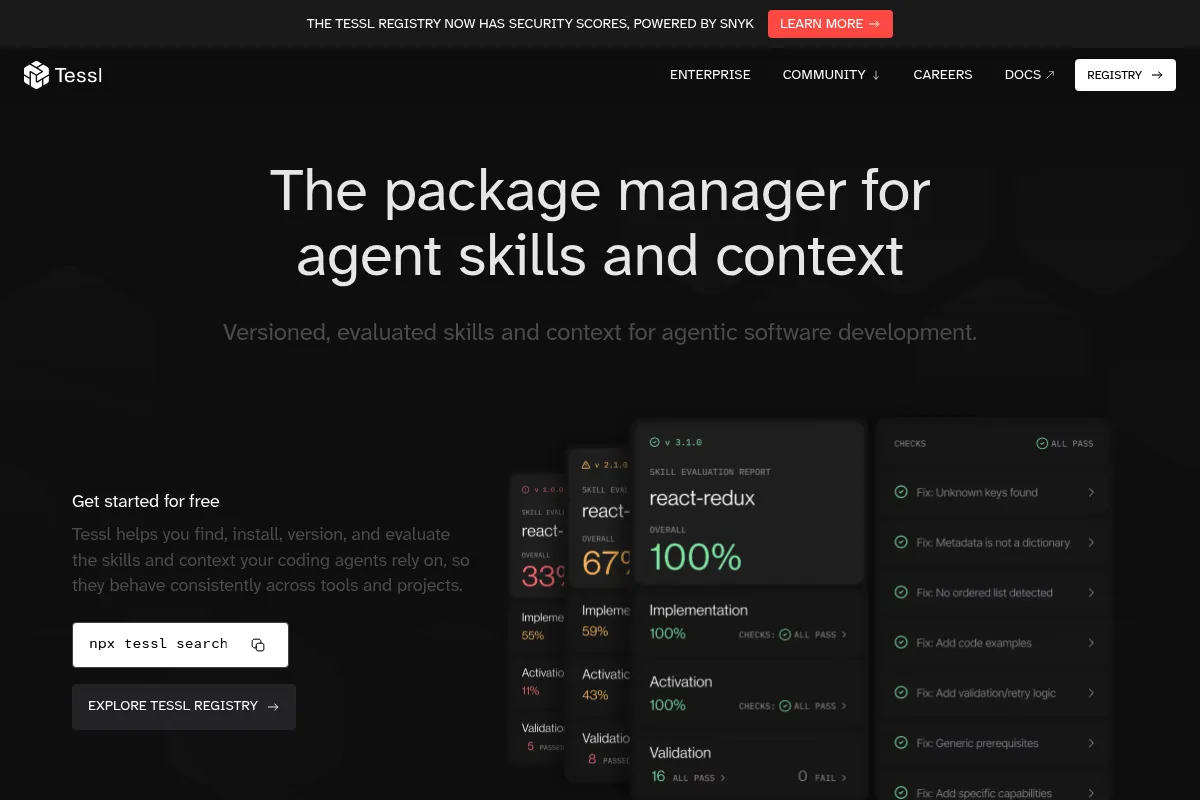
The platform acts as a package manager and orchestration layer for AI agent skills and development context. It enables teams to version-control specifications, evaluate agent performance against those specs, and distribute standardized instructions to coding agents.
What makes it different
Unlike IDE-based assistants that react to existing code, Tessl is proactive and spec-first. It treats the specification as the source of truth, using it to ground agent behavior and reduce the drift that occurs when agents generate code without deep architectural context.
Key Features
Spec-Driven Development
Developers write high-level requirements that agents use as a blueprint for code generation.
Agent Skill Manager
A repository for reusable capabilities that can be shared across different agents and projects.
Contextual Grounding
Ensures agents have access to relevant documentation and system architecture before they start coding.
Open Ecosystem
Designed to work with various LLMs and agent frameworks rather than being locked into one model.
Automated Maintenance
Agents monitor the spec and automatically update the codebase when requirements change.
Evaluation Framework
Tools to measure how accurately an agent's output matches the original specification.
Pricing
Early Access / Beta
- Access to the Tessl platform
- Spec management tools
- Agent skill distribution
- Direct support from the founding team
Pricing checked 6 months ago
Pricing guidance
- When moving from experimental agent use to production-grade agentic workflows
- When managing multiple agents across different engineering squads
- When requiring enterprise-level security and spec auditing
- Waitlist-only access
- Specific LLM provider requirements for certain agent skills
Premium enterprise positioning aimed at high-growth tech companies and large engineering organizations.
Pros & Cons
Strengths
-
Reduces implementation drift
By keeping the spec as the source of truth, it prevents AI agents from introducing 'creative' but incorrect architectural patterns.
-
Strong founder pedigree
Led by the creator of Snyk, the platform is built with enterprise-grade security and developer workflow standards in mind.
-
Scalable agent management
The package manager approach allows teams to standardize how agents interact with their specific tech stack.
Weaknesses
-
High cultural barrier
Requires developers to stop 'thinking in code' and start 'thinking in specs,' which is a significant shift in daily habits.
Affects: Individual contributors and senior developers
-
Early-stage ecosystem
As a relatively new platform, the library of pre-built skills and community-driven specs is still maturing.
Affects: Teams looking for out-of-the-box automation
-
Integration overhead
Setting up the initial specs and context for a large existing codebase requires substantial upfront effort.
Affects: Teams with large legacy repositories
Real User Sentiment
The developer community is cautiously optimistic, viewing it as a more structured alternative to the 'wild west' of current AI coding assistants.
Users tend to like
- The focus on specs over raw code generation
- The potential to reduce technical debt through automated maintenance
- The 'package manager' concept for agent skills
Users commonly complain about
- Skepticism about whether 'spec-first' development can handle edge cases
- Concerns about the complexity of writing perfect specs
- Limited public access to the full feature set
Recurring tradeoffs
- Trading immediate speed (autocomplete) for long-term maintainability (specs)
Happiest users
Engineering VPs and Architects who want to standardize how their teams use AI.
Often frustrated
Developers who prefer 'cowboy coding' or quick, un-documented iterations.
Use Cases
Standardizing Agent Behavior
Ensuring all AI agents used by a team follow the same architectural guidelines.
Spec-First Migration
Moving a legacy service to a new language by first defining the spec and letting agents implement it.
Agent Skill Sharing
Creating a library of internal tools and API contexts that any agent in the company can use.
Automated Documentation Sync
Keeping code and documentation perfectly aligned by making the spec the driver for both.
Reducing Hallucinations
Using the spec-driven approach to ground agents in reality during complex refactoring tasks.
Frequently Asked Questions
Is Tessl a replacement for GitHub Copilot?
No, Tessl is a platform for managing the lifecycle of AI-native software. While Copilot focuses on helping a human write code faster in the IDE, Tessl focuses on the specifications that allow agents to build and maintain software more autonomously.
How much does Tessl cost?
Tessl has not publicly released a standard pricing table. It is currently in an early access phase, and interested teams must apply or contact sales for a custom quote based on their needs.
What is 'AI-native' software development?
It is a methodology where software is designed from the ground up to be built and maintained by AI. Instead of humans writing every line of code, humans write specifications and review the work of AI agents who do the heavy lifting.
Does Tessl work with existing codebases?
Yes, but it requires 'spec-ifying' the existing logic. The platform is most effective when you can define the boundaries and requirements of your existing services so agents can understand the context they are working within.
What are the main limitations of Tessl right now?
The primary limitation is the maturity of the ecosystem and the 'cold start' problem of writing specs for existing systems. It also requires a significant shift in team culture away from traditional manual coding.
How does Tessl handle security?
Given the founder's background with Snyk, security is a core focus. The platform aims to build security and compliance directly into the specifications that agents follow, rather than treating it as an afterthought.
Why trust this page?
This evaluation combines product positioning, pricing analysis, traffic and market signals, and public user sentiment into a single decision-support page. Content is generated editorially — not copied from the vendor's website.
Funding & Company
Founded
2024
Stage
Series a
Total Raised
$125M
Latest Round
Series A (Nov 2024)
Notable Investors
Tessl has raised a total of $125 million across two rounds in its first year of operation. This includes a $100 million Series A led by Index Ventures, which signals strong investor confidence in its vision for AI-native software development. This substantial early-stage capital provides a long runway to build out its ambitious platform.
Market Signals & Traffic
Estimated visits, global rank, geography, traffic sources, monthly visit trends, and organic search keywords (Similarweb)—on a dedicated page built for depth and search.
- Estimated visits
- 0
- Global rank
- —
- Snapshot
- May 2026
- Traffic trend
- Rising
Estimated monthly visits
Alternatives to Tessl
View all alternatives
Similar Tools
All Hands AI
Developer Tools, Automation & Agents

Open-source platform for autonomous software engineering agents.
E2B
Developer Tools, Automation & Agents

Secure cloud sandboxes for running code and AI agents
PydanticAI
Developer Tools, Automation & Agents

Python agent framework for building production-grade applications with structured data.
Cognition
Developer Tools, Automation & Agents

Autonomous software engineer that plans and executes complex coding tasks.
Smol.ai
Developer Tools, Automation & Agents

Autonomous agent that generates entire codebases from simple markdown prompts.
Cerebras
Developer Tools, Automation & Agents

High-speed infrastructure for large-scale model inference and training