

A managed vector database that prioritizes developer speed and operational simplicity over cost-efficiency or local control.
Excellent for teams needing a production-ready vector store without managing infrastructure, weaker for high-volume workloads where self-hosting is more economical.
Analysis based on product data, pricing structure, traffic signals, and public user sentiment.
Who Should Use Pinecone?
Typical users
AI engineers and full-stack developers building RAG applications or semantic search engines who lack a dedicated DevOps team.
Maturity fit
beginner to scaling
Choose this if…
- You want to start in minutes without provisioning servers
- Your priority is developer velocity over infrastructure control
- You need serverless scaling that handles spikes without manual intervention
- You require deep integration with LangChain, LlamaIndex, or OpenAI
Skip this if…
- You need to run on-premise or in a VPC for strict compliance
- Your workflow requires a local-first development environment
- You have massive, predictable data volumes where self-hosting Qdrant or Milvus is cheaper
- You need a multi-modal database that handles more than just vector embeddings
About Pinecone
Pinecone is a cloud-native vector database designed for high-dimensional data storage and retrieval. It abstracts away the complexities of indexing and scaling vector search, allowing developers to focus on application logic rather than infrastructure management.
Official profiles
What it actually does
It stores vector embeddings generated by machine learning models and performs similarity searches to find related data. The platform handles indexing, data persistence, and query execution through a managed API, supporting both dense and sparse vectors.
What makes it different
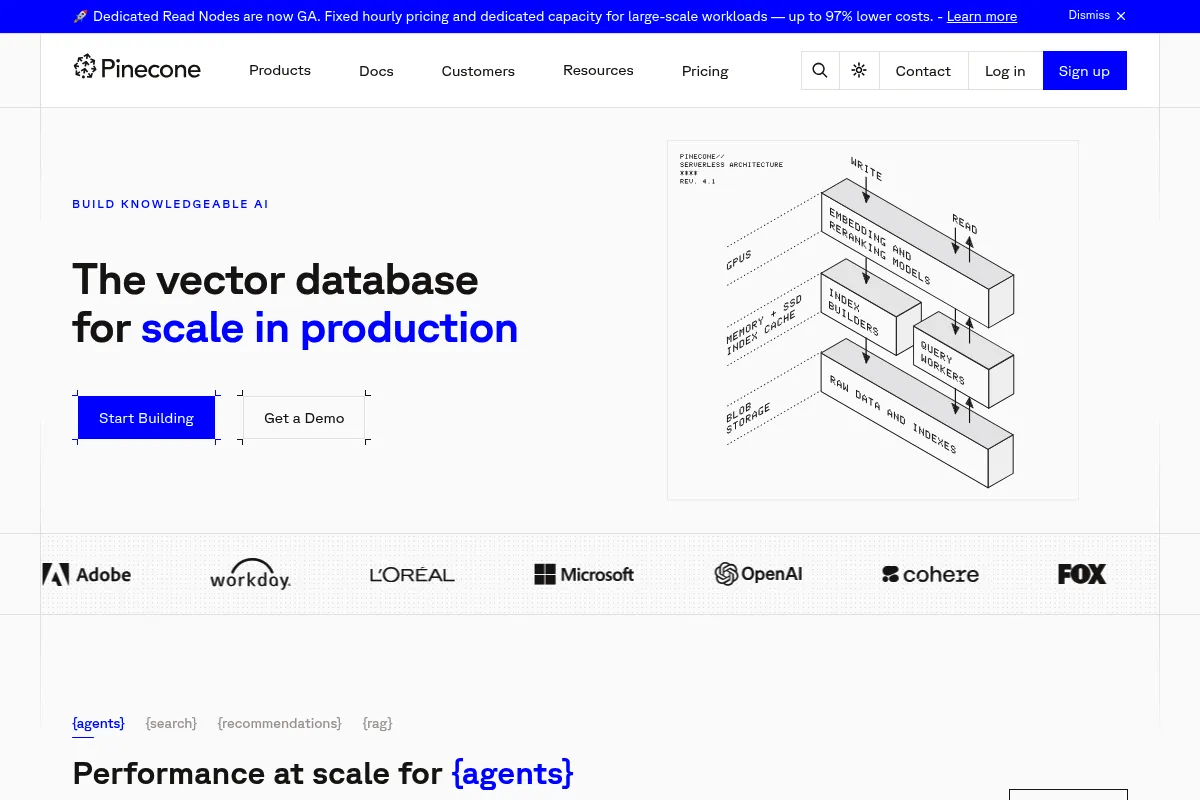
Unlike open-source competitors that require manual cluster management, Pinecone is strictly a managed service. Its serverless architecture decouples compute from storage, allowing users to pay for actual usage rather than idle capacity.
Ratings across the web

Ratings aggregated from independent review platforms.
Key Features
Serverless Architecture
Eliminates the need to provision or manage specific database pods.
Metadata Filtering
Allows narrowing search results using non-vector attributes like tags, IDs, or timestamps.
Hybrid Search
Combines semantic vector search with keyword-based sparse search for better relevance.
Namespaces
Enables data partitioning within a single index, essential for building multi-tenant apps.
Collections
Provides static backups of indexes for testing, archival, or environment migration.
Integrated Notebooks
Allows testing queries and data ingestion directly within the Pinecone console.
Index Visualization
Offers basic tools to monitor vector distribution and index health.
Pricing
Starter
- 1 index
- Up to 100,000 vectors (approx)
- Limited to 2GB storage
- Community support
Serverless
- $2.00 per GB of storage
- $0.0825 per 1M Read Units
- $0.33 per 1M Write Units
- Unlimited indexes
Standard (Pod-based)
- Starts at ~$0.096/hour per pod
- Dedicated resources
- Static performance
- Standard support
Enterprise (Pod-based)
- Starts at ~$0.144/hour per pod
- SSO/SAML integration
- Private Link support
- Priority support
Pricing checked 5 months ago
Pricing guidance
- When you need more than one index
- When your storage exceeds 2GB
- When you require enterprise security features like SSO
- When you need dedicated throughput via pod-based architecture
- Data transfer costs are not always obvious in the initial estimate
- Metadata size is limited and can impact index performance if overused
- Free tier indexes are deleted after 7 days of inactivity
Premium managed service positioning where you pay for convenience and operational reliability.
Pros & Cons
Strengths
-
Zero-ops overhead
No need to manage clusters, shards, or replicas, which is ideal for small teams that can't afford a dedicated database administrator.
-
Fast time-to-market
The API-first approach and extensive documentation allow developers to move from a prototype to a production-grade vector store in hours.
-
Usage-based pricing
The serverless tier makes small-scale experimentation and low-volume applications highly affordable compared to fixed-cost pod instances.
-
Strong ecosystem support
Native integrations with major LLM frameworks mean less boilerplate code when building RAG pipelines.
Weaknesses
-
Closed source and vendor lock-in
There is no option to self-host or run Pinecone locally, making it difficult to switch providers or maintain full data sovereignty.
Affects: Enterprises with strict data privacy requirements
-
Cost unpredictability at scale
High-volume read/write operations on the serverless plan can lead to unexpected monthly bills if query patterns are not tightly monitored.
Affects: High-growth startups with volatile traffic
-
Limited local development
The lack of a local Docker image or mock server forces developers to test against the cloud, which can introduce latency and cost during development.
Affects: Developers working in offline or restricted environments
Real User Sentiment
Generally positive, with users praising the 'it just works' experience while expressing caution regarding long-term costs.
Users tend to like
- Extremely easy setup process
- High-quality documentation and tutorials
- Reliable performance for RAG applications
- Serverless pricing for small projects
Users commonly complain about
- Lack of a local development version
- Difficulty predicting costs on the serverless plan
- Limited flexibility for custom indexing algorithms
- Vendor lock-in concerns
Recurring tradeoffs
- You trade architectural control and lower raw hardware costs for significantly reduced engineering overhead.
Happiest users
Small to mid-sized engineering teams building their first AI features who want to avoid infrastructure management.
Often frustrated
Platform engineers at large companies who want to optimize every cent of their cloud spend or need to run on-prem.
Use Cases
RAG for Chatbots
Providing relevant context to LLMs to reduce hallucinations.
Semantic Search
Improving search results by understanding intent rather than just keywords.
Recommendation Engines
Finding similar products or content based on user behavior embeddings.
Anomaly Detection
Identifying outliers in high-dimensional security or financial data.
Image Search
Enabling users to search for visual content using image-to-vector models.
Personalization
Tailoring user experiences by matching user profiles to content vectors.
Frequently Asked Questions
Is Pinecone free?
Pinecone offers a 'Starter' plan that is free forever. It allows for one index and roughly 2GB of storage, which is enough for small prototypes or learning. However, it is limited in performance and does not support the full range of serverless features.
Pinecone vs pgvector: Which should I choose?
Choose pgvector if you already use PostgreSQL and want to keep your relational data and vectors in one place. Choose Pinecone if you need a specialized, high-performance vector store that handles scaling and indexing automatically without adding load to your primary database.
Can I run Pinecone locally?
No, Pinecone is a managed cloud service and does not offer a local version or Docker image. For local development, you must use their cloud-based free tier or consider open-source alternatives like Chroma or Qdrant.
How does Pinecone Serverless pricing work?
Serverless pricing is based on three metrics: storage ($2/GB per month), Read Units (RUs), and Write Units (WUs). You only pay for what you use, making it more cost-effective for applications with variable traffic compared to the fixed hourly cost of pod-based plans.
Does Pinecone support hybrid search?
Yes, Pinecone supports hybrid search by allowing you to query both dense vectors (for semantic meaning) and sparse vectors (for keyword matching) simultaneously. This often results in higher retrieval accuracy for RAG applications.
What are the main limitations of Pinecone?
The primary limitations are the lack of self-hosting options, the inability to run locally, and the fact that it is a specialized tool—it cannot replace your primary relational or document database for non-vector data.
Why trust this page?
This evaluation combines product positioning, pricing analysis, traffic and market signals, and public user sentiment into a single decision-support page. Content is generated editorially — not copied from the vendor's website.
Funding & Company
Founded
2019
Stage
Series b
Total Raised
$138M
Latest Round
Series B (Apr 2023)
Notable Investors
Pinecone has raised a total of $138 million across three rounds, culminating in a $100 million Series B in April 2023. This significant funding from top-tier investors like Andreessen Horowitz and Menlo Ventures signals strong market confidence and provides substantial runway for product development and scaling operations.
Market Signals & Traffic
Estimated visits, global rank, geography, traffic sources, monthly visit trends, and organic search keywords (Similarweb)—on a dedicated page built for depth and search.
- Estimated visits
- 602,315
- Global rank
- #65,477
- Snapshot
- Apr 2026
- Traffic trend
- Surging
Estimated monthly visits
Alternatives to Pinecone
View all alternativesWeaviate
Developer Tools, Search

Open-source vector database for building scalable semantic search applications.
Qdrant
Developer Tools, Search

High-performance vector database and search engine for unstructured data.
GitHub Copilot
Developer Tools, AI Assistant

AI-powered coding assistant that suggests and generates code.
Similar Tools
Milvus
Developer Tools, Search

Open-source vector database for high-performance similarity search and RAG.
Voyage AI
Developer Tools, Search

High-performance embedding models and rerankers for retrieval-augmented generation.
LanceDB
Developer Tools, Search

Open-source vector database for multi-modal search and RAG applications
mixedbread ai
Developer Tools, Search

High-performance embedding and reranking models for semantic search.
Zilliz
Developer Tools, Search

High-performance vector database for similarity search and RAG applications.
Chroma
Developer Tools, Search

Open-source embedding database for building applications with long-term memory.