

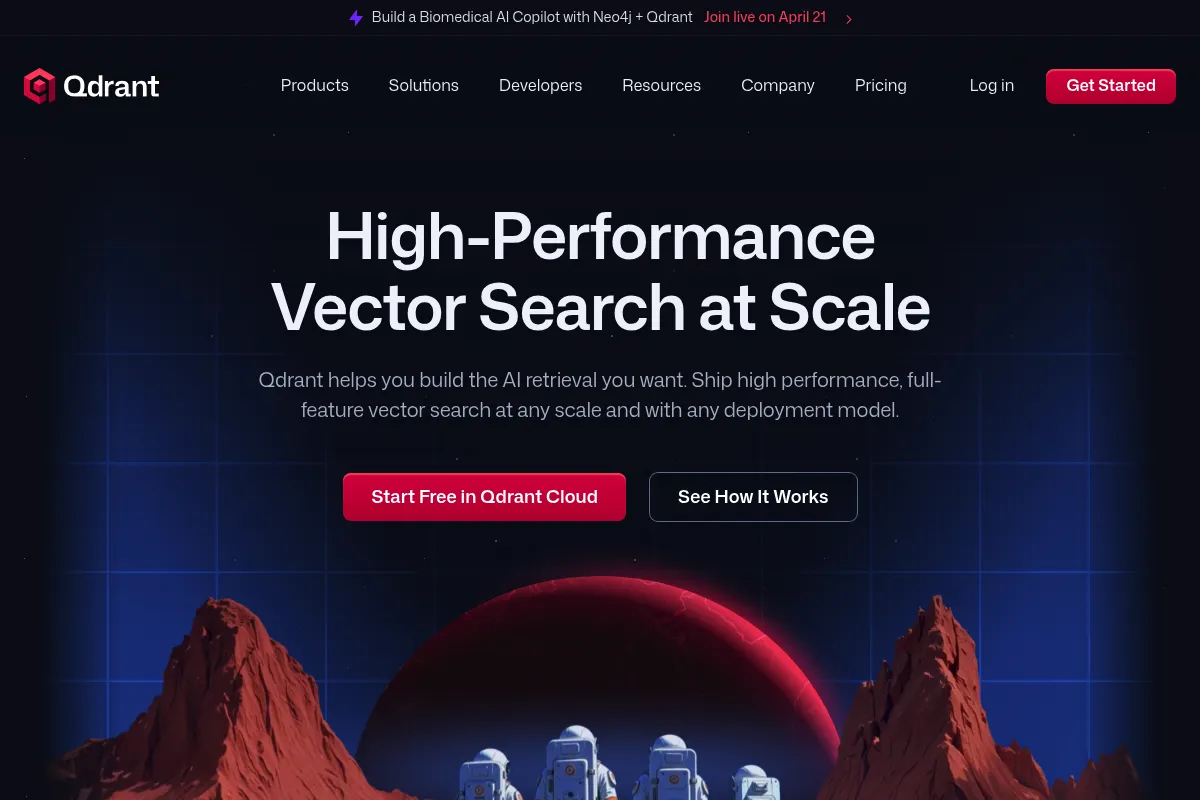
A high-performance, Rust-based vector database that prioritizes filtering efficiency and deployment flexibility—best for teams needing granular control over search logic without the overhead of heavier distributed systems.
Excellent for high-throughput production RAG and complex metadata filtering, weaker for teams wanting a zero-config serverless experience.
Analysis based on product data, pricing structure, traffic signals, and public user sentiment.
Who Should Use Qdrant?
Typical users
ML engineers and backend developers building production-grade RAG, recommendation systems, or semantic search applications.
Maturity fit
scaling to advanced
Choose this if…
- You need high-speed metadata filtering alongside vector similarity search
- Your priority is low-latency performance and predictable memory usage via Rust
- You want the option to self-host for data sovereignty while having a managed cloud path
Skip this if…
- You require a purely serverless 'set and forget' database with zero infrastructure management
- Your data is already in Postgres and your performance needs are met by pgvector
- You need a managed service with a massive global footprint of edge locations
About Qdrant
Qdrant is an open-source vector search engine written in Rust, designed to handle high-dimensional embeddings and associated metadata. It bridges the gap between simple vector stores and complex distributed databases by offering a standalone service with a focus on performance and filtering.
What it actually does
It stores vector embeddings from models and allows users to perform similarity searches. It supports complex filtering based on metadata (payloads) and can be deployed as a single node or a distributed cluster.
What makes it different
Unlike many competitors that treat metadata as an afterthought, Qdrant’s filtering engine is integrated into the core indexing process. Its Rust foundation provides predictable memory usage and high concurrency compared to Python or Java-based alternatives.
Ratings across the web

Ratings aggregated from independent review platforms.
Key Features
Payload Filtering
Allows narrowing search results using metadata without sacrificing vector search speed.
Quantization
Reduces memory footprint by up to 32x with minimal accuracy loss, lowering infrastructure costs.
Rust Core
Ensures high performance and memory safety under heavy concurrent loads without garbage collection pauses.
Sparse Vector Support
Enables hybrid search by combining traditional keyword search with semantic vector search in one query.
Distributed Mode
Scales horizontally to handle massive datasets and provide high availability.
Collection Sharding
Distributes data across multiple nodes to optimize resource utilization and throughput.
Optimizer Settings
Provides granular control over how and when segments are indexed and merged.
Pricing
Open Source
- Self-hosted
- Full feature set
- Apache 2.0 License
- Community support
Cloud Free Tier
- 1GB RAM
- 0.5 vCPU
- 4GB Disk
- 1 Cluster
Managed Cloud Standard
- Starts at 4GB RAM / 1 vCPU
- Automatic backups
- Monitoring dashboard
- Zero-downtime updates
Enterprise
- Dedicated clusters
- VPC Peering
- SLA guarantees
- Premium support
Pricing checked 5 months ago
Pricing guidance
- When you need high availability (HA) for production
- When your dataset exceeds 1GB of RAM
- When you require VPC peering for security compliance
- Cloud costs scale directly with RAM and Disk allocation
- High-dimensional vectors (e.g., 1536) consume memory rapidly without quantization enabled
- Free tier performance is limited by shared CPU resources
Competitive pricing that rewards users who understand resource optimization, positioned as a more flexible and often cheaper alternative to Pinecone.
Pros & Cons
Strengths
-
Resource efficiency
The Rust implementation allows Qdrant to handle more requests per second on smaller hardware footprints compared to Milvus or Weaviate.
-
Advanced filtering logic
Supports complex nested conditions on metadata, which is critical for multi-tenant applications where users must only search their own data.
-
Deployment flexibility
Can run as a local Docker container, a self-hosted cluster, or a managed cloud service, preventing vendor lock-in.
-
Memory optimization
Offers multiple quantization levels, making it possible to fit large datasets into RAM that would otherwise require much more expensive instances.
Weaknesses
-
Operational complexity
Setting up and maintaining a distributed cluster requires more DevOps effort than using a fully serverless provider like Pinecone.
Affects: Small teams without dedicated DevOps resources
-
Ecosystem maturity
While growing fast, it has fewer third-party integrations and community-contributed plugins than older search engines like Elasticsearch.
Affects: Enterprise teams looking for deep legacy integrations
-
Learning curve
Configuring HNSW parameters and quantization trade-offs requires a deeper understanding of vector search mechanics than entry-level tools.
Affects: Beginner developers or those looking for a 'black box' solution
Real User Sentiment
Highly positive, with users frequently citing the speed of the Rust implementation and the clarity of the API as major benefits.
Users tend to like
- Filtering performance on large datasets
- Rust-based stability and low resource overhead
- Excellent documentation and easy-to-use client libraries
- Ability to run the exact same setup locally and in the cloud
Users commonly complain about
- Distributed mode configuration can be complex
- Managed cloud UI is functional but lacks advanced visualization tools
- Sparse vector implementation is newer and has fewer examples
Recurring tradeoffs
- Trading the 'infinite' scaling of serverless for the predictable performance of dedicated resources
Happiest users
Developers building production RAG systems who need to filter results by user ID, category, or timestamp without losing speed.
Often frustrated
Beginners who want a 'database-as-an-API' experience and don't want to think about RAM or CPU allocation.
Use Cases
E-commerce
Semantic product search with real-time filters for price, brand, and availability.
RAG Pipelines
Storing document chunks for LLM context retrieval with metadata for source tracking and access control.
Recommendation Engines
Finding similar users or items based on high-dimensional behavior vectors in real-time.
Anomaly Detection
Identifying outliers in security logs or financial transactions by comparing new entries to historical baselines.
Image Search
Building reverse image search applications by storing and querying embeddings from vision models.
Frequently Asked Questions
How does Qdrant compare to Pinecone?
Pinecone is a closed-source, serverless-first platform that is easier to start with but can become expensive and offers less control over the underlying infrastructure. Qdrant is open-source, can be self-hosted, and generally offers better performance for complex filtering, though it requires more resource management than Pinecone's serverless model.
Is there a free version of Qdrant?
Yes, Qdrant is open-source (Apache 2.0) and free to self-host. Their managed cloud also offers a 'Free Tier' with 1GB of RAM and 0.5 vCPU, which is sufficient for small projects or prototyping.
What are the main limitations of Qdrant?
The primary limitation is the operational overhead of managing distributed clusters if you choose to self-host. Additionally, while it supports hybrid search, its sparse vector implementation is newer and less mature than its dense vector capabilities compared to specialized keyword search engines.
Does Qdrant integrate with LangChain and LlamaIndex?
Yes, Qdrant has first-class integrations with both LangChain and LlamaIndex, making it easy to drop into existing AI orchestration workflows for RAG and agentic applications.
How much memory do I need for my vectors?
Memory usage depends on vector dimensionality and the number of vectors. For example, 1 million 768-dimension vectors take roughly 3GB of RAM without quantization; with scalar quantization, this can drop to under 1GB.
Can I use Qdrant for traditional keyword search?
Qdrant is primarily a vector database, but it supports sparse vectors which can be used for BM25-like keyword search. This allows for hybrid search strategies where you combine semantic and keyword results in a single query.
Why trust this page?
This evaluation combines product positioning, pricing analysis, traffic and market signals, and public user sentiment into a single decision-support page. Content is generated editorially — not copied from the vendor's website.
Funding & Company
Founded
2021
Stage
Series b
Total Raised
$87.5M
Latest Round
Series B (Mar 2026)
Notable Investors
Qdrant has raised a total of $87.5 million across four funding rounds, culminating in a $50 million Series B in March 2026. This significant and recent funding from notable investors like AVP and Spark Capital signals strong market confidence and provides substantial runway for product development and enterprise expansion.
Market Signals & Traffic
Estimated visits, global rank, geography, traffic sources, monthly visit trends, and organic search keywords (Similarweb)—on a dedicated page built for depth and search.
- Estimated visits
- 315,875
- Global rank
- #155,992
- Snapshot
- Apr 2026
- Traffic trend
- Cooling
Estimated monthly visits
Alternatives to Qdrant
View all alternativesPinecone
Developer Tools, Search

Managed vector database for building scalable search and RAG applications
Weaviate
Developer Tools, Search

Open-source vector database for building scalable semantic search applications.
GitHub Copilot
Developer Tools, AI Assistant

AI-powered coding assistant that suggests and generates code.
Similar Tools
bloop
Developer Tools, Search

Natural language search engine for exploring and understanding codebases.
mixedbread ai
Developer Tools, Search

High-performance embedding and reranking models for semantic search.
Weaviate
Developer Tools, Search
Open-source vector database for building scalable semantic search applications.
Voyage AI
Developer Tools, Search

High-performance embedding models and rerankers for retrieval-augmented generation.
Chroma
Developer Tools, Search

Open-source embedding database for building applications with long-term memory.
Pinecone
Developer Tools, Search
Managed vector database for building scalable search and RAG applications