

Voyage AI
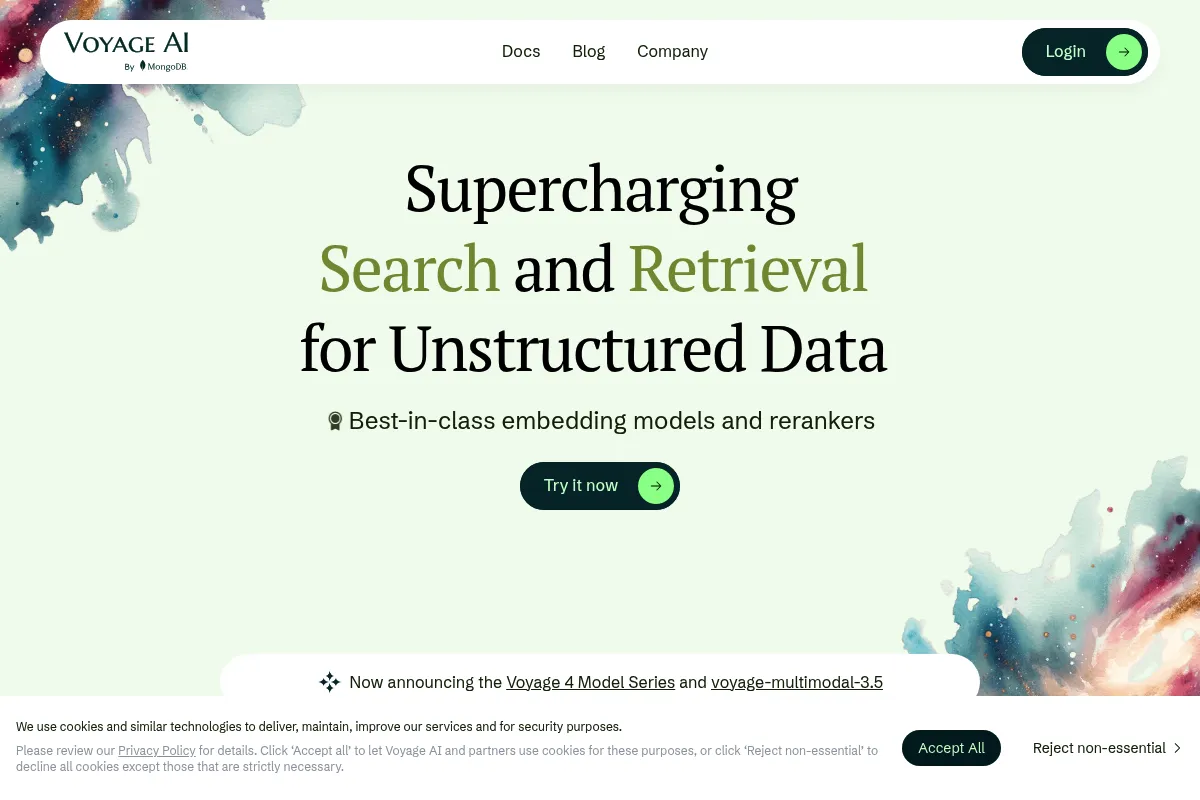
A specialized provider of embedding and reranking models that prioritizes retrieval accuracy and long context windows over general-purpose breadth.
Excellent for high-precision RAG and domain-specific search, weaker for developers who want a single-vendor LLM and embedding stack.
Analysis based on product data, pricing structure, traffic signals, and public user sentiment.
Who Should Use Voyage AI?
Typical users
ML engineers and RAG developers at startups or enterprises who have outgrown generic embedding models and need higher retrieval recall.
Maturity fit
scaling to advanced
Choose this if…
- You need to embed documents longer than 8,192 tokens without manual chunking.
- Your RAG system struggles with specialized terminology in law or programming.
- You want to reduce RAG costs compared to OpenAI's high-end embedding models.
Skip this if…
- You prefer the simplicity of using one provider for both embeddings and generation.
- Your data is simple enough that basic open-source models suffice.
- You require a self-hosted or on-premise solution for standard tiers.
About Voyage AI
Voyage AI provides specialized embedding models and rerankers designed to improve the retrieval stage of RAG systems. Founded by AI researchers from Stanford, it offers models optimized for specific domains like law and code, alongside a 32k context window.
Official profiles
What it actually does
It converts text into high-dimensional vectors for semantic search and provides a reranking API to re-order search results for better accuracy. Developers use these APIs to ensure their AI applications find the most relevant information before generating a response.
What makes it different
Unlike general-purpose providers, Voyage offers a 32k context window, significantly larger than the 8k standard found in most competitors. It also provides domain-specific models (law, code, finance) that outperform general models on specialized datasets.
Key Features
32k Context Window
Allows embedding of entire documents or long chapters without losing context to chunking.
voyage-law-2
Specialized model trained on legal corpora to understand complex terminology and citations.
voyage-code-2
Optimized for programming languages and technical documentation retrieval.
Rerank-2
A cross-encoder model that re-evaluates the top search results to significantly improve final RAG accuracy.
voyage-3-lite
A high-speed, lower-cost model for applications where latency is more critical than maximum recall.
Multilingual-2
Supports semantic search across diverse languages including Japanese, French, and German.
Pricing
Voyage-3 (Flagship)
- 32k context window
- Top-tier MTEB performance
- Optimized for general RAG
- Standard rate limits
Voyage-3-lite
- Lower latency
- 32k context window
- Cost-optimized
- High performance for simple queries
Specialized (Law/Code)
- Domain-specific training
- Higher recall for technical terms
- 16k to 32k context windows
- Optimized for technical docs
Rerank-2
- Cross-encoder performance
- 4k context window
- Improves top-K accuracy
- Supports 100+ documents per request
Pricing checked 5 months ago
Pricing guidance
- Moving from testing to production traffic
- Hitting default rate limits
- Requiring custom model fine-tuning
- Rate limits are tiered based on usage history
- Very high throughput requires enterprise negotiation
- Reranking costs apply to both the query and all documents sent for re-scoring
Premium performance at a commodity price point.
Pros & Cons
Strengths
-
Superior Retrieval Accuracy
Consistently ranks at the top of the MTEB leaderboard for retrieval tasks, leading to fewer hallucinations in RAG pipelines.
-
Large Context Support
The 32k limit reduces the need for complex chunking strategies for long-form content, preserving semantic meaning across large blocks of text.
-
Domain Specialization
Outperforms general models in technical fields like legal and software engineering by understanding industry-specific jargon.
-
Cost Efficiency
Pricing is competitive with OpenAI while offering better performance for specific RAG tasks, making it viable for high-volume applications.
Weaknesses
-
Single-Purpose Vendor
Requires managing an additional API key and provider if you already use OpenAI or Anthropic for generation.
Affects: Small teams wanting a consolidated stack
-
No Self-Hosting
Standard plans are API-only, which may not suit organizations with strict data residency requirements that forbid third-party cloud processing.
Affects: Enterprise compliance teams
-
Latency Overhead
Adding a reranking step increases the total time to generate a response in RAG pipelines, which can impact user experience in real-time chat.
Affects: Latency-sensitive applications
Real User Sentiment
Highly positive among technical users who prioritize retrieval quality over brand name recognition.
Users tend to like
- 32k context window size
- Legal and code model accuracy
- Easy integration with LangChain and LlamaIndex
- Competitive pricing compared to OpenAI
Users commonly complain about
- Lack of a free-forever tier beyond initial credit
- API-only availability for standard users
- Smaller community ecosystem than OpenAI
Recurring tradeoffs
- Choosing better retrieval means adding another dependency and API key to the tech stack.
Happiest users
Developers building specialized RAG apps for legal, finance, or technical support.
Often frustrated
Beginners who want a one-click AI solution without managing multiple APIs.
Use Cases
Legal Document Search
Using voyage-law-2 to find specific clauses in thousands of contracts.
Technical Support Bots
Improving documentation retrieval for developers using voyage-code-2.
Long-Form Content Analysis
Embedding entire whitepapers or books using the 32k context window.
Global Knowledge Bases
Implementing multilingual semantic search for international teams.
High-Accuracy RAG
Using rerank-2 to ensure the LLM only receives the most relevant context.
Frequently Asked Questions
Does Voyage AI have a free plan?
Voyage AI does not have a 'free forever' tier, but it offers a $50 credit to all new users. This is typically enough to embed several million tokens and thoroughly test the models before needing to add a credit card.
How does Voyage AI compare to OpenAI embeddings?
Voyage AI generally outperforms OpenAI's text-embedding-3-large on retrieval benchmarks. Crucially, Voyage offers a 32k context window compared to OpenAI's 8k, and provides domain-specific models for law and code which OpenAI lacks.
What are the limitations of Voyage AI?
The primary limitation is that Voyage is a specialized provider; it does not offer its own LLM for text generation. You must use it alongside a generator like Claude or GPT-4. Additionally, it is currently API-only for most users, with no self-hosting option.
Which vector databases integrate with Voyage AI?
Voyage AI integrates with most major vector databases including Pinecone, Weaviate, Milvus, and Qdrant. It is also natively supported in orchestration frameworks like LangChain and LlamaIndex.
Why should I use a reranker like Rerank-2?
Standard embedding models can sometimes miss the most relevant document in the top results. A reranker re-evaluates the top 50-100 results using a more expensive but accurate method, ensuring the LLM gets the absolute best context for its response.
Is my data used for training?
According to Voyage AI's standard terms, data sent through the API is not used to train their base models. This makes it more suitable for enterprise use cases than some open-source alternatives that may have different data privacy implications.
Why trust this page?
This evaluation combines product positioning, pricing analysis, traffic and market signals, and public user sentiment into a single decision-support page. Content is generated editorially — not copied from the vendor's website.
Funding & Company
Founded
2023
Stage
Acquired
Total Raised
$28M
Latest Round
Series A (Oct 2024)
Notable Investors
Voyage AI raised a total of $28 million across two rounds, culminating in a $20 million Series A led by CRV. The company was subsequently acquired by MongoDB in February 2025, which provides ultimate financial stability and a clear path for long-term product integration.
Market Signals & Traffic
Estimated visits, global rank, geography, traffic sources, monthly visit trends, and organic search keywords (Similarweb)—on a dedicated page built for depth and search.
- Estimated visits
- 137,550
- Global rank
- #219,496
- Snapshot
- Apr 2026
- Traffic trend
- Surging
Estimated monthly visits
Alternatives to Voyage AI
View all alternativesCohere
Developer Tools, Automation & Agents

Enterprise large language models for search, discovery, and generation.
Mistral AI
AI Assistant, Developer Tools

Efficient large language models for developers and enterprise applications.
GitHub Copilot
Developer Tools, AI Assistant

AI-powered coding assistant that suggests and generates code.
Similar Tools
Chroma
Developer Tools, Search

Open-source embedding database for building applications with long-term memory.
Qdrant
Developer Tools, Search

High-performance vector database and search engine for unstructured data.
Pinecone
Developer Tools, Search

Managed vector database for building scalable search and RAG applications
Milvus
Developer Tools, Search

Open-source vector database for high-performance similarity search and RAG.
Weaviate
Developer Tools, Search

Open-source vector database for building scalable semantic search applications.
bloop
Developer Tools, Search

Natural language search engine for exploring and understanding codebases.