

mixedbread ai
A specialized retrieval-focused provider offering high-accuracy embedding and reranking models that prioritize vector storage efficiency and search relevance over broad LLM features.
Best for developers building high-scale RAG pipelines who need to minimize vector database costs, weaker for teams wanting a single provider for both retrieval and generation.
Analysis based on product data, pricing structure, traffic signals, and public user sentiment.
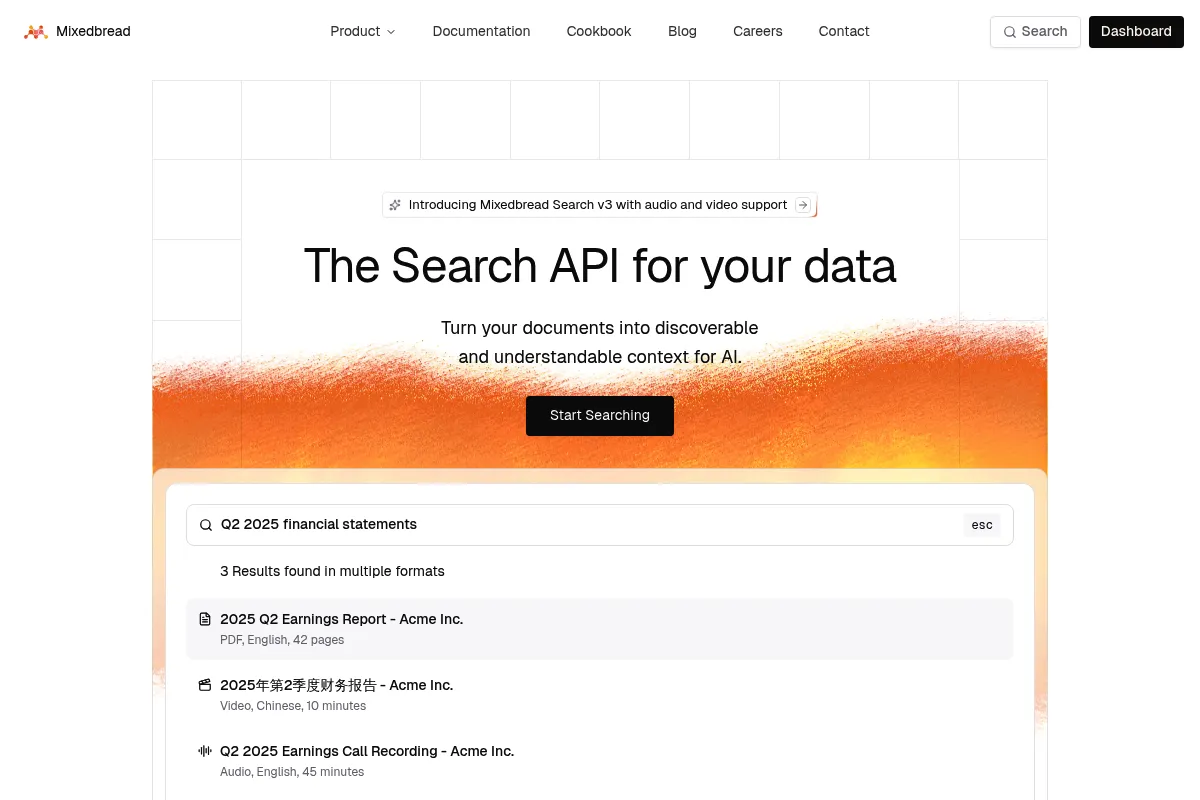
Who Should Use mixedbread ai?
Typical users
Machine learning engineers, backend developers, and search architects building retrieval-augmented generation (RAG) systems.
Maturity fit
scaling to advanced
Choose this if…
- Your priority is maximizing retrieval accuracy on the MTEB benchmark
- You want to reduce vector database costs using Matryoshka embeddings
- You need a dedicated reranker to improve the quality of LLM context windows
- You prefer the option to switch between a managed API and self-hosted open-source models
Skip this if…
- You need an all-in-one platform that includes generative LLMs (like OpenAI or Anthropic)
- Your project requires a managed vector database bundled with the embedding service
- You rely on a vast library of pre-built no-code integrations
About mixedbread ai
mixedbread ai is a German-based AI research company specializing in information retrieval. It provides optimized models designed to convert text into searchable vectors and re-rank results for maximum relevance in RAG pipelines and semantic search engines.
What it actually does
The tool provides an API for generating text embeddings and performing cross-encoder reranking. It allows developers to transform unstructured text into numerical representations and then sort those results to ensure the most relevant data is prioritized for search or LLM processing.
What makes it different
It focuses heavily on efficiency techniques like Matryoshka Representation Learning and binary quantization. These allow users to shrink vector dimensions (e.g., from 1024 to 256) with minimal accuracy loss, significantly reducing the storage and memory requirements of vector databases.
Key Features
mxbai-embed-large-v1
A top-performing open-source model on the MTEB benchmark for retrieval tasks.
Matryoshka Embeddings
Enables truncating vectors to save storage space without needing to re-embed data.
Reranking API
Uses cross-encoders to score document relevance more accurately than standard vector search.
Binary Quantization
Reduces vector size by up to 32x, allowing for massive scale search on limited hardware.
Hugging Face Availability
Model weights are public, allowing for local deployment to avoid API latency or privacy issues.
Flexible Dimensions
Users can choose vector sizes that balance performance and cost for their specific database.
Optimized for RAG
Specifically tuned to find the most relevant context for Large Language Models.
Pricing
Free
- 1 million embedding tokens per month
- 1,000 rerank requests per month
- Community support
- Access to all open-source models
Pay-as-you-go
- $0.06 per 1M embedding tokens
- $0.02 per 100 rerank units
- No monthly minimums
- Standard API rate limits
Enterprise
- Custom rate limits
- Dedicated support
- Private deployments
- SLA guarantees
Pricing checked 5 months ago
Pricing guidance
- When monthly embedding volume exceeds 1M tokens
- When rerank request volume exceeds 1,000 per month
- When production latency requirements necessitate higher rate limits
- Rerank units are calculated based on document count and length
- Rate limits on the free tier can be restrictive for bulk indexing
Highly competitive pricing that undercuts major providers like Cohere while offering more storage-saving features.
Pros & Cons
Strengths
-
Superior Retrieval Performance
Consistently ranks near the top of the Massive Text Embedding Benchmark (MTEB), often outperforming larger models from OpenAI and Cohere.
-
Significant Cost Savings
Matryoshka and quantization features allow users to use smaller vector dimensions, which can cut vector database hosting costs by 70% or more.
-
Deployment Flexibility
The availability of open-source weights means teams can prototype on the API and move to self-hosted infrastructure as they scale.
Weaknesses
-
Fragmented Stack
Because they don't offer generative models, you must manage separate API keys and billing for your LLM (e.g., OpenAI, Anthropic).
Affects: Small teams wanting a unified billing and management experience
-
Limited Ecosystem Integrations
Fewer native 'one-click' integrations in tools like LangChain or LlamaIndex compared to more established providers.
Affects: Developers looking for rapid, no-code prototyping
-
Niche Focus
The tool is highly specialized for search; it offers no features for fine-tuning, data labeling, or agent orchestration.
Affects: Teams looking for a broad AI development platform
Real User Sentiment
Generally positive, with users praising the technical innovation in vector compression and the performance of the mxbai-embed-large model.
Users tend to like
- Matryoshka embedding flexibility
- High accuracy on retrieval tasks
- Low cost per token
- Open-source availability of model weights
Users commonly complain about
- Documentation can be sparse for advanced configurations
- Lack of built-in generative capabilities
- Smaller community compared to OpenAI
Recurring tradeoffs
- Users trade the convenience of an all-in-one platform for better search accuracy and lower storage costs.
Happiest users
ML engineers who are frustrated with high Pinecone/Weaviate bills and need to optimize their vector storage.
Often frustrated
Beginners who want a single API to handle both 'finding' and 'answering' questions.
Use Cases
High-Scale RAG
Reducing vector database costs for millions of documents using Matryoshka embeddings.
E-commerce Search
Using reranking to ensure product results match user intent more accurately than keyword search.
Legal Discovery
Processing massive datasets where high retrieval recall is legally critical.
Multilingual Knowledge Bases
Building semantic search that works across different languages using their multilingual models.
Local AI Applications
Using the open-source weights to run private search on-premises without data leaving the network.
Frequently Asked Questions
How does mixedbread ai compare to OpenAI text-embedding-3?
While OpenAI is easier to integrate into an existing GPT-based stack, mixedbread ai models often score higher on retrieval benchmarks (MTEB). Additionally, mixedbread provides reranking models and Matryoshka embeddings, which OpenAI currently does not offer in the same flexible capacity for storage optimization.
What is the benefit of Matryoshka embeddings?
Matryoshka embeddings allow you to store only the first portion of a vector (e.g., 256 dimensions instead of 1024) while retaining most of the accuracy. This reduces your vector database storage and memory costs by up to 75% without requiring you to re-embed your entire dataset if you decide to change sizes later.
Can I use mixedbread ai for free?
Yes, they offer a free tier that includes 1 million embedding tokens and 1,000 rerank requests per month. This is sufficient for small-scale projects or testing the model's accuracy before committing to a paid plan.
Does mixedbread ai provide an LLM for generating text?
No, mixedbread ai focuses exclusively on the retrieval part of the AI stack (embeddings and reranking). You will need to use a separate provider like OpenAI, Anthropic, or a self-hosted Llama model to generate the final text response in a RAG pipeline.
Is it possible to self-host their models?
Yes, many of their models, including mxbai-embed-large-v1, are available on Hugging Face under open-source licenses. This allows you to run the models on your own infrastructure using libraries like Sentence-Transformers or Transformers.js.
What is the pricing for reranking?
Reranking is priced at $0.02 per 100 units on the Pro plan. A unit typically corresponds to a specific number of document-query pairs, making it a cost-effective way to add a second layer of precision to your search results.
Why trust this page?
This evaluation combines product positioning, pricing analysis, traffic and market signals, and public user sentiment into a single decision-support page. Content is generated editorially — not copied from the vendor's website.
Funding & Company
Founded
2023
Stage
Seed
Total Raised
$5.5M
Latest Round
Seed (Aug 2024)
Notable Investors
mixedbread ai has reportedly raised a $5.5 million Seed round in August 2024. This initial funding supports the development of its open-source and commercial AI models for information retrieval and semantic search.
Market Signals & Traffic
Estimated visits, global rank, geography, traffic sources, monthly visit trends, and organic search keywords (Similarweb)—on a dedicated page built for depth and search.
- Estimated visits
- 0
- Global rank
- —
- Snapshot
- Apr 2026
- Traffic trend
- —
Estimated monthly visits
Alternatives to mixedbread ai
View all alternatives
Similar Tools
Voyage AI
Developer Tools, Search

High-performance embedding models and rerankers for retrieval-augmented generation.
bloop
Developer Tools, Search

Natural language search engine for exploring and understanding codebases.
Pinecone
Developer Tools, Search

Managed vector database for building scalable search and RAG applications
Weaviate
Developer Tools, Search

Open-source vector database for building scalable semantic search applications.
LanceDB
Developer Tools, Search

Open-source vector database for multi-modal search and RAG applications
Milvus
Developer Tools, Search

Open-source vector database for high-performance similarity search and RAG.