

LanceDB
An embedded, serverless vector database that treats multi-modal data as a first-class citizen—best for developers who want to avoid infrastructure management while scaling to billions of vectors on disk.
Excellent for local-first development and serverless RAG applications, weaker for teams requiring a long-established enterprise cloud UI with legacy compliance certifications.
Analysis based on product data, pricing structure, traffic signals, and public user sentiment.
Who Should Use LanceDB?
Typical users
AI engineers and data scientists building RAG applications, multi-modal search engines, or recommendation systems who prefer a 'pip install' experience over managing database clusters.
Maturity fit
beginner to scaling
Choose this if…
- You want to start with a local database and transition to the cloud without code changes
- Your data includes images, video, or audio alongside text embeddings
- You need to perform complex metadata filtering using standard SQL syntax
- You want to minimize costs by storing data on S3 or local disk rather than expensive RAM
Skip this if…
- You require a database with a decade of enterprise uptime and SOC2 Type 2 history
- Your team lacks Python, Rust, or JavaScript expertise
- You need a fully managed service with a mature, feature-rich web console for non-technical admins
About LanceDB
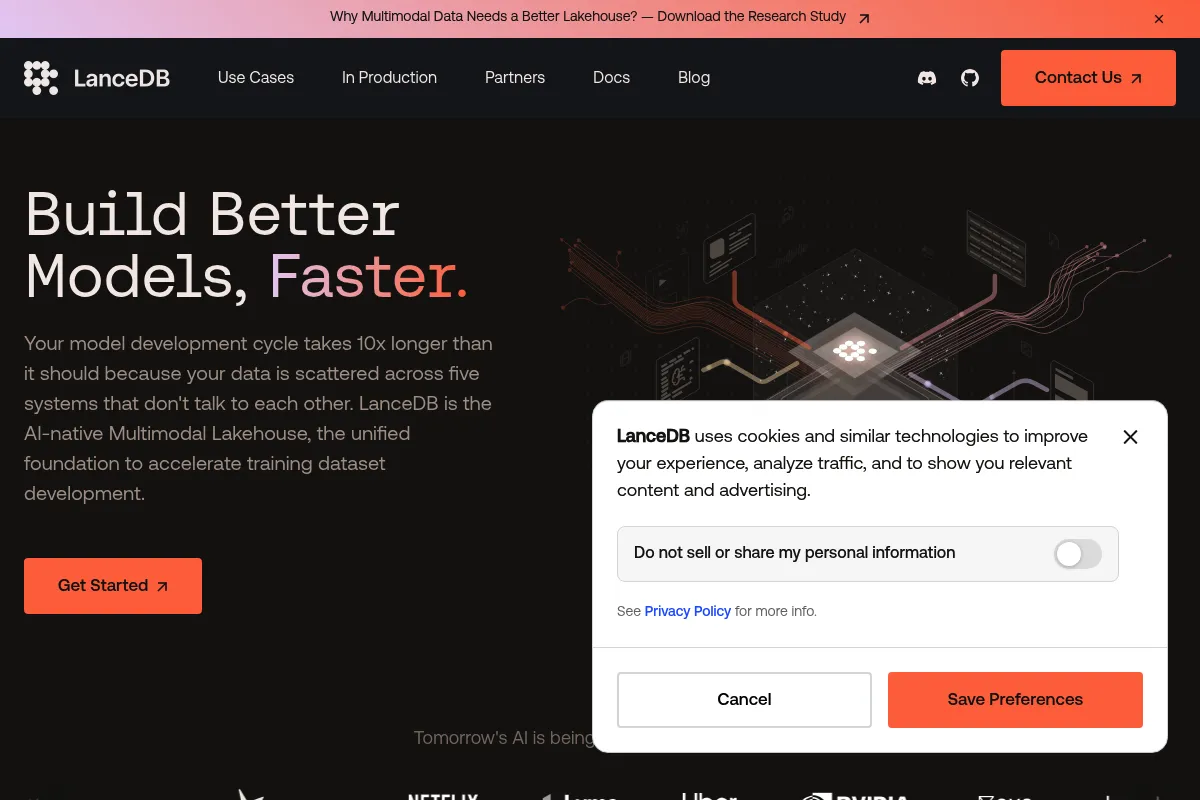
LanceDB is an open-source vector database built on the Lance columnar data format. It is designed to be embedded directly into applications, eliminating the need for separate database servers during development and providing a serverless path for production.
Official profiles
What it actually does
It stores and indexes vector embeddings alongside structured metadata and raw multi-modal files. Users can perform sub-second vector similarity searches, full-text searches, and SQL-based filtering across massive datasets stored on local disk or cloud object storage like AWS S3.
What makes it different
Unlike traditional vector databases that require data to be kept in memory for performance, LanceDB uses the Lance format to enable fast random access directly from disk. This architectural choice allows it to handle datasets larger than memory at a significantly lower cost than RAM-heavy competitors like Pinecone or Weaviate.
Key Features
Lance Columnar Format
Optimized for high-performance random access and vector search on disk.
Serverless Cloud
A managed version that scales compute independently from storage costs.
SQL Integration
Allows using standard SQL for complex filtering of vector metadata.
Multi-modal Storage
Stores actual images and videos alongside their embeddings in the same table.
Disk-based Indexing
Enables searching billions of vectors without requiring massive amounts of RAM.
Python/JS/Rust SDKs
Native libraries that allow the database to run inside your application process.
IVF-PQ Indexing
Supports advanced indexing techniques to balance search speed and accuracy.
Pricing
Open Source
- Self-hosted or embedded
- Unlimited vectors
- Local or S3 storage
- Full SQL support
- Multi-modal capabilities
Cloud Free
- Managed serverless setup
- Up to 10GB storage
- Community support
- Single user
Cloud Pro
- Pay-as-you-go storage ($0.06/GB)
- Pay-as-you-go compute
- Unlimited storage
- Priority support
- Team collaboration
Enterprise
- VPC Peering
- Dedicated infrastructure
- SLA guarantees
- Custom compliance (SOC2/HIPAA)
Pricing checked 4 months ago
Pricing guidance
- When you need a managed API endpoint for a web application
- When you require team collaboration and access control
- When you need SOC2 compliance or dedicated support
- Cloud Free tier has strict storage caps
- Compute costs in Pro can spike with high query volumes
- Self-hosted S3 performance depends on your network configuration
Highly competitive pricing that disrupts the market by decoupling storage from compute costs.
Pros & Cons
Strengths
-
Zero-overhead setup
You can initialize a database with a single line of code in Python or Node.js, making it the fastest way to move from a prototype to a functional RAG system.
-
Cost-efficient scaling
By utilizing disk-based storage and S3, it avoids the high monthly costs associated with keeping entire vector indexes in memory.
-
True multi-modal support
It doesn't just store links to files; it manages the underlying data, making it easier to build applications that search across different media types.
-
Standard SQL support
Developers don't have to learn a proprietary query language for metadata filtering, reducing the learning curve for teams already familiar with SQL.
Weaknesses
-
Cloud offering is relatively new
While the open-source core is stable, the managed Cloud version is still maturing and may lack the administrative bells and whistles of older competitors.
Affects: Enterprise teams requiring mature management consoles
-
Documentation gaps
As a fast-moving project, some advanced features or edge-case configurations are not as thoroughly documented as the core API.
Affects: Developers building highly custom or complex database architectures
-
Smaller ecosystem
Compared to Pinecone or Milvus, there are fewer third-party community tutorials and integrations available.
Affects: Beginners who rely heavily on community-made templates
Real User Sentiment
Users generally praise LanceDB for its simplicity and the performance of its underlying file format, though some note it is still 'early days' for the managed cloud service.
Users tend to like
- Ease of installation and local development
- Performance on large datasets using disk storage
- The ability to use SQL for filtering
- Integration with the Arrow ecosystem
Users commonly complain about
- Occasional breaking changes in early versions
- Cloud console lacks advanced monitoring features
- Documentation can be sparse for Rust and JS compared to Python
Recurring tradeoffs
- Trading off the maturity of a legacy provider for the cost-efficiency of a modern disk-based architecture
Happiest users
Python developers building RAG apps who want to avoid the complexity of Docker or cloud infrastructure during the MVP phase.
Often frustrated
Enterprise architects who need a 'boring' and highly certified database with a long track record of managed service stability.
Use Cases
RAG Applications
Storing document embeddings and metadata for context-aware LLM responses.
E-commerce Search
Building visual search engines where users upload a photo to find similar products.
Video Analytics
Indexing frames and timestamps for semantic search within video libraries.
Recommendation Engines
Using vector similarity to suggest content based on user behavior embeddings.
Local AI Tools
Embedding a database directly into a desktop or edge application for offline search.
Frequently Asked Questions
Is LanceDB really free?
The core LanceDB database is open-source and completely free to use, whether you run it locally or host it yourself on your own servers or cloud storage. You only pay if you choose to use their managed 'LanceDB Cloud' service, which handles the infrastructure for you.
How does LanceDB compare to Pinecone?
Pinecone is a fully managed, cloud-native service that is easy to use but can become expensive because it often requires data to be in RAM. LanceDB is 'embedded-first,' meaning it runs inside your app, and it uses a disk-based format (Lance) that is significantly cheaper for large datasets while remaining very fast.
What are the main limitations of LanceDB?
The primary limitation is its relative youth; the managed cloud service is newer than competitors like Weaviate or Milvus. Additionally, while it is excellent for Python and JS, support for other languages is still developing, and the administrative UI for the cloud version is currently minimal.
Does LanceDB support SQL?
Yes, one of LanceDB's standout features is its native support for SQL. You can combine vector similarity searches with standard SQL WHERE clauses to filter your results based on metadata like dates, categories, or user IDs.
Can I use LanceDB with LangChain or LlamaIndex?
Yes, LanceDB has deep, first-class integrations with both LangChain and LlamaIndex, making it easy to drop into existing RAG pipelines as the primary vector store.
What is the 'Lance' format?
Lance is a modern columnar data format designed to replace Parquet for AI workloads. It is optimized for high-performance random access, which is critical for vector search, and it allows LanceDB to query data directly from disk or S3 without loading everything into memory.
Why trust this page?
This evaluation combines product positioning, pricing analysis, traffic and market signals, and public user sentiment into a single decision-support page. Content is generated editorially — not copied from the vendor's website.
Funding & Company
Founded
2022
Stage
Series a
Total Raised
$41M
Latest Round
Series A (Jun 2025)
Notable Investors
LanceDB has raised a total of $41 million across three funding rounds, culminating in a $30 million Series A in mid-2025. This significant funding from notable investors like Theory Ventures and CRV provides substantial runway to develop its multimodal AI data platform.
Market Signals & Traffic
Estimated visits, global rank, geography, traffic sources, monthly visit trends, and organic search keywords (Similarweb)—on a dedicated page built for depth and search.
- Estimated visits
- 87,463
- Global rank
- #406,029
- Snapshot
- Apr 2026
- Traffic trend
- Surging
Estimated monthly visits
Alternatives to LanceDB
View all alternativesPinecone
Developer Tools, Search

Managed vector database for building scalable search and RAG applications
Weaviate
Developer Tools, Search

Open-source vector database for building scalable semantic search applications.
Qdrant
Developer Tools, Search

High-performance vector database and search engine for unstructured data.
Similar Tools
Chroma
Developer Tools, Search

Open-source embedding database for building applications with long-term memory.
mixedbread ai
Developer Tools, Search

High-performance embedding and reranking models for semantic search.
Zilliz
Developer Tools, Search

High-performance vector database for similarity search and RAG applications.
Weaviate
Developer Tools, Search
Open-source vector database for building scalable semantic search applications.
Milvus
Developer Tools, Search

Open-source vector database for high-performance similarity search and RAG.
Pinecone
Developer Tools, Search
Managed vector database for building scalable search and RAG applications