

Agenta
An open-source LLM-ops platform that bridges the gap between developer code and domain expert prompt tuning — best for teams prioritizing self-hosting and collaborative evaluation.
Excellent for teams needing a self-hosted evaluation environment, weaker for those requiring deep production observability compared to LangSmith.
Analysis based on product data, pricing structure, traffic signals, and public user sentiment.
Who Should Use Agenta?
Typical users
Small to mid-sized engineering teams building LLM applications where non-technical stakeholders need to iterate on prompts without touching code.
Maturity fit
scaling
Choose this if…
- You need to self-host your evaluation infrastructure for data privacy
- Your priority is enabling non-developers to test and version prompts in a UI
- You want to compare model outputs side-by-side across different providers
- You prefer an open-source core over proprietary SaaS lock-in
Skip this if…
- You are already deeply committed to the LangChain ecosystem and prefer LangSmith's native integration
- Your primary need is post-deployment monitoring and cost tracking rather than pre-production evaluation
- You want a fully managed, zero-config setup with no infrastructure overhead
About Agenta
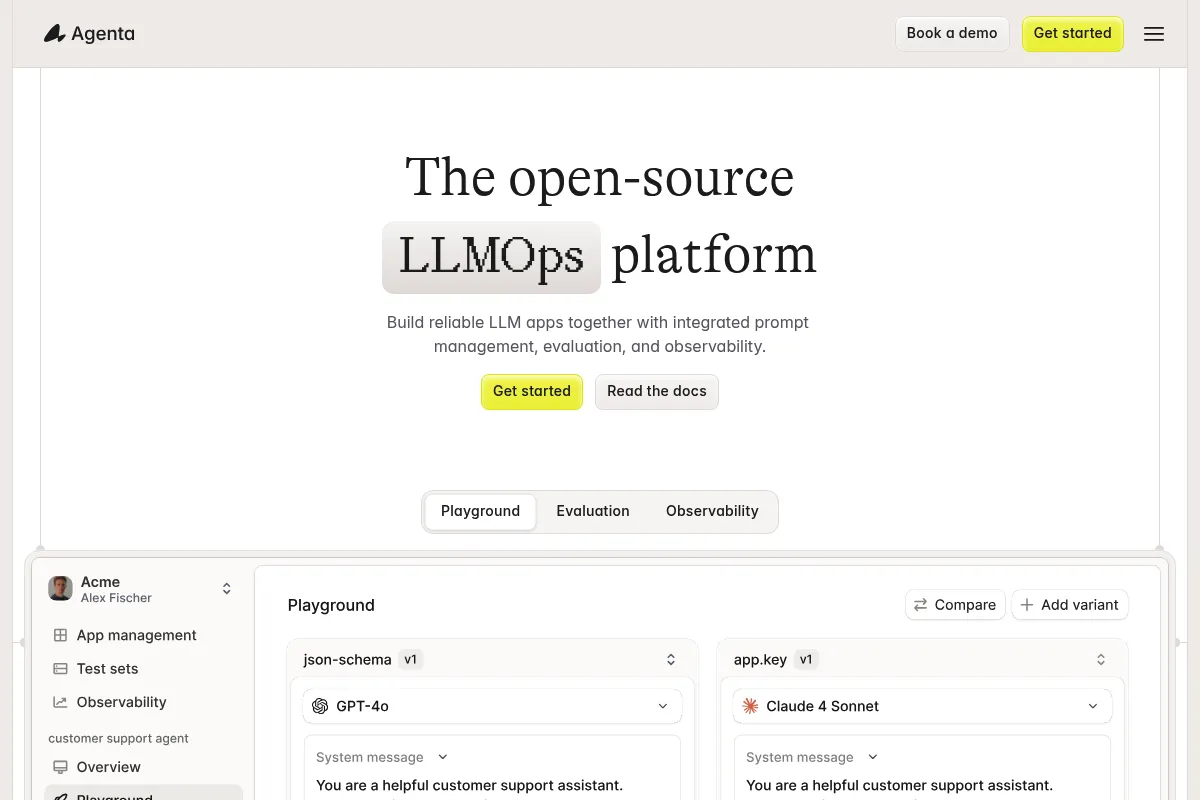
Agenta is an open-source developer platform for the end-to-end lifecycle of LLM applications. It provides a centralized environment for prompt engineering, automated testing, and human-in-the-loop evaluation to ensure model reliability before deployment.
Official profiles
What it actually does
It allows developers to define LLM apps in code and expose them to a web UI where team members can experiment with prompts and parameters. The platform facilitates systematic testing of these variations against datasets using both algorithmic scorers and manual human reviews.
What makes it different
Unlike SaaS-only competitors, Agenta is built to be self-hosted, giving teams full control over their data. It specifically targets the 'collaboration gap' by providing a playground that syncs directly with code-based configurations, allowing developers and domain experts to work on the same logic.
Ratings across the web

Ratings aggregated from independent review platforms.
Key Features
Prompt Playground
Enables non-technical users to tweak parameters and see results in real-time
Evaluation Suites
Runs batches of inputs through multiple prompt versions to calculate accuracy or cost
Human Evaluation UI
Provides a structured interface for experts to grade model responses manually
Deployment Management
Allows one-click promotion of prompt versions to production API endpoints
SDK & CLI
Connects your existing Python or TypeScript code to the Agenta management UI
Custom Scorers
Supports writing Python functions to validate outputs based on specific business logic
Version Control
Tracks every change to prompts and configurations for easy rollbacks
Pricing
Open Source
- Self-hosted via Docker
- Unlimited users
- All core evaluation features
- Community support
Cloud Starter
- Hosted by Agenta
- 1 user
- Limited test runs
- Basic support
Cloud Pro
- Unlimited test runs
- Collaboration features
- Priority support
- Advanced human evaluation
Enterprise
- SSO/SAML
- Role-based access control
- Dedicated support
- Custom deployment options
Pricing checked 6 months ago
Pricing guidance
- When you need hosted convenience over self-management
- When you require team collaboration and RBAC
- When you need SSO for enterprise security compliance
- Cloud Starter has strict limits on the number of test cases and runs
- Self-hosted version requires managing your own database and storage backups
Competitive and accessible, with a strong emphasis on the free open-source tier to drive adoption.
Pros & Cons
Strengths
-
Privacy-first self-hosting
Being open-source allows enterprises with strict data residency requirements to run the entire stack on their own VPC.
-
Developer-to-Expert collaboration
The UI allows subject matter experts to refine prompts without needing to understand Git or Python, speeding up the iteration cycle.
-
Model agnostic architecture
It doesn't force a specific framework, making it easier to switch between providers or use local models via LiteLLM.
Weaknesses
-
Limited production observability
While it handles evaluation well, it lacks the deep execution tracing and performance monitoring found in tools like LangSmith or Arize Phoenix.
Affects: Teams needing detailed post-deployment debugging
-
Self-hosting complexity
Setting up the full stack via Docker can be cumbersome for small teams compared to a pure SaaS solution.
Affects: Solo developers or very small startups
-
Smaller integration ecosystem
Has fewer out-of-the-box integrations with third-party vector databases and monitoring tools than more established players.
Affects: Teams with complex, multi-tool AI stacks
Real User Sentiment
Generally positive, with users appreciating the clean UI and the ability to involve non-coders in the prompt engineering process.
Users tend to like
- Ease of comparing different model outputs
- Clean and intuitive human evaluation interface
- Flexibility of the open-source license
- Ability to version prompts independently of code
Users commonly complain about
- Initial setup hurdles with Docker
- Documentation can lag behind new feature releases
- Lack of advanced tracing features
Recurring tradeoffs
- You trade the deep ecosystem of LangChain for a more focused, framework-agnostic evaluation tool.
Happiest users
Product managers and developers working together on complex prompt logic that requires frequent qualitative review.
Often frustrated
Developers looking for a 'set it and forget it' SaaS observability tool with zero configuration.
Use Cases
Prompt Optimization
Comparing how GPT-4 vs Claude 3 handles a specific customer support persona.
Regression Testing
Ensuring a new prompt version doesn't break existing successful outputs across a dataset.
Human-in-the-loop Review
Having legal or domain experts grade AI-generated summaries for accuracy.
Model Switching
Testing if a cheaper model (like Llama 3) can replace a more expensive one without quality loss.
Collaborative Prompting
Allowing a marketing lead to edit the 'tone' of an AI writer without touching the backend code.
Frequently Asked Questions
Is Agenta free to use?
Yes, Agenta offers a fully functional open-source version that you can self-host via Docker for free. They also offer a Cloud Starter plan for free with usage limits, while the Cloud Pro plan costs $20 per user per month for those who prefer a managed service.
How does Agenta compare to LangSmith?
LangSmith is a proprietary tool deeply integrated with the LangChain framework, excelling at production tracing and debugging. Agenta is open-source, framework-agnostic, and focuses more heavily on the collaborative evaluation and prompt engineering phase before production.
Can I use Agenta with local models?
Yes, Agenta supports local models. You can connect it to local inference servers like Ollama or vLLM, typically using LiteLLM as a bridge to provide an OpenAI-compatible API endpoint.
Does Agenta store my API keys?
In the Cloud version, your keys are stored encrypted to facilitate model calls. In the self-hosted version, you have complete control over where and how your keys and data are stored within your own infrastructure.
What languages does the Agenta SDK support?
Agenta primarily supports Python and TypeScript/JavaScript, which covers the majority of LLM application development. You can use the CLI to sync your code-based applications with the Agenta UI.
Can I use Agenta for production monitoring?
While Agenta has some deployment and versioning capabilities, it is primarily an evaluation and prompt engineering platform. It is not a full-featured observability tool like Helicone or Arize Phoenix for real-time production monitoring.
Why trust this page?
This evaluation combines product positioning, pricing analysis, traffic and market signals, and public user sentiment into a single decision-support page. Content is generated editorially — not copied from the vendor's website.
Funding & Company
Founded
2023
Stage
Seed
Total Raised
$108K
Latest Round
Undisclosed (Jan 2024)
Notable Investors
Agenta has raised a disclosed Seed round of $108K and secured an additional undisclosed investment from the venture capital firm Antler in early 2024. This early-stage backing provides the company with the initial capital to develop its open-source LLMOps platform and build a foundational user community.
Market Signals & Traffic
Estimated visits, global rank, geography, traffic sources, monthly visit trends, and organic search keywords (Similarweb)—on a dedicated page built for depth and search.
- Estimated visits
- 30,936
- Global rank
- #858,720
- Snapshot
- Apr 2026
- Traffic trend
- Falling
Estimated monthly visits
Alternatives to Agenta
View all alternatives
Similar Tools
Tessl
Developer Tools, Automation & Agents

Package manager for agent skills and development context
All Hands AI
Developer Tools, Automation & Agents

Open-source platform for autonomous software engineering agents.
Cerebras
Developer Tools, Automation & Agents

High-speed infrastructure for large-scale model inference and training
Codegen
Developer Tools, Automation & Agents

Autonomous software engineering agent for automating complex coding tasks.
AgentOps
Developer Tools, Automation & Agents

Observability and monitoring platform for developers building autonomous agents
Plandex
Developer Tools, Automation & Agents

Terminal-based coding engine for complex multi-file development tasks