

Groq offers unparalleled AI inference speed through its specialized LPU hardware, making it a top choice for latency-sensitive applications but less suitable for general-purpose AI development.
Best for real-time AI inference, weaker for model training or broad AI workloads.
Analysis based on product data, pricing structure, traffic signals, and public user sentiment.
Who Should Use Groq?
Typical users
Developers and enterprises building applications that require extremely low latency and high throughput for AI model inference, such as real-time conversational AI, voice assistants, and interactive agents.
Maturity fit
scaling to advanced
Choose this if…
- Your primary requirement is sub-millisecond latency for AI inference.
- You need to process large volumes of requests with consistent, predictable performance.
- You are working with open-source LLMs and want to maximize their inference speed.
- Cost-efficiency at high inference volumes is a key consideration.
Skip this if…
- You need to train or fine-tune AI models.
- Your application requires a wide range of AI model types beyond LLMs and speech processing.
- You need extensive integration with a broad ecosystem of AI development tools.
- Cost is not a primary concern and flexibility for diverse AI tasks is paramount.
About Groq
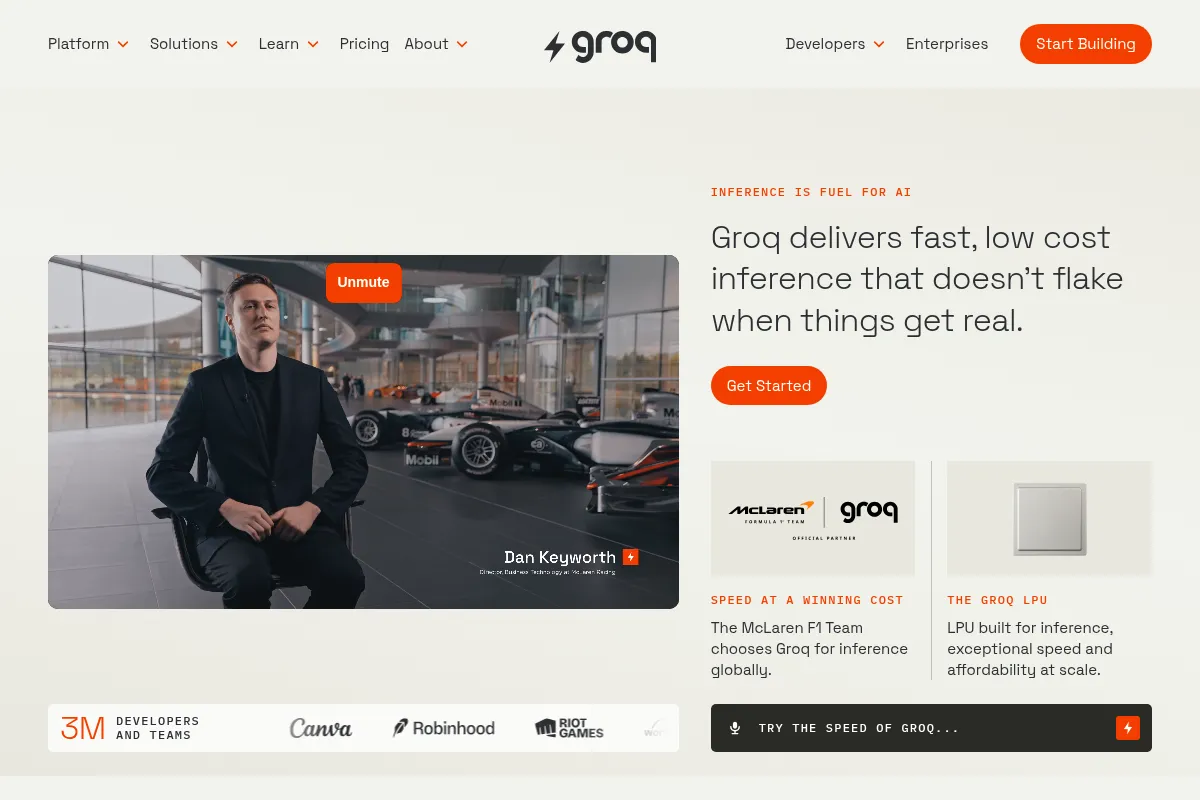
Groq is an AI hardware company that has developed its own Language Processing Units (LPUs) specifically designed to accelerate AI inference. Their platform, including GroqCloud and GroqRack, focuses on delivering exceptionally fast and low-latency processing for large language models and other AI workloads. Groq aims to enable a new generation of real-time AI applications by providing specialized hardware that outperforms traditional GPUs in inference speed and efficiency.
Official profiles
What it actually does
Groq provides a platform for running AI model inference at extremely high speeds and low latencies. It utilizes proprietary LPU chips and a specialized software stack to process LLMs and other AI models. Developers can access this through GroqCloud's API or on-premise with GroqRack, enabling real-time AI applications that were previously not feasible due to hardware limitations.
What makes it different
Groq's differentiation lies in its custom-designed Language Processing Units (LPUs), which are architected from the ground up for AI inference. Unlike GPUs designed for broader tasks including graphics and training, LPUs focus on deterministic, high-throughput, and low-latency execution of AI models. This specialized hardware, combined with a kernel-less compiler and on-chip SRAM, eliminates architectural bottlenecks common in GPU-based systems, leading to significant performance gains in inference speed.
Ratings across the web

Ratings aggregated from independent review platforms.
Key Features
Language Processing Units (LPUs)
Custom-designed chips optimized for AI inference, delivering superior speed and efficiency compared to GPUs.
GroqCloud API
Provides cloud-based access to Groq's LPU inference engine, allowing developers to integrate high-speed AI processing into their applications.
Deterministic Execution
Ensures predictable performance and consistent latency, crucial for real-time applications.
On-chip SRAM
Integrates large amounts of SRAM directly on the LPU for faster data access and reduced latency.
Kernel-less Compiler
Simplifies the process of compiling and running new models, enabling faster deployment.
Support for Open-Source Models
Offers optimized performance for a wide range of popular open-source LLMs.
GroqRack
On-premise hardware solution for enterprises requiring dedicated LPU infrastructure.
Batch Processing
Allows for asynchronous processing of large workloads at a reduced cost.
Pricing
Free
- API access
- Community support
- Zero-data retention
- Build and test on Groq
Developer
- Higher token limits
- Chat support
- Flex Service Tier
- Batch processing
- Spend limits
- Prompt caching
Enterprise
- Custom models
- Regional endpoint selection
- Performance Tier
- Scalable capacity
- Dedicated support
- LoRA fine-tunes
Pricing checked 6 months ago
Pricing guidance
- When your application requires higher token limits or more consistent performance tiers.
- When you need dedicated support and custom solutions for large-scale deployments.
- When batch processing or prompt caching becomes essential for your workflow.
- The free tier has rate limits that are not explicitly detailed but are implied for testing purposes.
- While pricing is generally transparent, specific model costs can vary, and output tokens are often priced higher than input tokens.
- Enterprise plans require custom quotes, meaning pricing is not publicly available and requires direct engagement with sales.
Groq offers a tiered pricing model from a free tier for experimentation to custom enterprise solutions, with a pay-as-you-go developer plan that provides flexibility and cost predictability for scaling inference workloads.
Pros & Cons
Strengths
-
Unmatched Inference Speed
Groq's LPUs deliver industry-leading tokens per second and sub-millisecond latency, enabling real-time AI applications that are not possible with traditional hardware. This speed is critical for conversational AI and interactive agents.
-
Predictable Performance
The deterministic nature of Groq's architecture ensures consistent latency and throughput, making it reliable for mission-critical applications where timing is paramount.
-
Cost-Effective at Scale
While hardware can be expensive, the efficiency and speed of LPUs can lead to lower operational costs per inference at high volumes compared to GPU clusters.
-
Optimized for Inference
Unlike GPUs, Groq's LPUs are purpose-built for inference, eliminating overhead and bottlenecks associated with general-purpose hardware, leading to superior performance for this specific task.
-
Growing Ecosystem and Developer Support
Groq is actively expanding its platform, offering developer tools, community support, and integrations with popular frameworks like LangChain, making it easier for developers to adopt.
Weaknesses
-
Limited to Inference
Groq's LPUs are exclusively designed for AI inference and cannot be used for model training or fine-tuning, requiring users to maintain separate GPU infrastructure for development.
-
High Hardware Cost for On-Premise
Deploying GroqRack for on-premise solutions involves significant upfront hardware investment, making it less accessible for smaller organizations or those with limited capital.
-
Niche Hardware Architecture
The specialized nature of LPUs means they are not a drop-in replacement for all AI workloads and may require specific software optimizations or architectural considerations.
-
Less Versatile than GPUs
While excelling at inference, LPUs are not designed for the broad range of AI tasks that GPUs can handle, such as complex model training, scientific computing, or graphics rendering.
-
Limited Model Selection on GroqCloud
While supporting many open-source models, the selection of proprietary or highly specialized models available on GroqCloud may be more limited compared to broader cloud AI platforms.
Real User Sentiment
Users are highly impressed with Groq's inference speed and low latency, often describing it as a 'game-changer' for real-time AI applications. The performance consistently exceeds expectations, though some users note limitations in model variety and the specialized nature of the hardware.
Users tend to like
- Exceptional inference speed and low latency
- Predictable and consistent performance
- Cost-effectiveness at scale for inference
- The potential for real-time AI applications
- Support for open-source models
Users commonly complain about
- Limited to inference workloads; not suitable for training.
- High cost of on-premise hardware (GroqRack).
- Less versatile than GPUs for general AI tasks.
- Potentially limited selection of proprietary models on GroqCloud.
- Requires separate GPU infrastructure for model development.
Recurring tradeoffs
- Speed vs. Versatility: Groq offers extreme speed for inference but lacks the versatility of GPUs for training and other AI tasks.
- Cost vs. Performance: While cost-effective at scale for inference, the initial hardware investment for on-premise solutions is high.
- Specialized Hardware vs. General Purpose: LPUs are optimized for inference, which can be a limitation if broader AI capabilities are needed.
Happiest users
Developers and companies building real-time AI applications, conversational agents, and interactive systems where sub-millisecond latency is critical.
Often frustrated
Users who require a single solution for both AI model training and inference, or those who need a wide array of specialized or proprietary AI models not yet supported by Groq.
Use Cases
Powering real-time conversational AI chatbots and virtual assistants.
Enabling instant responses for voice-activated applications and smart devices.
Accelerating medical diagnostics and healthcare agent applications with low-latency data processing.
Building dynamic and responsive NPCs for AI-driven video games.
Providing real-time fact-checking and news aggregation services.
Enhancing RAG (Retrieval-Augmented Generation) pipelines for faster knowledge retrieval.
Developing interactive educational tools and personalized learning platforms.
Frequently Asked Questions
What is Groq's LPU technology?
Groq's Language Processing Unit (LPU) is a custom-designed chip architecture specifically built for accelerating AI inference. Unlike GPUs, which are designed for a broader range of tasks including graphics and model training, LPUs are optimized for the deterministic, high-throughput, and low-latency execution of AI models. This specialized design allows Groq to achieve significantly faster inference speeds and more consistent performance for workloads like large language models (LLMs).
How does Groq's pricing work?
Groq offers a tiered pricing model. There is a free tier for getting started, a pay-as-you-go Developer plan based on token usage, and custom Enterprise plans for large-scale needs. The Developer plan is highlighted as a good option for flexibility and scaling, with pricing generally being transparent and predictable, avoiding the hidden costs or elastic pricing seen with some other providers.
What are the main limitations of Groq?
The primary limitation of Groq is its specialization in AI inference; its LPU hardware is not designed for AI model training or fine-tuning, meaning users will still need separate GPU infrastructure for those tasks. Additionally, while Groq supports many open-source models, the selection of proprietary or highly specialized models available on GroqCloud might be more limited compared to broader cloud AI platforms. The cost of on-premise GroqRack hardware can also be a significant barrier for smaller organizations.
How does Groq compare to NVIDIA GPUs?
Groq's LPUs are designed specifically for AI inference, offering significantly faster speeds and lower, more deterministic latency compared to NVIDIA GPUs, which are more general-purpose and also optimized for training. While GPUs are versatile for a wide range of AI tasks, Groq excels in pure inference performance. Groq's architecture uses on-chip SRAM for faster memory access, whereas GPUs typically rely on HBM.
Can I train AI models on Groq?
No, Groq's LPU technology is exclusively designed for AI inference and cannot be used for training or fine-tuning AI models. Users will need to use traditional GPU hardware for model development and training before deploying them on Groq for inference.
What kind of AI models does Groq support?
Groq primarily supports a wide range of popular open-source large language models (LLMs) and speech models. This includes models from providers like Meta (LLaMA), Mistral, Qwen, and DeepSeek. While they focus on open-source models for their platform, they also offer custom model support for enterprise clients.
What are the integration options for Groq?
Groq offers several integration patterns, including a straightforward API for cloud-based access via GroqCloud, and on-premise solutions with GroqRack. They provide SDKs for popular languages like Python and JavaScript, and integrate with industry-standard frameworks such as LangChain and Vercel AI SDK. Groq also offers built-in tools (like web search and code execution) and supports remote tool calling via MCP servers for agentic workflows.
Is Groq suitable for enterprise-level deployments?
Yes, Groq offers Enterprise plans designed for businesses with large-scale needs, including custom models, scalable capacity, regional endpoint selection, and dedicated support. Their GroqRack solution also provides on-premise hardware for enterprises. Groq's predictable pricing and high performance at scale make it attractive for enterprise applications requiring real-time AI capabilities.
Why trust this page?
This evaluation combines product positioning, pricing analysis, traffic and market signals, and public user sentiment into a single decision-support page. Content is generated editorially — not copied from the vendor's website.
Funding & Company
Founded
2016
Stage
Late stage
Total Raised
$2.41B
Latest Round
Venture (May 2026)
Notable Investors
Groq has raised over $2.4 billion in equity financing to develop its high-speed AI inference hardware and cloud platform. [5] Following a significant $20 billion licensing and talent deal with Nvidia in late 2025, the company raised an additional $650 million in May 2026 to recapitalize and focus on its GroqCloud inference service. [3, 12] This substantial funding from top-tier investors like BlackRock and Disruptive signals a strong, albeit complex, path to longevity as a specialized cloud provider. [1, 4]
Market Signals & Traffic
Estimated visits, global rank, geography, traffic sources, monthly visit trends, and organic search keywords (Similarweb)—on a dedicated page built for depth and search.
- Estimated visits
- 3,686,783
- Global rank
- #12,315
- Snapshot
- Apr 2026
- Traffic trend
- Surging
Estimated monthly visits
Alternatives to Groq
View all alternatives
Similar Tools
Reka
Developer Tools, AI Assistant

Multimodal language models for text, image, video, and audio.
Sourcegraph
Developer Tools, AI Assistant

Code intelligence platform for searching, writing, and understanding codebases
NXCode
Developer Tools, AI Assistant

Coding assistant for generating, debugging, and optimizing software code.
Replit
Developer Tools, AI Assistant

An AI-powered platform for building and deploying software applications directly from a browser.
Codeium
Developer Tools, AI Assistant

AI-powered coding assistant for enhanced developer productivity.
GitHub Copilot
Developer Tools, AI Assistant

AI-powered coding assistant that suggests and generates code.