
Reka
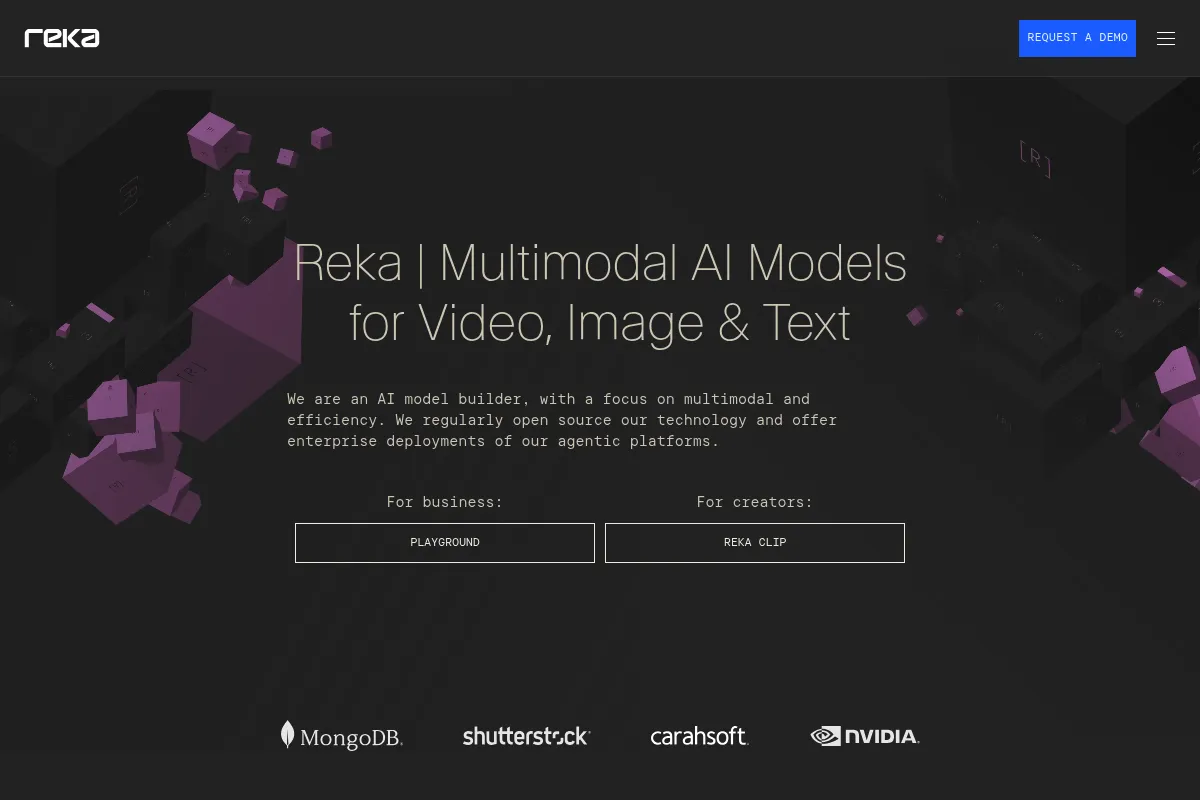
A specialized multimodal model provider that excels at native video and audio understanding with flexible deployment options for privacy-sensitive enterprises.
Excellent for developers building video-first AI agents or requiring VPC/on-premise deployment, weaker for those needing a massive third-party integration ecosystem.
Analysis based on product data, pricing structure, traffic signals, and public user sentiment.
Who Should Use Reka?
Typical users
AI engineers at scaling startups and enterprise developers building applications for video surveillance, media asset management, or high-privacy data processing.
Maturity fit
scaling to advanced
Choose this if…
- You need native video understanding (not just frame extraction) for search or Q&A
- Your data sovereignty requirements mandate VPC or on-premise deployment
- You want a model trained from scratch on multimodal data rather than a text-only model with vision adapters
Skip this if…
- You require a consumer-facing chat interface with a large plugin library
- Your primary use case is text-only and you want the lowest possible cost
- You need a context window larger than 128k for massive document analysis
About Reka
Reka develops frontier multimodal language models designed to process text, images, video, and audio simultaneously. Founded by researchers from DeepMind, Google, and Meta, it focuses on 'physical AI'—models that understand the visual and auditory signals of the real world.
What it actually does
Reka provides a suite of models (Core, Flash, Edge) accessible via API or private cloud. These models can describe video scenes, search through media libraries using natural language, transcribe audio, and perform complex reasoning tasks across different data types.
What makes it different
Unlike many competitors that 'bolt on' vision to a text model, Reka's models are natively multimodal from the start of training. This architecture allows for superior temporal consistency in video analysis and more nuanced understanding of audio-visual relationships.
Key Features
Reka Core
Flagship 67B model for complex reasoning and high-fidelity multimodal tasks.
Reka Flash
A 21B 'turbo-class' model optimized for speed and cost-efficiency.
Reka Edge
A compact 7B model designed for local, on-device execution.
Video Indexing
Managed service for pre-processing and storing video embeddings for fast retrieval.
Agentic Research
Capability to browse the web and synthesize information from multiple sources.
Private Deployment
Support for Snowflake, AWS, and Oracle Cloud Infrastructure (OCI) environments.
Highlight Generation
Automatically identifies and clips key moments from longer video footage.
Pricing
Reka Spark
- Compact model for on-device use
- $0.05 per 1M output tokens
- $0.005 per image
- $0.01 per video minute
Reka Flash
- Balanced speed and intelligence
- $2.00 per 1M output tokens
- $0.01 per image
- $0.06 per video minute
Reka Core
- Flagship reasoning capabilities
- $6.00 per 1M output tokens
- $0.02 per image
- $0.08 per video minute
Reka Research
- Agentic web browsing
- Multi-step reasoning traces
- Structured JSON output
Pricing checked 5 months ago
Pricing guidance
- When you need complex reasoning or high-fidelity image/video analysis (Core)
- When you require VPC or on-premise deployment for compliance
- When you hit the 60 RPM rate limit on the developer tier
- API is credit-based (pre-pay only)
- Standard video indexing auto-deletes after 30 days unless on Enterprise
- Video input is generally limited to 1 minute for optimal performance
Competitive pricing that undercuts OpenAI's multimodal offerings while charging a premium for specialized agentic research and private deployment.
Pros & Cons
Strengths
-
Superior video understanding
Outperforms many frontier models in video Q&A and temporal reasoning, making it a top choice for media-heavy applications.
-
Flexible deployment posture
Offers VPC, on-premise, and air-gapped options, which is a critical requirement for defense, healthcare, and finance sectors.
-
Native multimodality
The unified architecture leads to fewer hallucinations when reasoning between different data types (e.g., matching audio cues to visual actions).
Weaknesses
-
Limited ecosystem
Lacks the extensive third-party library support (e.g., pre-built connectors) found in OpenAI or Anthropic ecosystems.
Affects: Developers looking for 'plug-and-play' integrations
-
Lower rate limits
Standard API limits are capped at 60 requests per minute, which may require enterprise negotiation for high-volume production.
Affects: High-scale consumer applications
-
Hallucinations in long video
While strong, accuracy can degrade in videos approaching the 1-minute limit or with complex, fast-moving scenes.
Affects: Security and surveillance use cases
Real User Sentiment
Generally positive among technical users who appreciate the native video capabilities, though some find the text-only performance slightly behind GPT-4.
Users tend to like
- Exceptional video Q&A accuracy
- Flexible deployment options (VPC/OCI)
- Clean, developer-friendly API
- Strong reasoning for its parameter size
Users commonly complain about
- Occasional hallucinations in complex video scenes
- Documentation can be sparse compared to competitors
- API rate limits are restrictive for free/low-tier users
Recurring tradeoffs
- You trade the massive ecosystem of OpenAI for better video understanding and deployment flexibility.
Happiest users
Developers building specialized media search tools or enterprise apps with strict data residency requirements.
Often frustrated
Users expecting a polished, consumer-grade chatbot experience or those needing massive context windows (1M+ tokens).
Use Cases
Digital Asset Management
Automatically tagging and searching through thousands of hours of video footage.
Security & Surveillance
Identifying specific events or objects in security feeds using natural language.
Content Moderation
Scanning video and audio for policy violations with high temporal accuracy.
Market Research
Using Reka Research to synthesize competitor data and product reviews from the web.
On-Device AI
Running Reka Edge on local hardware for real-time image and audio processing without cloud latency.
Frequently Asked Questions
How does Reka's pricing compare to OpenAI?
Reka Core is significantly cheaper for input tokens ($2/1M vs GPT-4o's $5/1M) and video processing. While OpenAI charges per frame, Reka charges per video minute, which is often more predictable for media-heavy workloads.
Can I run Reka models on my own servers?
Yes. Reka offers flexible deployment options including on-premise, VPC (AWS/GCP), and private cloud environments like Snowflake or Oracle OCI for enterprise customers.
What is the maximum video length Reka can process?
The API is optimized for videos up to 1 minute. While longer videos can be uploaded, performance and accuracy for Q&A and search are best within this window.
Does Reka support audio-only tasks?
Yes, Reka has a dedicated Speech model and multimodal support for audio files, enabling transcription, translation, and contextual understanding beyond simple text conversion.
Is there a free tier available?
Reka provides a free playground to test models and a Vision API free tier that includes 3 hours of indexed video for evaluation purposes.
How does Reka handle data privacy?
Reka is SOC 2 Type I compliant. For enterprise customers, they offer zero-retention policies and the ability to deploy within your own secure infrastructure so data never leaves your environment.
Why trust this page?
This evaluation combines product positioning, pricing analysis, traffic and market signals, and public user sentiment into a single decision-support page. Content is generated editorially — not copied from the vendor's website.
Funding & Company
Founded
2022
Stage
Series b
Total Raised
$168M
Latest Round
Series B (Jul 2025)
Notable Investors
Reka has raised a total of $168 million over two significant funding rounds, achieving a valuation of over $1 billion. This substantial backing from major industry players like NVIDIA and Snowflake signals strong confidence in its multimodal AI technology and provides a solid financial runway for product development and market expansion.
Market Signals & Traffic
Estimated visits, global rank, geography, traffic sources, monthly visit trends, and organic search keywords (Similarweb)—on a dedicated page built for depth and search.
- Estimated visits
- 0
- Global rank
- —
- Snapshot
- May 2026
- Traffic trend
- Falling
Estimated monthly visits
Alternatives to Reka
View all alternativesClaude
AI Assistant

A conversational AI assistant for writing, analysis, coding, and more.
Mistral AI
AI Assistant, Developer Tools

Efficient large language models for developers and enterprise applications.
Cohere
Developer Tools, Automation & Agents

Enterprise large language models for search, discovery, and generation.
Similar Tools
Sourcegraph
Developer Tools, AI Assistant

Code intelligence platform for searching, writing, and understanding codebases
Groq
Developer Tools, AI Assistant

AI inference acceleration platform with specialized LPU chips.
Replit
Developer Tools, AI Assistant

An AI-powered platform for building and deploying software applications directly from a browser.
GitHub Copilot
Developer Tools, AI Assistant

AI-powered coding assistant that suggests and generates code.
Codeium
Developer Tools, AI Assistant

AI-powered coding assistant for enhanced developer productivity.
NXCode
Developer Tools, AI Assistant

Coding assistant for generating, debugging, and optimizing software code.