

A specialized code intelligence platform that excels at searching and navigating massive, multi-repository codebases where standard IDE tools and GitHub search fail.
Excellent for platform engineers and developers managing distributed systems, weaker for solo developers working within a single repository.
Analysis based on product data, pricing structure, traffic signals, and public user sentiment.
Who Should Use Sourcegraph?
Typical users
Senior developers, platform engineers, and security auditors at mid-to-large enterprises managing hundreds or thousands of repositories.
Maturity fit
scaling to advanced
Choose this if…
- Your codebase is spread across multiple repositories and hosts (e.g., GitHub and GitLab).
- You need to perform large-scale refactors or security audits across the entire organization.
- Your priority is an AI assistant (Cody) that uses your entire codebase as context rather than just open files.
Skip this if…
- You work primarily in a single repository where local IDE search is sufficient.
- You need a lightweight, low-cost AI autocomplete tool without the overhead of a search platform.
- Your team lacks the resources to manage a self-hosted instance if required for security.
About Sourcegraph
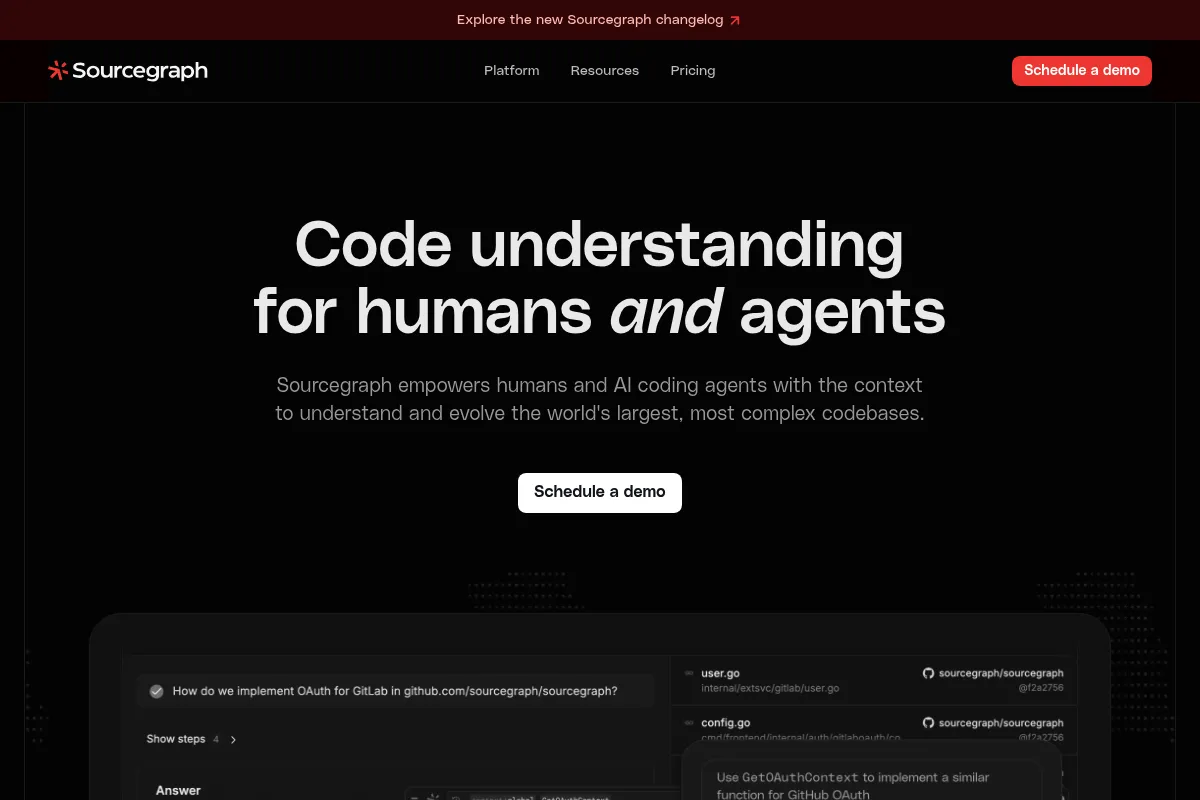
Sourcegraph is a code intelligence platform designed to help developers find, fix, and understand code across their entire organization. It indexes code from various version control systems to provide a centralized interface for search and AI-assisted development.
Official profiles
What it actually does
It provides a high-speed search engine for code that supports regex, symbols, and structural patterns across all repositories. It also includes Cody, an AI assistant that answers technical questions and generates code by retrieving context from the indexed codebase.
What makes it different
Unlike standard search tools, Sourcegraph offers cross-repository navigation, allowing users to 'find references' or 'go to definition' even when the code lives in a different project. Its Batch Changes feature allows users to automate code updates across thousands of repositories simultaneously.
Ratings across the web

Ratings aggregated from independent review platforms.
Key Features
Cody AI
Uses the full codebase index to provide answers that include internal library context.
Structural Search
Finds code based on syntax patterns (e.g., nested loops) rather than just text strings.
Batch Changes
Creates and tracks pull requests across hundreds of repositories for migrations.
Code Insights
Generates dashboards to track migration progress or library adoption over time.
Precise Navigation
Uses LSIF/SCIP data to provide compiler-accurate 'jump to definition' in the browser.
Notebooks
Allows developers to create and share live, searchable documentation with embedded code blocks.
Repository Graph
Maps dependencies and relationships between different services and libraries.
Pricing
Cody Free
- 500 autocomplete completions
- 20 AI chats per month
- Standard LLM models
- Public and local repo context
Cody Pro
- Unlimited autocomplete
- Unlimited AI chats
- Advanced LLM models (Claude 3, GPT-4o)
- Priority support
Enterprise
- Full Code Search platform
- Batch Changes
- Code Insights
- SSO and advanced security
- Self-hosted or Cloud deployment
Pricing checked 6 months ago
Pricing guidance
- When you hit the 20-chat limit on Cody Free
- When you need to search across more than just your local files
- When you need to automate changes across multiple repositories
- Cody Pro is for individuals only; teams require Enterprise for shared context
- Self-hosted instances require separate licensing from Cody Pro
Premium enterprise positioning with a low-cost entry point for its AI assistant.
Pros & Cons
Strengths
-
Superior context for AI
Cody outperforms many competitors because it can pull context from any repository in your organization, not just the files you have open in your IDE.
-
Unmatched search speed at scale
It indexes code specifically for search, making it significantly faster and more reliable than GitHub's native search for large organizations.
-
Streamlined dependency management
Platform teams can instantly see every repository using a specific version of a library, making security patching much faster.
Weaknesses
-
High resource requirements for self-hosting
Running Sourcegraph on-premise requires significant CPU and RAM, which can be a burden for smaller DevOps teams.
Affects: Infrastructure and DevOps teams
-
IDE plugin performance
The VS Code and JetBrains extensions for Cody can occasionally be laggy or conflict with other extensions like GitHub Copilot.
Affects: Individual developers
-
Complex pricing for full platform
While Cody has a clear tier, the full Code Search and Batch Changes platform pricing is opaque and scales quickly for enterprise users.
Affects: Procurement and engineering leadership
Real User Sentiment
Generally positive, with high praise for its search capabilities and growing respect for Cody's context-retrieval logic.
Users tend to like
- The ability to search across thousands of repos instantly
- Cody's 'Chat with Codebase' feature
- Batch Changes for massive migrations
- Support for multiple LLM models in Cody
Users commonly complain about
- The UI can feel cluttered with too many features
- Occasional indexing delays for new code
- The cost of the Enterprise tier is high compared to basic AI tools
Recurring tradeoffs
- Users trade simplicity for power; it is much more complex to set up than GitHub Copilot but offers deeper insights.
Happiest users
Developers at companies with 500+ repositories who frequently need to find how internal APIs are used.
Often frustrated
Solo developers who find the interface overkill for a single-repo workflow.
Use Cases
Security Auditing
Finding every instance of a vulnerable library version across the whole company.
Onboarding
New hires using Cody to ask questions about how specific internal services work.
Library Migrations
Using Batch Changes to update a deprecated API call in 200 different services at once.
Incident Response
Quickly finding the source of an error message that could be in any of dozens of microservices.
Code Discovery
Finding existing implementations of a feature to avoid reinventing the wheel.
Frequently Asked Questions
How does Cody compare to GitHub Copilot?
Cody's primary advantage is context. While Copilot mostly looks at your open files, Cody uses Sourcegraph's index to pull information from your entire codebase. Cody also allows you to switch between different LLMs like Claude 3 and GPT-4o, whereas Copilot is locked into OpenAI's models.
Is there a free version of Sourcegraph?
Yes, Cody has a free tier for individuals with limited chats and completions. However, the full Code Search platform and Enterprise features require a paid subscription or a custom quote.
Can Sourcegraph be used with private code?
Yes. Sourcegraph can be deployed as a managed cloud instance or self-hosted on your own infrastructure (on-premise or VPC) to ensure your private code never leaves your network.
Does Sourcegraph support GitLab and Bitbucket?
Yes, Sourcegraph integrates with GitHub, GitLab, Bitbucket, and any other Git-based code host. It can even search across multiple different hosts simultaneously.
What are the limitations of the Cody Pro plan?
Cody Pro is designed for individual use. It does not include the administrative controls, SSO, or the full 'Batch Changes' and 'Code Insights' features found in the Enterprise tier.
How does Batch Changes work?
You write a declarative spec file (YAML) that defines a search query and a transformation script. Sourcegraph then runs that script across all matching repositories, creates branches, and tracks the status of the resulting pull requests in a single dashboard.
Why trust this page?
This evaluation combines product positioning, pricing analysis, traffic and market signals, and public user sentiment into a single decision-support page. Content is generated editorially — not copied from the vendor's website.
Funding & Company
Founded
2013
Stage
Late stage
Total Raised
$223M
Latest Round
Series D (Jul 2021)
Notable Investors
Sourcegraph has raised a total of $223 million over five funding rounds, culminating in a $125 million Series D in July 2021 which valued the company at $2.625 billion. This substantial funding from top-tier investors like Andreessen Horowitz and Sequoia Capital indicates strong market confidence and provides a significant runway for product development and market expansion.
Market Signals & Traffic
Estimated visits, global rank, geography, traffic sources, monthly visit trends, and organic search keywords (Similarweb)—on a dedicated page built for depth and search.
- Estimated visits
- 0
- Global rank
- —
- Snapshot
- May 2026
- Traffic trend
- Falling
Estimated monthly visits
Alternatives to Sourcegraph
View all alternativesGitHub Copilot
Developer Tools, AI Assistant

AI-powered coding assistant that suggests and generates code.
Tabnine
Developer Tools

AI code assistant for faster, more accurate software development.
Cursor
AI Assistant

An AI-powered code editor designed to help developers build software faster.
Similar Tools
GitHub Copilot
Developer Tools, AI Assistant
AI-powered coding assistant that suggests and generates code.
Magic
Developer Tools, AI Assistant

Software engineering assistant with an ultra-long context window.
Reka
Developer Tools, AI Assistant

Multimodal language models for text, image, video, and audio.
Codeium
Developer Tools, AI Assistant

AI-powered coding assistant for enhanced developer productivity.
NXCode
Developer Tools, AI Assistant

Coding assistant for generating, debugging, and optimizing software code.
Groq
Developer Tools, AI Assistant

AI inference acceleration platform with specialized LPU chips.