

Magic.dev is an AI-powered development platform focused on automating coding tasks and acting as a collaborative partner for developers, aiming to significantly boost productivity.
Best for developers seeking AI-driven code automation and collaboration, weaker for those needing a fully managed, out-of-the-box solution.
Analysis based on product data, pricing structure, traffic signals, and public user sentiment.
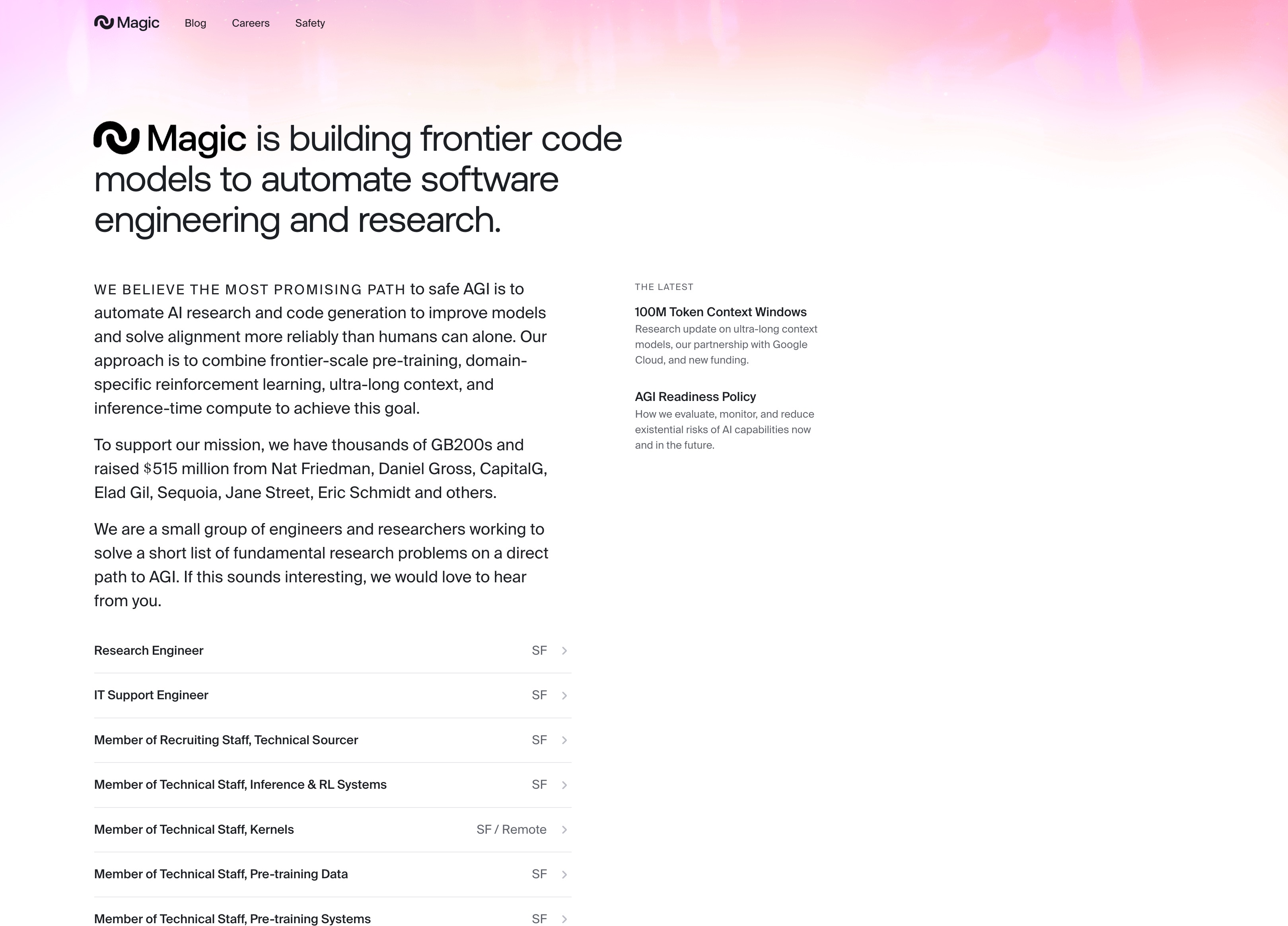
Who Should Use Magic?
Typical users
Software engineers and development teams looking to accelerate their coding process through AI assistance. This includes individual developers, startups, and larger enterprises aiming to improve efficiency and reduce development time.
Maturity fit
beginner to advanced
Choose this if…
- You want to automate repetitive coding tasks.
- You are looking for an AI pair programmer to collaborate with.
- Your priority is to speed up development cycles.
- You need assistance understanding and navigating legacy code.
Skip this if…
- You require a fully managed, no-code or low-code platform.
- Your workflow is heavily reliant on specific, non-standard IDE integrations.
- You need a tool with extensive, pre-built integrations with a wide array of third-party services.
- You are looking for a mature, established product with extensive user reviews and case studies.
About Magic
Magic.dev is an AI-driven platform designed to automate software engineering tasks and serve as an AI colleague for developers. It aims to boost productivity by generating code, assisting with reviews, and understanding complex codebases, with a long-term vision of contributing to safe Artificial General Intelligence (AGI).
Official profiles
What it actually does
Magic.dev provides AI-powered assistance for software development, including code generation, autocompletion, code review, and understanding of large codebases. It functions as a collaborative tool, aiming to act like a pair programmer that learns from user context and project history.
What makes it different
Magic.dev differentiates itself through its focus on building a true AI colleague rather than just a coding assistant, its advanced neural network architecture capable of processing very large codebases (100 million token context window), and its long-term mission to contribute to safe AGI research. It also emphasizes understanding and navigating legacy code.
Ratings across the web

Ratings aggregated from independent review platforms.
Key Features
AI Code Assist
Provides intelligent suggestions to improve code quality and accelerate development.
Seamless API Integration
Offers easy integration with powerful APIs to boost efficiency.
Automated Testing
Ensures code reliability with built-in testing automation.
Collaboration Tools
Enhances teamwork through shared coding environments.
Ultra-Long Context Windows (up to 100 million tokens)
Enables processing of extensive codebases or large documents efficiently.
Understanding Legacy Code
Assists in navigating and working with older, complex codebases.
AI Colleague/Pair Programmer
Functions as an interactive partner that communicates in natural language and learns from user context.
Pricing
Developer
- Basic features
- Limited usage
Pro
- Advanced features
- Priority support
Business
- All features
- Unlimited usage
Pricing checked 6 months ago
Pricing guidance
- When you need advanced features and priority support.
- When you exceed the usage limits of the free or lower tiers.
- When your team requires collaborative features and dedicated support.
- Usage limits on the free and potentially lower-tier plans (specifics not detailed).
- Feature availability may be tiered, with advanced functionalities locked behind higher plans.
Tiered pricing with a free option for individual developers, scaling up to business plans with more features and support.
Pros & Cons
Strengths
-
Advanced AI for Code Generation and Assistance
Magic.dev utilizes sophisticated AI models to generate code, offer suggestions, and assist with refactoring, significantly speeding up development workflows.
-
Large Context Window Capability
With a 100 million token context window, Magic.dev can process and understand very large codebases, which is crucial for complex projects and legacy systems.
-
Focus on AI Colleague Concept
The platform aims to be more than just a tool; it's designed to act as an AI colleague, learning from user context and project history to provide more relevant assistance.
-
Assistance with Legacy Code
Magic.dev is positioned to help developers understand and work with older, complex codebases, a common pain point in many organizations.
Weaknesses
-
Limited Public Information on Pricing and Specific Features
Detailed pricing tiers and a comprehensive list of all features are not readily available, making it difficult for potential users to assess value and compare directly.
Affects: Potential buyers evaluating the tool
-
Emerging Product with Less Established User Base
As a relatively newer tool compared to established competitors like GitHub Copilot, Magic.dev may have fewer real-world user reviews and case studies, and its long-term stability is less proven.
Affects: Risk-averse organizations and developers
-
Potential for Vendor Lock-in with Proprietary Technology
The focus on proprietary LLM technology and unique architectures might lead to vendor lock-in, making it harder to switch to alternative solutions later.
Affects: Organizations prioritizing open-source or interoperable solutions
Real User Sentiment
Magic.dev is seen as a promising and innovative AI development tool, particularly for its advanced capabilities like long context windows and its vision of an 'AI colleague'. However, as a newer product, detailed user sentiment is still developing, and comparisons often highlight its potential against more established tools.
Users tend to like
- Advanced AI capabilities and potential for productivity gains.
- The concept of an 'AI colleague' and pair programmer.
- Long context window for handling large codebases.
- Focus on understanding and working with legacy code.
Users commonly complain about
- Lack of detailed public pricing and feature breakdowns.
- As a newer tool, it has less real-world user feedback compared to established competitors.
- Potential for vendor lock-in due to proprietary technology.
Recurring tradeoffs
- Cutting-edge AI features vs. established reliability and user base.
- Potential for higher cost for full capabilities vs. more affordable, simpler tools.
Happiest users
Developers and teams looking for advanced AI assistance to tackle complex coding tasks and large codebases.
Often frustrated
Users who require readily available, detailed pricing information or those who prefer more established, widely-adopted tools.
Use Cases
Automating repetitive coding tasks like boilerplate generation.
Assisting developers in understanding and refactoring legacy code.
Acting as an AI pair programmer for real-time coding collaboration.
Generating code snippets and complete functions based on natural language descriptions.
Improving code quality through AI-driven review and suggestions.
Accelerating the development cycle for new features and applications.
Frequently Asked Questions
What is Magic.dev?
Magic.dev is an AI-powered platform designed to automate software engineering tasks and act as an AI colleague for developers. It aims to boost productivity by generating code, assisting with reviews, and understanding complex codebases, with a long-term vision of contributing to safe Artificial General Intelligence (AGI). It differentiates itself with advanced neural network architecture capable of processing very large codebases (100 million token context window) and its focus on understanding and navigating legacy code.
How does Magic.dev compare to GitHub Copilot?
Magic.dev positions itself as more than just a code completion tool, aiming to be an 'AI colleague' that understands context and legacy code. While GitHub Copilot is a widely adopted tool for code completion and generation within the GitHub ecosystem, Magic.dev emphasizes its advanced architecture for handling large codebases and its long-term research goals in AI. Comparisons suggest Magic.dev offers more analytical capabilities and a deeper approach to code understanding, whereas Copilot is more integrated into the existing GitHub workflow.
What are the pricing plans for Magic.dev?
Magic.dev offers tiered pricing. The 'Developer' plan is free and suitable for individual experimentation. The 'Pro' plan, at $29/month, offers advanced features and priority support. The 'Business' plan, at $99/month, provides all features and unlimited usage, making it the recommended option for teams and organizations. Specific details on usage limits for lower tiers are not extensively publicized.
Does Magic.dev have integrations?
Magic.dev emphasizes seamless integration capabilities, allowing developers to connect with a wide range of platforms and services through its flexible architecture and comprehensive API offerings. While specific third-party integrations are not exhaustively listed, the platform is designed to be adaptable and support custom integrations tailored to specific needs. It also integrates with IDEs like VS Code.
What are the limitations of Magic.dev?
As a relatively new and advanced tool, Magic.dev's limitations may include a less established user base and fewer real-world case studies compared to more mature competitors. Detailed public information on pricing tiers and specific feature limitations can also be scarce, making it harder for potential users to fully assess its value proposition. The proprietary nature of its technology might also pose a risk of vendor lock-in for some organizations.
What is the context window of Magic.dev's models?
Magic.dev has developed models with an ultra-long context window, notably up to 100 million tokens. This capability allows the AI to process and understand significantly larger amounts of code or text compared to many other models, which is particularly beneficial for working with extensive codebases or complex documentation.
Why trust this page?
This evaluation combines product positioning, pricing analysis, traffic and market signals, and public user sentiment into a single decision-support page. Content is generated editorially — not copied from the vendor's website.
Funding & Company
Founded
2022
Stage
Series c
Total Raised
$515M
Latest Round
Series C (Jul 2024)
Notable Investors
Magic has raised a total of $515 million, with a significant Series B of $117 million in early 2024 and a subsequent large Series C. This substantial backing from top-tier investors like CapitalG and Sequoia Capital indicates strong confidence in its mission to build an AI software engineering assistant.
Market Signals & Traffic
Estimated visits, global rank, geography, traffic sources, monthly visit trends, and organic search keywords (Similarweb)—on a dedicated page built for depth and search.
- Estimated visits
- 33,580
- Global rank
- #821,116
- Snapshot
- Apr 2026
- Traffic trend
- Falling
Estimated monthly visits
Alternatives to Magic
View all alternativesGitHub Copilot
Developer Tools, AI Assistant

AI-powered coding assistant that suggests and generates code.
Cursor
AI Assistant

An AI-powered code editor designed to help developers build software faster.
Amazon CodeWhisperer
Developer Tools

AI-powered coding companion that generates code recommendations.
Similar Tools
Codeium
Developer Tools, AI Assistant

AI-powered coding assistant for enhanced developer productivity.
NXCode
Developer Tools, AI Assistant

Coding assistant for generating, debugging, and optimizing software code.
Replit
Developer Tools, AI Assistant

An AI-powered platform for building and deploying software applications directly from a browser.
Reka
Developer Tools, AI Assistant

Multimodal language models for text, image, video, and audio.
Sourcegraph
Developer Tools, AI Assistant

Code intelligence platform for searching, writing, and understanding codebases
Groq
Developer Tools, AI Assistant

AI inference acceleration platform with specialized LPU chips.