

Upstage
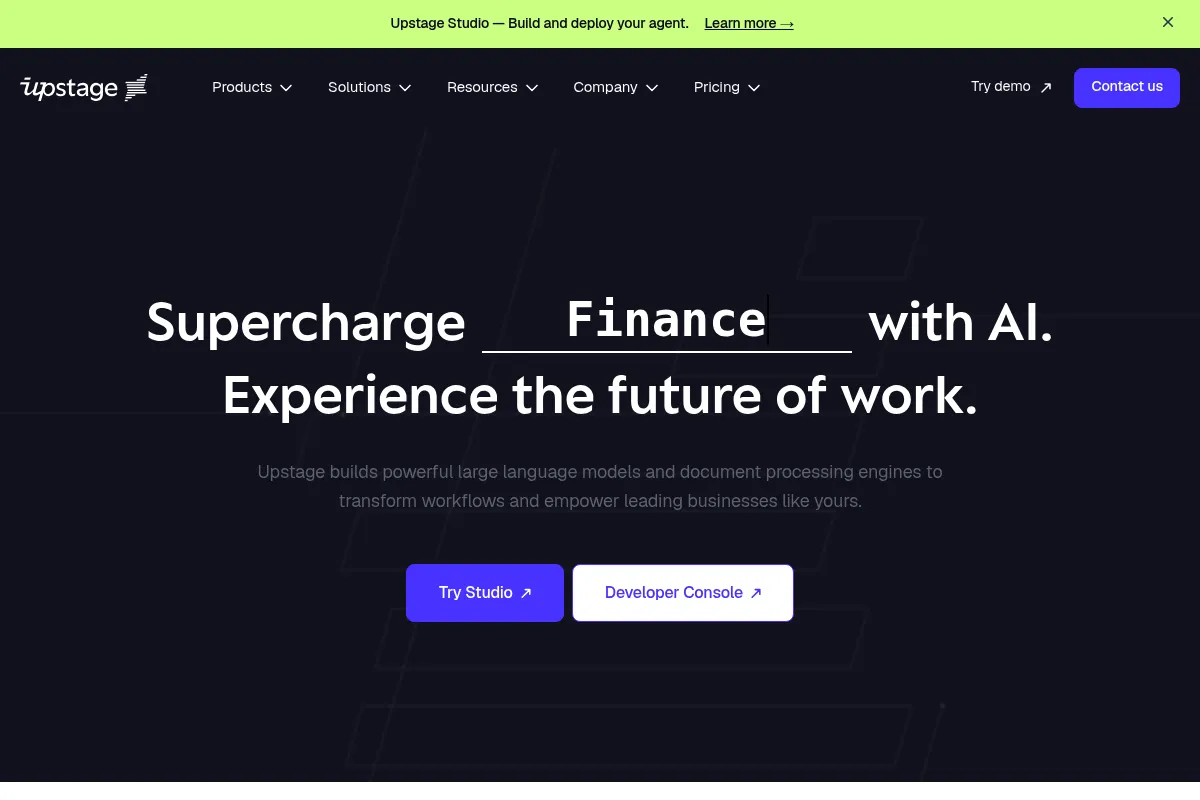
Upstage provides a specialized stack for Document AI and RAG, combining high-performance small language models with superior layout analysis for complex enterprise data.
Excellent for developers building RAG systems from messy PDFs and tables, weaker for general-purpose creative writing or massive ecosystem support.
Analysis based on product data, pricing structure, traffic signals, and public user sentiment.
Who Should Use Upstage?
Typical users
ML engineers and enterprise developers building internal knowledge bases or automated document processing workflows.
Maturity fit
scaling to advanced
Choose this if…
- You need to extract structured data from complex PDFs and tables for RAG
- Your priority is a high-performance model with low latency and a small footprint
- You require private cloud or on-premise deployment for data sovereignty
Skip this if…
- You need a consumer-ready chatbot interface rather than an API
- Your workflow relies on a massive library of third-party community plugins
- You only process simple, plain-text documents where basic OCR suffices
About Upstage
Upstage is a South Korean AI company that develops the Solar LLM family and specialized Document AI tools. It focuses on the 'Document-to-LLM' pipeline, providing the infrastructure to turn unstructured enterprise files into machine-readable context for RAG applications.
Official profiles
What it actually does
It provides a suite of APIs for LLM inference, advanced OCR, and document layout analysis. The platform identifies headers, tables, and figures in documents to ensure that when data is fed into an LLM, the logical structure and context remain intact.
What makes it different
Unlike general LLM providers, Upstage focuses heavily on the 'pre-processing' stage of AI. Their Layout Analysis API is specifically tuned to recognize table structures and reading orders that standard OCR often breaks, making their RAG results more accurate for financial or technical documents.
Key Features
Solar-mini
A 10.7B parameter model that outperforms much larger models on benchmarks while maintaining low latency.
Layout Analysis API
Identifies document elements like tables, figures, and headers to preserve context for LLMs.
Groundedness Check
A specialized API that verifies if an LLM's response is actually supported by the provided context.
Table Extraction
Converts complex PDF tables into structured Markdown or JSON without losing cell relationships.
Multi-language Support
Optimized performance for English and Korean, with expanding support for other languages.
Custom Model Tuning
Allows enterprises to train Solar on proprietary data for specialized industry terminology.
Pricing
Free Trial
- Free credits for API testing (typically $10-$30)
- Access to Solar-mini and Solar-pro
- Access to Layout Analysis API
- Standard rate limits
Pay-as-you-go
- Solar-mini: ~$0.15 per 1M tokens
- Layout Analysis: ~$0.10 per page
- Groundedness Check: ~$0.007 per request
- No upfront commitment
Enterprise
- On-premise deployment
- Private cloud hosting
- Custom fine-tuning services
- Dedicated support and higher rate limits
Pricing checked 4 months ago
Pricing guidance
- When document volume exceeds 10,000 pages per month
- When data security policies mandate on-premise hosting
- When you need custom fine-tuning on proprietary datasets
- Rate limits on the standard API can be restrictive for bulk historical data processing
- Layout Analysis is billed per page, which can scale quickly for large PDF archives
Competitive pricing for LLM tokens, but premium positioning for specialized Document AI and layout analysis features.
Pros & Cons
Strengths
-
Superior RAG-ready document parsing
The Layout Analysis tool is significantly better at handling multi-column layouts and nested tables than standard open-source OCR libraries.
-
High performance-to-cost ratio
Solar-mini provides GPT-3.5 or better performance at a fraction of the size, leading to faster inference and lower compute costs.
-
Enterprise-grade privacy options
Offers genuine on-premise and private cloud deployment options for industries with strict data residency requirements.
Weaknesses
-
Smaller developer ecosystem
Compared to OpenAI or Anthropic, there are fewer community tutorials, pre-built integrations, and third-party wrappers.
Affects: Solo developers and small startups
-
Niche focus on Document AI
While excellent for documents, it lacks the broad multimodal capabilities (like advanced image generation or complex audio) of larger frontier models.
Affects: Teams building general-purpose multimodal apps
-
Documentation gaps
Some advanced features and edge-case behaviors are less documented than those of more established Western AI labs.
Affects: Developers requiring deep technical troubleshooting
Real User Sentiment
Generally positive, with users highlighting the technical efficiency of the Solar model and the accuracy of the layout engine.
Users tend to like
- Accuracy of table extraction from PDFs
- Speed and low latency of Solar-mini
- Ease of integrating the Groundedness Check into RAG pipelines
- Performance on the Hugging Face leaderboard
Users commonly complain about
- API documentation can be sparse for complex use cases
- Limited availability of SDKs in languages other than Python
- Higher cost per page for layout analysis compared to basic OCR
Recurring tradeoffs
- Users trade a broad ecosystem for specialized document processing accuracy.
Happiest users
Engineers building RAG systems for legal, financial, or technical departments where document structure is critical.
Often frustrated
Developers looking for a 'one-stop-shop' with the same level of third-party integration as OpenAI.
Use Cases
Financial Report Analysis
Extracting structured data from complex quarterly earnings PDFs for investment research.
Legal Document Review
Using Layout Analysis to maintain clause hierarchy and table references in contracts.
Customer Support Automation
Powering a RAG-based bot that answers questions from technical product manuals.
Data Privacy Compliance
Deploying a private LLM instance to process sensitive PII without sending data to public clouds.
Academic Research
Summarizing and querying large batches of scientific papers while preserving figure and table context.
Frequently Asked Questions
How does Solar-mini compare to GPT-3.5 or GPT-4?
Solar-mini is a 10.7B parameter model designed to match or exceed GPT-3.5 performance in a much smaller footprint. While it may not match GPT-4's complex reasoning, it offers significantly lower latency and cost for specialized tasks like RAG and summarization.
What is the pricing for the Layout Analysis API?
The Layout Analysis API is typically billed at approximately $0.10 per page. This is separate from the token costs associated with the Solar LLM inference.
Does Upstage offer a free plan?
Upstage provides a trial period with free credits (usually around $10-$30) upon signing up for the Upstage Console, but there is no permanent free tier for high-volume use.
Can I deploy Upstage models on my own servers?
Yes, one of Upstage's primary enterprise selling points is the ability to deploy Solar models on-premise or within a private cloud environment for maximum data security.
What languages does Upstage support?
Upstage is highly optimized for English and Korean. It supports many other languages for OCR and general LLM tasks, though performance may vary for less common dialects.
How does the Groundedness Check work?
The Groundedness Check API takes a source document and an LLM-generated response as input, then returns a score indicating whether the response is factually supported by the source, helping to prevent hallucinations in RAG systems.
Why trust this page?
This evaluation combines product positioning, pricing analysis, traffic and market signals, and public user sentiment into a single decision-support page. Content is generated editorially — not copied from the vendor's website.
Funding & Company
Founded
2020
Stage
Series c
Total Raised
$269.6M
Latest Round
Series C (Apr 2026)
Notable Investors
Upstage has raised approximately $270 million, culminating in a $126 million Series C in April 2026 that established it as a unicorn. [9, 21] This significant and recent funding from major corporate and financial investors provides a strong capital base for product development and global expansion.
Market Signals & Traffic
Estimated visits, global rank, geography, traffic sources, monthly visit trends, and organic search keywords (Similarweb)—on a dedicated page built for depth and search.
- Estimated visits
- 101,042
- Global rank
- #310,291
- Snapshot
- Apr 2026
- Traffic trend
- Rising
Estimated monthly visits
Alternatives to Upstage
View all alternatives
Similar Tools
AuraScape
Privacy & Compliance, Developer Tools

Real-time security and governance platform for generative applications.
Lyzr
Automation & Agents, Developer Tools, Workflow

Framework for building autonomous agents and enterprise agentic workflows.
Sembly
Data Extraction, Productivity

AI models for speech-to-text, summarization, and voice understanding.
Mistral / Le Chat
AI Assistant, Productivity, Content Creation

A versatile AI assistant for work and life, offering fast responses and advanced features.
Retell AI
Communication, Automation & Agents, AI Assistant

Build and deploy human-like conversational voice agents for business.
DSPy
Developer Tools, Research, Automation

Framework for programming and optimizing language model pipelines.