

DSPy
A programmatic framework that replaces manual prompt engineering with modular logic and automated optimization—essential for complex pipelines, overkill for simple chat apps.
Excellent for engineers building reproducible, multi-stage LLM pipelines; weaker for those who prefer manual control over every word in a prompt.
Analysis based on product data, pricing structure, traffic signals, and public user sentiment.
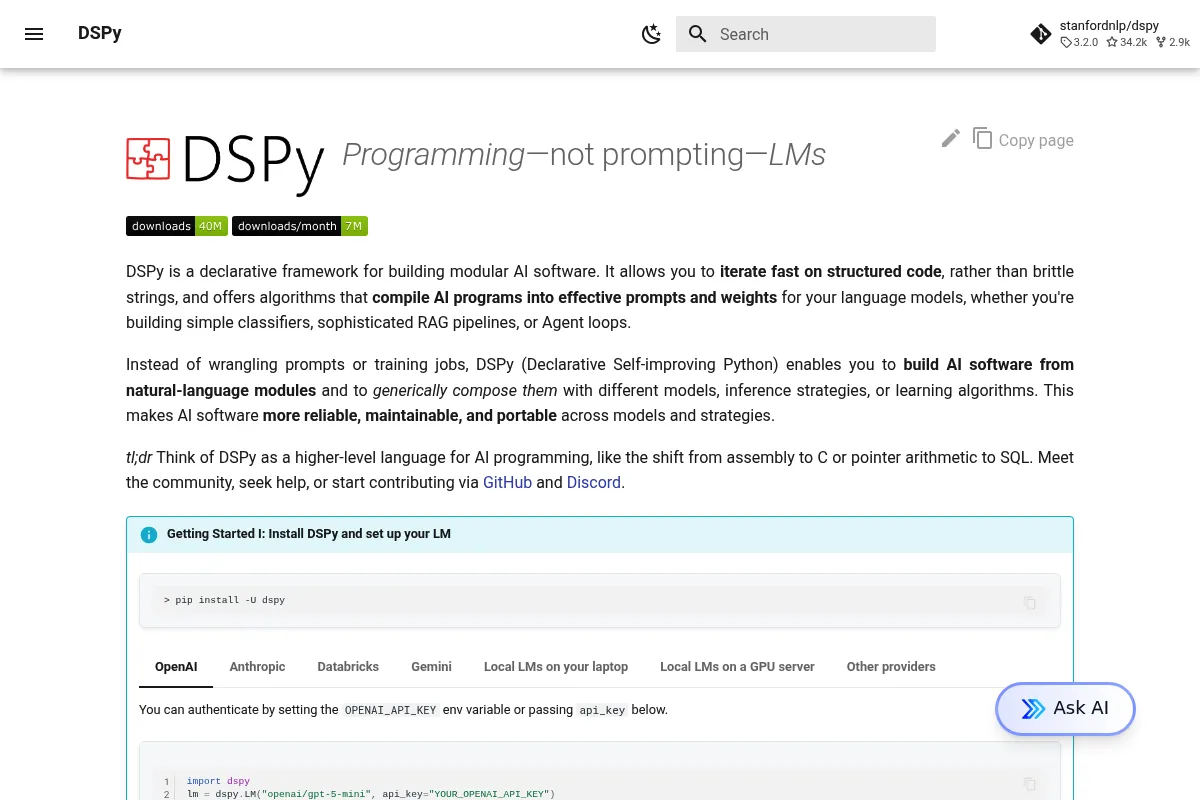
Who Should Use DSPy?
Typical users
AI engineers and researchers building complex RAG systems or multi-step agents who need systematic optimization rather than manual prompt tweaking.
Maturity fit
advanced
Choose this if…
- You want to treat LLM calls like code modules rather than long strings of text
- You need to switch between different models (e.g., OpenAI to Llama 3) without rewriting all your prompts
- You have at least a small set of labeled examples to use for optimization
- Your priority is system reliability and reproducibility over quick prototyping
Skip this if…
- You are building a simple chatbot where a single prompt suffices
- You want total manual control over the exact phrasing of every instruction
- You aren't comfortable with PyTorch-like abstractions or programmatic logic
About DSPy
DSPy is an open-source framework from Stanford that shifts LLM development from manual prompt engineering to a systematic programming model. It separates the logic of your application from the specific phrasing of prompts, allowing the system to self-optimize based on your goals.
What it actually does
It provides a set of declarative modules and a compiler that automatically generates and refines prompts for your specific task. Users define the input/output behavior, and DSPy uses 'optimizers' to find the most effective instructions or few-shot examples for the chosen model.
What makes it different
Unlike LangChain or LlamaIndex, which provide pre-built templates, DSPy treats prompts as parameters that can be tuned. It uses a compiler to translate high-level logic into optimized prompts, making the entire pipeline model-agnostic and significantly more robust to model updates.
Ratings across the web

Ratings aggregated from independent review platforms.
Key Features
Signatures
Defines the input/output schema without hardcoding instructions.
Modules
Reusable components like ChainOfThought or ReAct that encapsulate prompting strategies.
Optimizers (Teleprompters)
Algorithms that iterate on prompts to maximize a specific metric.
Assertions
Programmatic constraints that force the LLM to self-correct during runtime.
Data Loaders
Utilities to convert small datasets into training sets for the optimizer.
Typed Predictors
Ensures LLM outputs adhere to specific data structures or formats.
Pricing
Open Source
- Full access to the DSPy library
- MIT License for commercial use
- Community support via GitHub and Discord
- Support for all major LLM providers and local models
Pricing checked 5 months ago
Pricing guidance
- When you need managed hosting or monitoring (look to third-party tools like LangSmith or Braintrust)
- When you require enterprise-grade support and SLAs not provided by open-source maintainers
- Optimization runs can consume a high volume of tokens during the 'training' phase
- Performance is heavily dependent on the quality of your evaluation metrics
Completely free and open-source, positioned as a foundational research and engineering tool.
Pros & Cons
Strengths
-
Eliminates 'prompt brittleness'
By automating prompt generation, you avoid the common issue where a small change in wording breaks the entire pipeline.
-
Seamless model portability
You can swap a high-end model for a smaller, cheaper one and let the optimizer rewrite the prompts to maintain performance.
-
Systematic optimization
Moves LLM development from 'vibes-based' testing to a data-driven approach using actual metrics and evaluation sets.
Weaknesses
-
Steep learning curve
The PyTorch-like syntax and abstract concepts like 'Teleprompters' take time to master compared to simple string templates.
Affects: Beginner developers and teams looking for quick, simple implementations
-
Opaque prompt generation
Because the framework generates the prompts, it can be difficult to see exactly what is being sent to the model without extra logging.
Affects: Developers who need strict auditability of every token sent to an LLM
-
Documentation gaps
As a rapidly evolving research project, the documentation often lags behind the latest features or contains breaking changes.
Affects: Enterprise teams requiring stable, well-documented tools for production
Real User Sentiment
Highly positive among experienced AI engineers who find manual prompting unsustainable, though beginners often find it intimidating.
Users tend to like
- The ability to switch models without manual prompt rewrites
- The programmatic approach to RAG
- The shift from 'guessing' prompts to 'compiling' them
Users commonly complain about
- The documentation is often confusing or incomplete
- Hard to debug when the optimizer produces unexpected prompts
- High token usage during the optimization process
Recurring tradeoffs
- You trade immediate simplicity for long-term maintainability and performance.
Happiest users
Engineers building complex, multi-step LLM applications who have at least 50-100 labeled examples for evaluation.
Often frustrated
Developers trying to build a simple wrapper around an LLM who find the abstraction layer unnecessary and confusing.
Use Cases
Advanced RAG
Optimizing multi-hop retrieval and summarization pipelines.
Model Distillation
Using a large model (GPT-4) to optimize prompts for a smaller model (Llama 3).
Structured Data Extraction
Ensuring LLMs consistently return valid JSON or specific schemas.
Agentic Workflows
Programming complex logic where multiple LLM calls must coordinate reliably.
Automated Evaluation
Building systems that grade their own performance and improve over time.
Frequently Asked Questions
Is DSPy free to use?
Yes, DSPy is an open-source framework released under the MIT License. You can use it for free in both personal and commercial projects. However, you are still responsible for the costs of the LLM APIs (like OpenAI or Anthropic) that the framework calls during optimization and execution.
How does DSPy compare to LangChain?
LangChain is primarily a library of pre-built integrations and templates (chains) for connecting LLMs to other tools. DSPy is a framework for *optimizing* those interactions. While LangChain focuses on 'how to connect,' DSPy focuses on 'how to get the best output' by automatically generating the best prompts for your specific model and task.
Do I need a lot of data to use DSPy?
No, you don't need 'big data.' DSPy is designed to work with 'small data'—often as few as 10 to 50 examples are enough for the optimizers to significantly improve your prompt performance compared to manual engineering.
Can I use DSPy with local models like Llama 3 or Mistral?
Yes, DSPy supports local models through integrations with tools like Ollama, vLLM, and Hugging Face. This makes it a popular choice for developers who want to optimize performance on smaller, self-hosted models to reduce costs or improve privacy.
What are the main limitations of DSPy?
The primary limitations are its steep learning curve and the 'black box' nature of its optimization. Because it generates prompts for you, debugging can be harder than with traditional templates. Additionally, the optimization process itself can be token-intensive, leading to higher initial costs during development.
Does DSPy replace prompt engineering?
It replaces *manual* prompt engineering. Instead of you spending hours trial-and-erroring different words, you spend that time defining the logic and the evaluation metrics, and the framework handles the 'engineering' of the prompt text for you.
Why trust this page?
This evaluation combines product positioning, pricing analysis, traffic and market signals, and public user sentiment into a single decision-support page. Content is generated editorially — not copied from the vendor's website.
Funding & Company
Founded
—
Stage
Bootstrapped
Total Raised
Bootstrapped
Latest Round
—
DSPy is an open-source research project developed at Stanford University and is not a venture-funded company. It has not raised any capital from investors, with its stability and development supported by its academic origins and growing community adoption.
Market Signals & Traffic
Estimated visits, global rank, geography, traffic sources, monthly visit trends, and organic search keywords (Similarweb)—on a dedicated page built for depth and search.
- Estimated visits
- 160,889
- Global rank
- #273,026
- Snapshot
- Apr 2026
- Traffic trend
- Surging
Estimated monthly visits
Alternatives to DSPy
View all alternatives
Similar Tools
Labelbox
Developer Tools, Research, Automation

Platform for data labeling, management, and model evaluation workflows.
SuperAnnotate
Developer Tools, Research, Automation

Platform for data labeling, management, and high-quality dataset curation.
Scale
Developer Tools, Research, Automation

Data infrastructure for training, labeling, and evaluating machine learning models.
Ragas
Developer Tools, Research, Automation

Evaluation framework for Retrieval Augmented Generation (RAG) pipelines
Argilla
Developer Tools, Research, Automation

Open-source data curation platform for building high-quality language models.
Alpha Drive AI
Developer Tools, Research, Automation

Cloud-based testing and validation platform for autonomous driving algorithms.