
Argilla
A developer-centric data curation platform that prioritizes programmatic workflows and Hugging Face integration over traditional manual labeling interfaces.
Excellent for AI teams building LLMs or RAG pipelines who need tight integration with the Hugging Face ecosystem, weaker for teams without Python resources.
Analysis based on product data, pricing structure, traffic signals, and public user sentiment.
Who Should Use Argilla?
Typical users
AI engineers, data scientists, and ML researchers working in mid-to-large tech companies or specialized AI startups.
Maturity fit
scaling to advanced
Choose this if…
- You want to automate data curation via Python rather than manual clicking
- Your workflow is already centered around the Hugging Face ecosystem
- You require an open-source core to maintain data privacy on-premises
Skip this if…
- You need a purely visual, no-code labeling tool for non-technical staff
- Your primary focus is computer vision or complex video annotation
- You do not have internal Python development resources to manage the setup
About Argilla
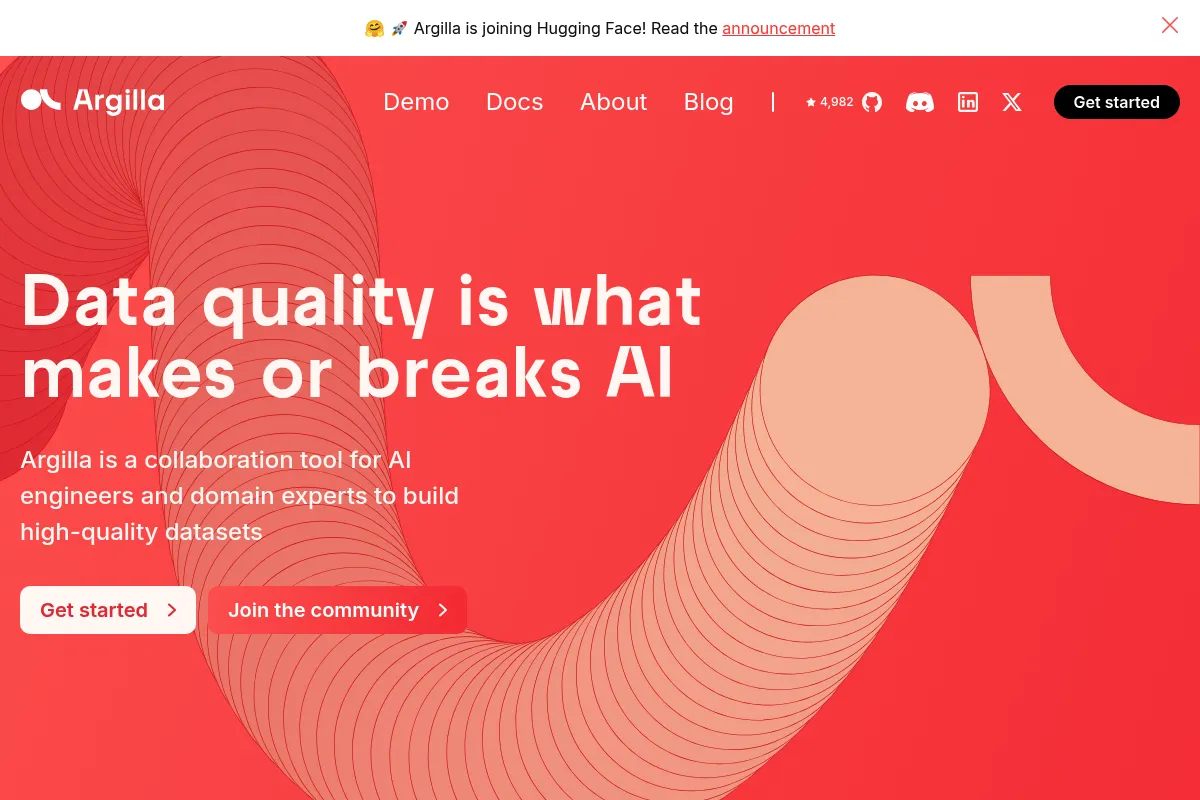
Argilla is an open-source collaboration platform for AI engineers and domain experts to curate datasets for LLMs. It focuses on the iterative process of data labeling, model evaluation, and feedback loops like RLHF. Since its acquisition by Hugging Face, it has become the default recommendation for open-source LLM alignment.
Official profiles
What it actually does
It provides a centralized hub for managing datasets where users can manually label data, provide feedback on model outputs, and programmatically refine data using a Python SDK. It bridges the gap between raw data storage and model training environments by allowing for continuous data improvement.
What makes it different
Unlike traditional labeling tools that treat data as a static asset, Argilla treats data curation as an iterative, code-first process. Its deep integration with Hugging Face allows for direct dataset deployments and feedback loops from hosted models, making it more of an MLOps component than a standalone labeling tool.
Key Features
Feedback Task
A flexible task type for collecting multi-modal feedback like ratings, rankings, and text for LLM alignment.
Python SDK
Enables developers to push, pull, and manipulate datasets directly from notebooks or automated scripts.
Hugging Face Integration
Allows for loading and saving datasets to the Hub without manual export/import steps.
Bulk Labeling
Tools to label thousands of records simultaneously using similarity search or metadata filters.
Zero-shot/Few-shot Labeling
Uses existing models to pre-label data, which humans then verify or correct to speed up curation.
Role-based Access Control
Manages specific permissions for annotators, editors, and admins within the platform.
Semantic Search
Finds similar data points to ensure labeling consistency across large datasets.
Pricing
Open Source
- Self-hosted via Docker
- Full Python SDK access
- Unlimited users and datasets
- Community support
Argilla Cloud Base
- Managed infrastructure
- Up to 10 users
- 50GB storage
- Standard support
Enterprise
- SSO and advanced security
- Unlimited storage
- Dedicated support engineer
- Custom deployment options
Pricing checked 4 months ago
Pricing guidance
- When you need managed hosting to save engineering time
- When you require SSO for corporate security compliance
- When you need dedicated technical support for production pipelines
- Self-hosting requires managing your own Elasticsearch or Opensearch instance, which can be resource-intensive.
- The Cloud Base plan has a strict 50GB storage limit which can be hit quickly with large text datasets.
Competitive and developer-friendly, offering a high-value free tier to capture the open-source market while charging for convenience.
Pros & Cons
Strengths
-
Open-source flexibility
Can be self-hosted on private infrastructure, ensuring sensitive data never leaves your VPC, which is critical for healthcare or finance.
-
Developer-first design
The Python SDK is the primary interface, making it easy to integrate into existing CI/CD or MLOps pipelines compared to UI-only tools.
-
Hugging Face synergy
The acquisition ensures the tightest possible integration with the most popular AI model repository, simplifying the path from data to model.
-
Cost-effective at scale
The open-source version has no per-label or per-user seat taxes, which significantly reduces costs for massive dataset projects.
Weaknesses
-
Steep learning curve
Non-technical domain experts may find the interface and initial setup intimidating without constant developer support.
Affects: Small teams without dedicated ML engineers
-
UI performance issues
Large datasets with millions of rows can cause the web interface to lag or become unresponsive during manual review.
Affects: Teams working with massive-scale web crawl data
-
Limited non-NLP support
While it can handle other data types, its primary strength and feature set are heavily skewed toward text and LLM workflows.
Affects: Computer vision or multi-modal AI teams
Real User Sentiment
Highly positive among engineers who value control and programmatic access, though some find the UI less polished than commercial competitors.
Users tend to like
- Ease of integration with Python scripts
- The flexibility of the Feedback Task
- Active and helpful community on Slack/Discord
- No-nonsense open-source licensing
Users commonly complain about
- Documentation can be fragmented across versions
- Initial setup of the backend (Elasticsearch) is a common pain point
- UI lacks some of the advanced project management features of Labelbox
Recurring tradeoffs
- You trade a slick, turnkey SaaS UI for deep programmatic control and data ownership.
Happiest users
AI engineers building custom fine-tuned models or complex RAG applications.
Often frustrated
Non-technical managers looking for a turnkey labeling solution for external contractors without writing code.
Use Cases
RLHF for LLMs
Collecting human rankings of model responses to align model behavior.
RAG Evaluation
Labeling the relevance of retrieved documents to improve search and generation accuracy.
Dataset Cleaning
Using programmatic filters to find and remove low-quality or biased training data.
Domain Expert Review
Providing a UI for doctors or lawyers to verify AI-generated summaries.
Active Learning
Iteratively selecting the most uncertain samples for human labeling to maximize model improvement.
Frequently Asked Questions
Is Argilla free?
Yes, the core platform is open-source and free to self-host using Docker. A managed 'Argilla Cloud' version is available starting at $250/month for teams that want to avoid managing their own infrastructure.
How does Argilla compare to Label Studio?
Argilla is more focused on LLMs and programmatic workflows via a Python SDK, whereas Label Studio is a broader, multi-modal tool with a more mature UI for manual labeling across images, audio, and video.
Do I need to know Python to use Argilla?
Yes. While annotators use a simple web UI, setting up the environment, importing data, and managing the lifecycle of datasets requires Python proficiency.
Can I use Argilla for image labeling?
While possible, Argilla is primarily optimized for text and NLP. Tools like CVAT or Labelbox are better suited for complex computer vision tasks like polygon segmentation.
Where is my data stored?
If you self-host, the data stays entirely on your servers. If you use Argilla Cloud, it is stored on their managed infrastructure, typically hosted on AWS or Hugging Face Spaces.
Does Argilla support SSO?
SSO (Single Sign-On) is available for Enterprise customers. The standard open-source and base cloud tiers use basic email/password authentication.
Why trust this page?
This evaluation combines product positioning, pricing analysis, traffic and market signals, and public user sentiment into a single decision-support page. Content is generated editorially — not copied from the vendor's website.
Funding & Company
Founded
2017
Stage
Acquired
Total Raised
$6.95M
Latest Round
Seed (Nov 2023)
Notable Investors
Argilla raised a total of $6.95M across two seed rounds in 2023, with notable investors including Zetta Venture Partners and Caixa Capital Risc. The company was subsequently acquired by AI leader Hugging Face in June 2024 for a reported $10 million. This acquisition provides significant long-term stability and resources, integrating Argilla's open-source data curation technology into a major AI ecosystem.
Market Signals & Traffic
Estimated visits, global rank, geography, traffic sources, monthly visit trends, and organic search keywords (Similarweb)—on a dedicated page built for depth and search.
- Estimated visits
- 26,609
- Global rank
- #906,814
- Snapshot
- Apr 2026
- Traffic trend
- Rising
Estimated monthly visits
Alternatives to Argilla
View all alternativesLabelbox
Developer Tools, Research, Automation

Platform for data labeling, management, and model evaluation workflows.
SuperAnnotate
Developer Tools, Research, Automation

Platform for data labeling, management, and high-quality dataset curation.
Snorkel AI
Developer Tools, Automation, Research

Programmatic data labeling and development platform for enterprise model building.
Similar Tools
DSPy
Developer Tools, Research, Automation

Framework for programming and optimizing language model pipelines.
Labelbox
Developer Tools, Research, Automation
Platform for data labeling, management, and model evaluation workflows.
Ragas
Developer Tools, Research, Automation

Evaluation framework for Retrieval Augmented Generation (RAG) pipelines
Alpha Drive AI
Developer Tools, Research, Automation

Cloud-based testing and validation platform for autonomous driving algorithms.
SuperAnnotate
Developer Tools, Research, Automation
Platform for data labeling, management, and high-quality dataset curation.
Scale
Developer Tools, Research, Automation

Data infrastructure for training, labeling, and evaluating machine learning models.