

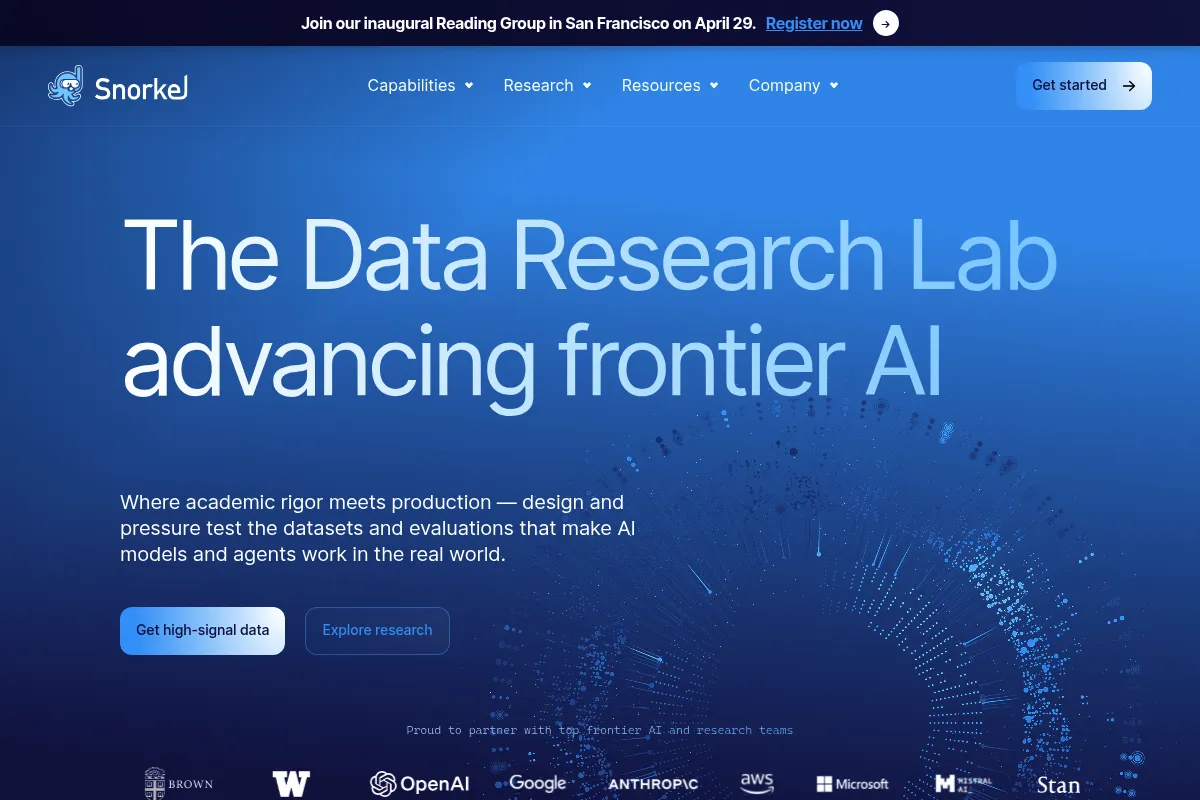
Snorkel AI is a data-centric development platform that replaces manual data labeling with programmatic rules, specifically built for enterprises handling massive, sensitive datasets.
Excellent for large-scale NLP and document intelligence in regulated industries, but overkill for small teams with simple classification needs.
Analysis based on product data, pricing structure, traffic signals, and public user sentiment.
Who Should Use Snorkel AI?
Typical users
Data science teams and ML engineers at Fortune 500 companies, particularly in finance, healthcare, and government.
Maturity fit
advanced
Choose this if…
- You have millions of data points that are too expensive or slow to label manually
- Your data is highly sensitive (PII/PHI) and cannot be sent to third-party human annotators
- You need to iterate on your labeling schema frequently without restarting the labeling process from scratch
- Your priority is model performance through data quality rather than just hyperparameter tuning
Skip this if…
- You have a small dataset (under 10,000 rows) where manual labeling is faster
- You do not have data scientists capable of writing Python-based labeling functions
- You are looking for a low-cost, self-service tool for a side project
About Snorkel AI
Snorkel AI originated from the Stanford AI Lab to solve the 'data bottleneck' in machine learning. It focuses on programmatic labeling—using code to tag data—rather than relying on thousands of human clickers.
Official profiles
What it actually does
The platform, Snorkel Flow, allows users to write 'labeling functions' that capture heuristics, rules of thumb, or existing models to tag data. It then uses a mathematical engine to resolve conflicts between these rules and produce high-probability labels for training machine learning models.
What makes it different
Unlike competitors like Labelbox or Scale AI that primarily manage human workforces, Snorkel focuses on 'weak supervision.' This architectural choice allows teams to treat labels as code, making the entire training set versionable, auditable, and instantly updatable.
Ratings across the web
Ratings aggregated from independent review platforms.
Key Features
Labeling Functions (LFs)
Write Python rules to tag thousands of records simultaneously.
Snorkel Flow IDE
A unified environment to develop, monitor, and iterate on training data.
Weak Supervision Engine
Automatically calculates the accuracy and correlation of different labeling sources.
Data Slicing
Identify specific subsets of data where the model is underperforming for targeted improvement.
Foundation Model Proxy
Use LLMs to generate initial labels that are then refined by the Snorkel engine.
Enterprise Deployment
On-premise or VPC deployment options for high-security environments.
Model-Agnostic Export
Export labeled datasets to train models in PyTorch, TensorFlow, or Scikit-learn.
Pricing
Enterprise
- Full Snorkel Flow platform access
- Programmatic labeling for text, image, and PDF
- Foundation model fine-tuning
- VPC or On-premise deployment
- Dedicated support and solutions engineering
Pricing checked 6 months ago
Pricing guidance
- When manual labeling costs exceed six figures
- When data privacy requirements block external labeling
- When model performance plateaus due to noisy training data
- Requires significant compute resources for large-scale label resolution
- Seat-based or volume-based pricing can scale quickly with large teams
Premium enterprise positioning with high-touch sales and custom pricing.
Pros & Cons
Strengths
-
Massive scalability
Once a labeling function is written, it can label millions of rows in minutes, a feat impossible for human workforces.
-
Superior data privacy
Because labeling is done via code and internal logic, sensitive data never needs to leave the enterprise firewall or be seen by external contractors.
-
Rapid iteration cycles
If the business requirements change, you update the code and re-label the entire dataset instantly, rather than waiting weeks for a manual re-labeling effort.
Weaknesses
-
Steep learning curve
Users must understand the concept of weak supervision and be comfortable writing Python-based heuristics, which excludes non-technical subject matter experts.
Affects: Subject matter experts and non-coding analysts
-
High cost of entry
The platform is positioned as a premium enterprise solution with no public self-service tier, making it inaccessible for startups.
Affects: Early-stage startups and individual researchers
-
Complexity for simple tasks
For straightforward tasks like binary sentiment analysis on small sets, the overhead of setting up Snorkel Flow outweighs the benefits.
Affects: Teams with small or simple datasets
Real User Sentiment
Users generally view Snorkel as a sophisticated, high-end tool that solves the specific pain of slow manual labeling for complex data.
Users tend to like
- Ability to handle 'dark data' that was previously unlabelable
- The shift from managing people to managing code
- Significant reduction in time-to-production for ML models
Users commonly complain about
- The platform can feel heavy and complex for new users
- Initial setup and 'cold start' for labeling functions takes effort
- Lack of transparent pricing
Recurring tradeoffs
- You trade human management overhead for technical engineering overhead.
Happiest users
Data science leads at banks or insurance companies who need to build custom models on private documents.
Often frustrated
Solo developers or small teams looking for a quick, cheap way to label a few hundred images.
Use Cases
Banking
Classifying millions of transactions for fraud detection without exposing PII.
Healthcare
Extracting specific data points from unstructured clinical notes and EHRs.
Legal
Reviewing massive contract repositories for specific clauses or risks.
Insurance
Automating the routing and classification of complex claims documents.
E-commerce
Categorizing massive product catalogs using existing metadata and rules.
Frequently Asked Questions
How much does Snorkel AI cost?
Snorkel AI does not publish pricing. It is an enterprise-grade platform typically sold on an annual contract basis. Estimates for similar enterprise ML tools suggest mid-to-high five-figure or six-figure starting points depending on scale.
How does Snorkel AI compare to Labelbox?
Labelbox is primarily a manual labeling management platform with some AI assistance. Snorkel AI is a programmatic labeling platform. Choose Labelbox if you want to manage human annotators; choose Snorkel if you want to replace them with code and rules.
Do I need to be a programmer to use Snorkel?
Yes. While there is a UI, the core value comes from writing Labeling Functions in Python. It is designed for data scientists and ML engineers, not for non-technical annotators.
Can Snorkel AI help with LLM fine-tuning?
Yes. Snorkel is increasingly used to generate high-quality instruction-tuning datasets for LLMs and to distill large foundation models into smaller, specialized models for production.
Is there a free version of Snorkel?
There is an open-source version (Snorkel) available on GitHub, but it is a library, not a full platform. It lacks the Snorkel Flow UI, collaboration features, and enterprise integrations.
What data types does Snorkel support?
Snorkel Flow supports unstructured text, complex PDFs (including tables and layouts), images, and tabular data.
Why trust this page?
This evaluation combines product positioning, pricing analysis, traffic and market signals, and public user sentiment into a single decision-support page. Content is generated editorially — not copied from the vendor's website.
Funding & Company
Founded
2019
Stage
Late stage
Total Raised
$235.25M
Latest Round
Undisclosed (Aug 2025)
Notable Investors
Snorkel AI has raised a total of $235.25 million across several funding rounds, culminating in a $100 million Series D in May 2025. This substantial backing from top-tier investors like Addition, Greylock, and Lightspeed Venture Partners indicates strong market confidence in its data-centric AI development platform. The consistent funding provides a solid foundation for long-term product development and operational stability.
Market Signals & Traffic
Estimated visits, global rank, geography, traffic sources, monthly visit trends, and organic search keywords (Similarweb)—on a dedicated page built for depth and search.
- Estimated visits
- 138,502
- Global rank
- #308,104
- Snapshot
- Apr 2026
- Traffic trend
- Cooling
Estimated monthly visits
Alternatives to Snorkel AI
View all alternativesLabelbox
Developer Tools, Research, Automation

Platform for data labeling, management, and model evaluation workflows.
Scale
Developer Tools, Research, Automation

Data infrastructure for training, labeling, and evaluating machine learning models.
Encord
Developer Tools, Workflow, Research

Data development platform for labeling, managing, and evaluating multimodal datasets.
Similar Tools
Lightning AI
Developer Tools, Automation, Research
Cloud platform for building, training, and deploying machine learning models
Fullstory
Automation & Agents, Developer Tools, Privacy & Compliance

Digital experience intelligence platform for tracking and analyzing user behavior.
inriver
Marketing Automation, Automation, Content Creation

Comprehensive product information management platform for multi-channel commerce.
OpenClaw
AI Assistant, Automation, Developer Tools

Open-source AI agent that automates tasks via messaging platforms.
Arahi AI
Privacy & Compliance, Workflow
Governance and risk management platform for enterprise deployments.
Shield AI
Automation & Agents

Autonomous pilot software for defense aircraft and drone fleets