

A data-centric platform for computer vision that prioritizes dataset curation and automated labeling over manual clicking—best for teams handling high-volume video or specialized medical data.
Excellent for scaling computer vision teams with complex video or DICOM data, but likely overkill for simple image classification tasks.
Analysis based on product data, pricing structure, traffic signals, and public user sentiment.
Who Should Use Encord?
Typical users
Machine learning engineers and data operations teams in medical AI, autonomous systems, and retail analytics.
Maturity fit
scaling to advanced
Choose this if…
- Your primary data format is video or 3D medical imaging (DICOM/NIfTI).
- You want to use 'micro-models' to automate labeling rather than outsourcing to manual labor.
- Your priority is dataset curation and finding edge cases over just drawing boxes.
Skip this if…
- You are working with small, static image datasets where open-source tools like CVAT suffice.
- You have a limited budget and cannot justify enterprise-tier pricing.
- Your workflow requires a simple, no-frills annotation tool without data management layers.
About Encord
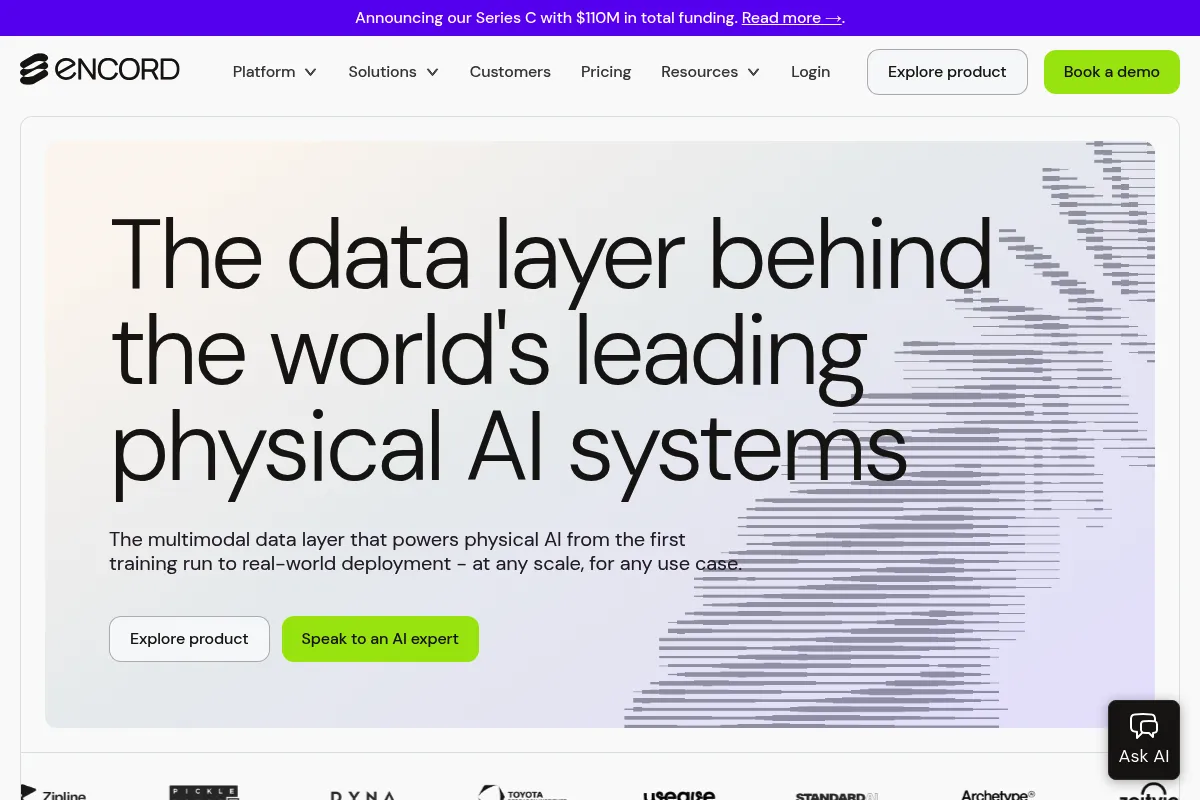
Encord is a data development platform built to handle the entire lifecycle of computer vision data. It moves beyond simple annotation by providing tools for data discovery, curation, and model evaluation within a single environment.
What it actually does
The platform provides a video-native annotation interface, a visual data management system (Index) for querying datasets, and an evaluation module (Apollo) to identify where models are failing. It uses automation to propagate labels across video frames and allows users to train small models to assist in the labeling process.
What makes it different
Encord stands out through its video-first architecture and native support for medical imaging, whereas many competitors treat video as a sequence of independent images. Its 'Index' feature allows teams to treat their visual data like a searchable database, using embeddings to find similar images or outliers without manual metadata tagging.
Ratings across the web
Ratings aggregated from independent review platforms.
Key Features
Encord Index
A data management layer that lets you search and filter visual data using embeddings or metadata.
Micro-models
Small, specialized models trained within the platform to automate specific labeling tasks.
Video-Native Labeling
Handles long-form video with frame-accurate synchronization and automated object tracking.
Active Learning Loops
Automatically identifies high-loss or uncertain data points for human review.
DICOM/NIfTI Toolset
Specialized viewers and annotation tools for 3D medical imaging slices.
Workflow Management
Customizable pipelines for moving data between annotators, reviewers, and ML engineers.
Performance Analytics
Dashboards to track annotator efficiency and label quality over time.
Pricing
Free Trial
- Limited data storage
- Basic annotation tools
- Access to Encord Index (limited)
- Community support
Enterprise
- Full access to Encord Annotate, Index, and Apollo
- Unlimited micro-model training
- Advanced DICOM/NIfTI support
- Dedicated account manager
- SLA and custom integrations
Pricing checked 5 months ago
Pricing guidance
- When you need to manage more than a few thousand assets
- When you require automated labeling (micro-models)
- When you need to integrate with cloud storage like S3 or GCP
- Storage costs may apply if hosting data on Encord's servers
- API rate limits on lower-tier custom agreements
- Seat-based pricing can scale quickly for large labeling workforces
Premium enterprise positioning that targets high-value AI teams rather than the mass market.
Pros & Cons
Strengths
-
Superior video handling
Unlike image-based tools, Encord tracks objects across frames natively, which significantly reduces the time spent on temporal consistency.
-
Specialized medical imaging support
Native support for DICOM and NIfTI makes it a top choice for healthcare AI teams who would otherwise need custom-built viewers.
-
Data-centric curation
The Index feature helps teams prune redundant data and focus on edge cases, which is more effective for model performance than just increasing dataset size.
-
Automation efficiency
The ability to train micro-models for pre-labeling can reduce manual annotation hours by up to 80% for specific use cases.
Weaknesses
-
Opaque pricing
The lack of public pricing makes it difficult for smaller teams to evaluate the tool without entering a high-pressure sales cycle.
Affects: Startups and independent researchers
-
Steep learning curve
The platform is feature-dense; non-technical project managers may find the initial setup and workflow configuration overwhelming.
Affects: Operations-heavy teams without dedicated ML engineers
-
Overkill for simple tasks
If you only need to label 1,000 static images for a basic classifier, the overhead of setting up Encord is not worth the effort.
Affects: Small-scale or one-off projects
Real User Sentiment
Users generally view Encord as a high-end, reliable platform that excels in technical niches like medical imaging and complex video.
Users tend to like
- The responsiveness of the engineering and support teams
- The quality of the video interpolation engine
- The ability to query data via embeddings in Index
- Robust Python SDK for automation
Users commonly complain about
- High cost compared to open-source or basic tools
- Occasional UI lag when handling extremely large datasets
- Complexity of the initial project configuration
Recurring tradeoffs
- You trade simplicity and low cost for advanced automation and data management capabilities.
Happiest users
ML engineers at mid-to-large enterprises handling specialized visual data formats.
Often frustrated
Solo developers or small startups looking for a quick, cheap way to label a few images.
Use Cases
Medical AI
Annotating 3D CT scans or MRIs using specialized DICOM tools.
Autonomous Vehicles
Managing and labeling massive amounts of multi-camera video data.
Retail Analytics
Tracking customer movement and shelf stock using automated video labeling.
Geospatial Analysis
Curation and labeling of high-resolution satellite imagery.
Manufacturing QC
Identifying defects in high-speed production line video.
Frequently Asked Questions
How much does Encord cost?
Encord does not publish its pricing. It typically uses an enterprise model where costs are based on a combination of seats, data volume, and specific modules (Annotate vs. Index). Expect premium pricing comparable to Labelbox or Scale AI.
How does Encord compare to Labelbox?
While both are enterprise leaders, Encord is often preferred for video-heavy workflows and medical imaging (DICOM). Labelbox has a broader ecosystem of third-party labeling services, but Encord's 'Index' feature provides deeper native data curation tools.
Does Encord support DICOM and NIfTI?
Yes, Encord is one of the few commercial platforms with native, high-performance support for 3D medical imaging, including multi-planar reconstruction (MPR) and windowing/leveling.
Can I use my own labeling workforce?
Yes, Encord is platform-agnostic regarding who does the labeling. You can use your internal team, a third-party BPO, or Encord's own managed labeling services.
Does Encord offer a free version?
There is no permanent free tier for production use. They offer a limited trial or 'sandbox' for developers to test the features and SDK before committing to a contract.
What integrations are supported?
Encord integrates with major cloud providers (AWS S3, GCP Cloud Storage, Azure Blob) and provides a comprehensive Python SDK for integrating with existing ML pipelines and notebooks.
Why trust this page?
This evaluation combines product positioning, pricing analysis, traffic and market signals, and public user sentiment into a single decision-support page. Content is generated editorially — not copied from the vendor's website.
Funding & Company
Founded
2020
Stage
Series c
Total Raised
$110M
Latest Round
Series C (Feb 2026)
Notable Investors
Encord has raised a total of $110 million, culminating in a $60 million Series C in February 2026. This substantial and recent funding from high-profile investors like Wellington Management and Next47 signals strong market confidence and provides significant capital for product development and expansion.
Market Signals & Traffic
Estimated visits, global rank, geography, traffic sources, monthly visit trends, and organic search keywords (Similarweb)—on a dedicated page built for depth and search.
- Estimated visits
- 232,408
- Global rank
- #120,383
- Snapshot
- Apr 2026
- Traffic trend
- Rising
Estimated monthly visits
Alternatives to Encord
View all alternativesLabelbox
Developer Tools, Research, Automation

Platform for data labeling, management, and model evaluation workflows.
V7
Developer Tools, Automation, Workflow

Data platform for computer vision and automated image labeling
Scale
Developer Tools, Research, Automation

Data infrastructure for training, labeling, and evaluating machine learning models.
Similar Tools
DagsHub
Developer Tools, Workflow, Research

Collaboration platform for data science and machine learning teams
Evidently AI
Developer Tools, Workflow, Research

Open-source framework for evaluating, testing, and monitoring machine learning models.
Kolena
Developer Tools, Workflow, Research

Testing and validation platform for machine learning models.
Day
Automation, Productivity, Workflow

Automated CRM that captures interactions and updates records automatically.
Chroma
Developer Tools, Search

Open-source embedding database for building applications with long-term memory.
Refiant AI
Privacy & Compliance, Automation, Marketing Automation

Automated compliance review for marketing materials and regulatory risk management.