

Kolena
A rigorous model validation framework that replaces broad accuracy scores with granular unit tests to identify specific failure modes in CV, NLP, and LLM systems.
Best for ML teams in high-stakes industries needing to find edge-case failures, weaker for teams looking for simple real-time monitoring.
Analysis based on product data, pricing structure, traffic signals, and public user sentiment.
Who Should Use Kolena?
Typical users
ML engineers, data scientists, and QA teams at scaling startups or enterprises in regulated sectors like automotive, healthcare, and finance.
Maturity fit
scaling to advanced
Choose this if…
- Your model's aggregate accuracy is high but it fails unpredictably on specific data slices
- You need to prove model safety and lack of bias to stakeholders or regulators
- You want to implement a 'unit testing' culture for machine learning models
Skip this if…
- You only need basic real-time drift monitoring without deep offline validation
- Your team lacks the bandwidth to curate the metadata required for hidden stratification
- You are working on simple, low-stakes hobbyist projects where 80% accuracy is sufficient
About Kolena
Kolena is a model quality platform designed to bring software engineering rigor to machine learning. It moves beyond 'black box' metrics by allowing teams to build comprehensive test suites that scrutinize model behavior across thousands of specific scenarios. It exists to help engineers catch regressions and edge-case failures before they reach production.
Official profiles
What it actually does
The platform enables teams to upload model results and datasets to perform 'hidden stratification'—breaking down performance by specific attributes like lighting conditions, demographics, or document types. It provides a programmatic way to define, run, and track model 'unit tests' through a Python SDK and web interface.
What makes it different
Unlike monitoring tools that focus on production drift, Kolena focuses on pre-deployment validation through 'Hidden Stratification.' It forces developers to look at performance on specific data slices rather than averages, making it easier to pinpoint exactly why and where a model is failing.
Key Features
Hidden Stratification
Breaks down aggregate metrics into specific data slices to find hidden failure modes.
Test Suites
Collections of test cases that act as a permanent quality gate for every model version.
Model Comparison
Side-by-side visualization of how different versions handle the same edge cases.
Autoarena
An open-source tool for ranking LLMs and RAG systems through head-to-head testing.
Metadata-Driven Debugging
Uses data attributes to filter and identify exactly which images or texts caused a failure.
Citations & Reasoning
Provides explainable outputs for LLM extractions to build user trust.
Pre-training Data Quality
Tools to assess the quality and diversity of training data before a model is even built.
Pricing
Free Trial
- Full access to platform features
- Limited data upload volume
- Basic support
Starter
- Core testing and validation tools
- Standard test suite management
- Python SDK access
Enterprise
- Unlimited models and test cases
- Advanced bias and fairness auditing
- SSO and role-based access control
- Dedicated success manager
Pricing checked 4 months ago
Pricing guidance
- When you need to automate testing in a CI/CD pipeline
- When you have more than 3 users requiring collaborative access
- When you need to process more than 100k records
- Data retention limits on lower tiers
- API rate limits for model result uploads
- Support response times vary by tier
Premium positioning justified by the depth of its diagnostic capabilities compared to generic monitoring tools.
Pros & Cons
Strengths
-
Granular failure diagnostics
Instead of seeing a 2% drop in accuracy, you see exactly which lighting conditions or text styles caused the drop, allowing for targeted retraining.
-
Engineering-first workflow
The Python SDK allows testing to be integrated directly into developer workflows, making it feel like standard software unit testing.
-
High-quality stakeholder reporting
The visual dashboards make it easy to show non-technical leaders exactly where the model is safe to deploy and where it still has risks.
Weaknesses
-
High metadata dependency
To get the most out of the platform, you must have well-labeled metadata for your datasets. If your data isn't already enriched, the setup is labor-intensive.
Affects: Teams with raw, unorganized datasets
-
Enterprise-skewed pricing
While there is a free trial, the full platform is positioned for enterprise budgets, making it expensive for small teams or solo researchers.
Affects: Early-stage startups and individual developers
-
Steep learning curve
The shift from aggregate metrics to scenario-based testing requires a change in mindset and significant initial configuration of test suites.
Affects: Teams used to traditional, metric-only evaluation
Real User Sentiment
Users generally praise the platform for its ability to uncover 'silent' model failures that aggregate metrics miss.
Users tend to like
- The 'unit testing' analogy for ML
- Granular visualization of failure modes
- Significant time savings in document review tasks
- Explainability and citations in LLM outputs
Users commonly complain about
- Complexity of initial setup
- Requirement for high-quality metadata
- Lack of public pricing transparency
Recurring tradeoffs
- Deep diagnostics require more upfront work in data preparation compared to simple monitoring.
Happiest users
ML Engineers in high-stakes industries who are tired of models failing in production despite high accuracy scores.
Often frustrated
Developers looking for a 'plug-and-play' monitoring tool who don't want to spend time defining test cases.
Use Cases
Autonomous Vehicles
Testing object detection models across specific weather and lighting conditions.
Medical Imaging
Validating diagnostic models for bias across different patient demographics.
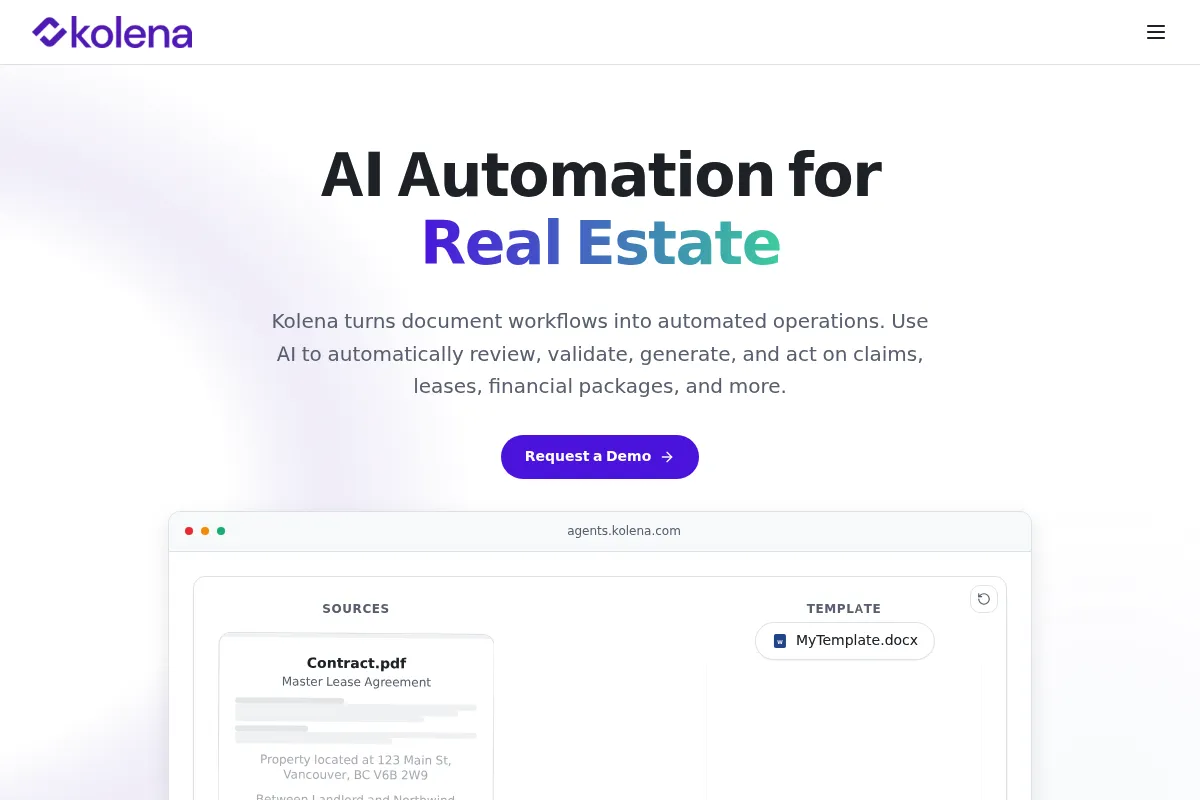
Commercial Real Estate
Automating lease abstraction with 95%+ accuracy and structured data export.
Financial Underwriting
Verifying loan applications by cross-referencing multiple financial documents.
LLM Red Teaming
Testing RAG systems for hallucinations and toxic content before public launch.
Frequently Asked Questions
Does Kolena have a free plan?
Kolena offers a 2-week free trial for its full platform. Additionally, they provide a free 'no-signup' tool specifically for single-document lease abstraction, though it only provides text summaries rather than structured data.
How does Kolena compare to Deepchecks?
Deepchecks is often used for both validation and production monitoring with a focus on data drift. Kolena is more specialized in 'Hidden Stratification' and rigorous pre-deployment unit testing to find specific failure modes.
What are the main limitations of Kolena?
The biggest limitation is the 'metadata tax.' To find out why a model fails on 'rainy days,' you must have your data tagged with 'weather=rain.' Without metadata, Kolena's core value of stratification is hard to achieve.
Can Kolena be integrated into CI/CD?
Yes, Kolena is built for automation. It provides a Python SDK that allows you to trigger test suites and block model deployments if they fail specific quality gates, similar to how you would block code with failing unit tests.
What data modalities does Kolena support?
Kolena is multimodal, supporting Computer Vision (images/video), NLP (text), LLMs (RAG/Generative), and structured data (tabular).
Is Kolena SOC 2 compliant?
Yes, Kolena is SOC 2 Type II compliant, which is a standard requirement for the enterprise and government sectors they serve.
Why trust this page?
This evaluation combines product positioning, pricing analysis, traffic and market signals, and public user sentiment into a single decision-support page. Content is generated editorially — not copied from the vendor's website.
Funding & Company
Founded
2021
Stage
Series a
Total Raised
$21M
Latest Round
Series A (Sep 2023)
Notable Investors
Kolena has raised a total of $21 million over two rounds, including a $15 million Series A in late 2023. This funding provides the company with a solid financial runway to continue developing its ML testing platform and expand its enterprise customer base.
Market Signals & Traffic
Estimated visits, global rank, geography, traffic sources, monthly visit trends, and organic search keywords (Similarweb)—on a dedicated page built for depth and search.
- Estimated visits
- 0
- Global rank
- —
- Snapshot
- Apr 2026
- Traffic trend
- —
Estimated monthly visits
Alternatives to Kolena
View all alternativesDeepchecks
Developer Tools, Automation, Workflow

Testing and monitoring platform for machine learning and LLM applications.
Evidently AI
Developer Tools, Workflow, Research

Open-source framework for evaluating, testing, and monitoring machine learning models.
Weights & Biases (W&B)
Developer Tools, Research

Developer platform for tracking, visualizing, and managing machine learning experiments.
Similar Tools
Encord
Developer Tools, Workflow, Research

Data development platform for labeling, managing, and evaluating multimodal datasets.
Evidently AI
Developer Tools, Workflow, Research
Open-source framework for evaluating, testing, and monitoring machine learning models.
DagsHub
Developer Tools, Workflow, Research

Collaboration platform for data science and machine learning teams
Axflow
Developer Tools, Workflow

TypeScript framework for building modular and scalable language model applications
Zenlytic
AI Assistant, Automation & Agents, Productivity

Conversational business intelligence platform for self-service data analysis
Chatbox AI
AI Assistant, Developer Tools, Productivity

Cross-platform desktop and mobile client for multiple language models