

A developer-first speech-to-text API that prioritizes high-accuracy transcription and integrated LLM analysis over the absolute lowest market price.
Excellent for product teams building AI-driven media or telephony apps, weaker for high-volume users where cost-per-minute is the only metric that matters.
Analysis based on product data, pricing structure, traffic signals, and public user sentiment.
Who Should Use AssemblyAI?
Typical users
Software engineers and product teams at startups or mid-market companies building transcription-heavy features like meeting assistants, podcast editors, or call center analytics.
Maturity fit
scaling to advanced
Choose this if…
- You need high accuracy out of the box without fine-tuning models
- Your workflow requires applying LLMs to audio data for summarization or Q&A
- You want a clean, modern API experience compared to legacy cloud providers like AWS or Google
Skip this if…
- You have massive audio volumes and need the absolute lowest per-minute cost (Deepgram is often cheaper)
- You prefer self-hosting open-source models like Whisper to keep data entirely on-premise
- You only need basic transcription without any post-processing or intelligence features
About AssemblyAI
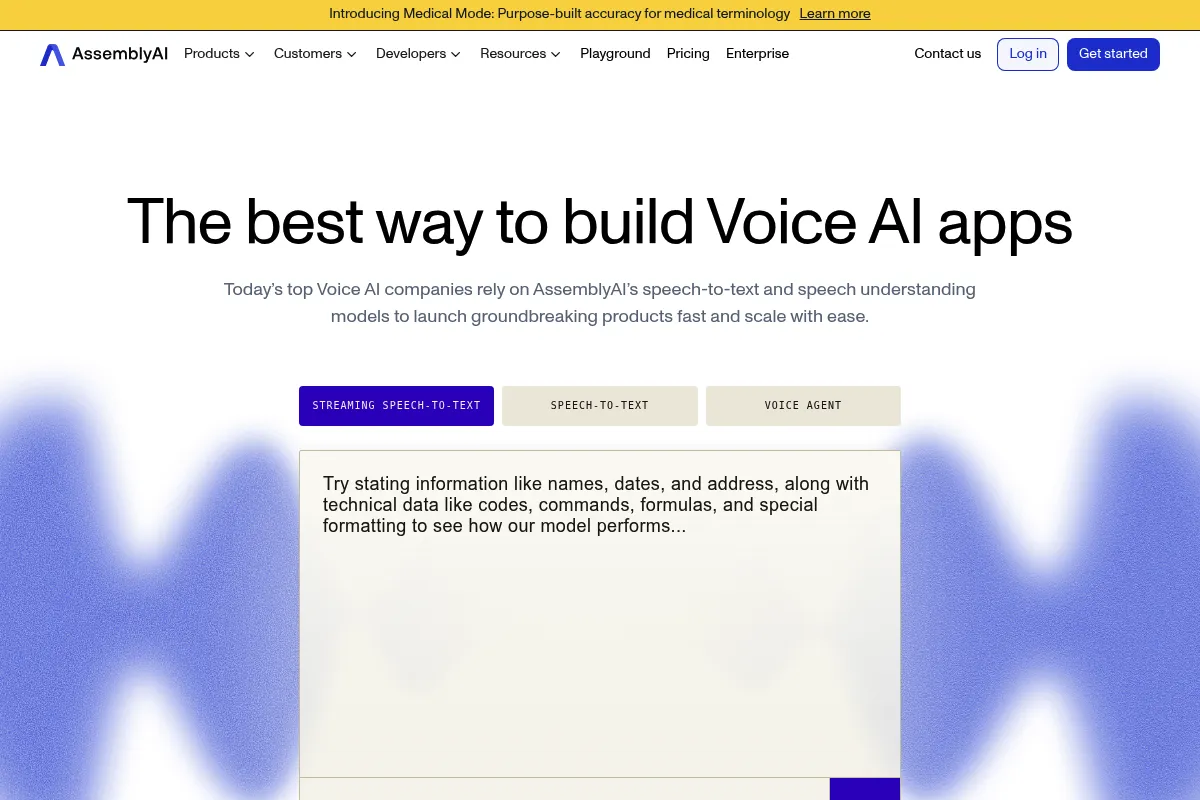
AssemblyAI is an API-first platform providing speech-to-text and audio intelligence models. It is designed for developers who need to convert audio to text and extract structured data like summaries, sentiment, or PII redaction without managing their own machine learning infrastructure.
What it actually does
It provides asynchronous and real-time transcription for over 80 languages. Beyond simple text conversion, it offers a suite of 'Audio Intelligence' tools and a framework called LeMUR for running large language model prompts directly against audio transcripts.
What makes it different
AssemblyAI differentiates itself through its LeMUR framework, which eliminates the need for developers to build custom pipelines to feed transcripts into LLMs like GPT-4. Its Universal-1 model is specifically engineered for high accuracy across diverse accents and noisy environments, often outperforming generic cloud provider models.
Ratings across the web

Ratings aggregated from independent review platforms.
Key Features
Universal-1 Model
High-accuracy transcription trained on 12.5 million hours of audio data.
LeMUR
Allows developers to apply LLMs to transcripts for summarization, action item extraction, or custom Q&A.
Speaker Diarization
Automatically detects and labels different speakers in a multi-party conversation.
PII Redaction
Identifies and removes sensitive information like credit card numbers or SSNs from transcripts.
Auto-Chapters
Segments long-form audio into logical sections with concise summaries for each.
Real-time Streaming
Low-latency transcription for live broadcasts, meetings, or telephony.
Sentiment Analysis
Provides a breakdown of positive, negative, and neutral sentiment at the sentence level.
Pricing
Nano
- Best for high-volume, low-cost needs
- Supports 99+ languages
- Standard transcription accuracy
- Pay-as-you-go
Universal-1
- Highest accuracy model
- Fastest processing speeds
- Robust to background noise
- Best for production apps
Real-time
- Low-latency streaming
- WebSocket support
- Ideal for live meetings
- 60-word-per-minute minimum
Audio Intelligence
- Sentiment analysis
- PII Redaction
- Auto-chapters
- Entity detection
Pricing checked 6 months ago
Pricing guidance
- When you need real-time transcription for live features
- When you require LLM-based analysis via LeMUR
- When moving from testing to a production environment requiring higher rate limits
- Default rate limits apply to concurrent jobs
- LeMUR usage is billed separately based on token counts ($0.015/1k input, $0.06/1k output)
- Minimum billing increments may apply to very short files
Mid-to-premium positioning. It targets users who value engineering time and output quality over the lowest possible infrastructure cost.
Pros & Cons
Strengths
-
Top-tier accuracy
The Universal-1 model handles background noise, accents, and technical jargon better than most off-the-shelf alternatives.
-
Superior Developer Experience
Documentation is exceptionally clear, and the SDKs (Python, JS, Go, etc.) are modern and well-maintained.
-
Integrated LLM capabilities
LeMUR simplifies the stack by allowing you to summarize or analyze audio in a single API call rather than piping text to OpenAI.
Weaknesses
-
Premium pricing
While competitive with legacy cloud providers, it is significantly more expensive than self-hosting Whisper or using Deepgram's lowest tiers.
Affects: High-volume users and bootstrapped startups
-
Async processing latency
For very large files, the turnaround time for asynchronous transcription can be slower than competitors optimized for raw speed.
Affects: Apps requiring near-instant turnaround for long-form content
-
Language parity gaps
While it supports 80+ languages, advanced features like sentiment analysis and LeMUR are primarily optimized for English.
Affects: International products focusing on non-English markets
Real User Sentiment
Generally very positive, with developers frequently citing the ease of integration and the quality of the Universal-1 model.
Users tend to like
- Excellent documentation and SDKs
- High accuracy on difficult audio
- LeMUR's ability to summarize audio without extra code
- Responsive technical support
Users commonly complain about
- Higher cost compared to Deepgram
- Occasional delays in async processing queues
- Limited language support for advanced intelligence features
Recurring tradeoffs
- Users trade lower cost for significantly better developer experience and built-in AI features.
Happiest users
Product teams building complex AI features who want to move fast and don't want to manage their own LLM prompts or transcription pipelines.
Often frustrated
Developers at high-volume, low-margin companies where a $0.20 difference per hour significantly impacts the bottom line.
Use Cases
Meeting Assistants
Transcribing Zoom calls and using LeMUR to extract action items and summaries.
Content Creation
Generating subtitles and automated chapters for podcasts or YouTube videos.
Call Centers
Redacting PII from customer recordings and analyzing sentiment for quality assurance.
Media Monitoring
Transcribing live news broadcasts in real-time to alert users of specific keywords.
EdTech
Converting lecture recordings into searchable text and structured study notes.
Frequently Asked Questions
How does AssemblyAI compare to OpenAI Whisper?
While Whisper is a powerful open-source model, AssemblyAI's Universal-1 often provides better accuracy on noisy audio and specialized accents. Furthermore, AssemblyAI provides a managed API with features like speaker diarization, PII redaction, and real-time streaming that Whisper does not offer natively without significant custom engineering.
Is there a free version of AssemblyAI?
AssemblyAI does not have a permanent free tier. However, they provide $50 in free credits upon sign-up, which allows developers to test all features, including Universal-1 and LeMUR, without an upfront commitment.
What are the main limitations of the API?
The primary limitations are the cost at extreme scales and the fact that advanced 'Audio Intelligence' features (like sentiment and LeMUR) are not yet available for all 80+ supported transcription languages, with the best performance reserved for English.
Does AssemblyAI support real-time transcription?
Yes, AssemblyAI offers a real-time streaming API via WebSockets. It is priced at $0.75 per hour and is designed for low-latency use cases like live captioning or real-time meeting analysis.
Can AssemblyAI identify different speakers?
Yes, the platform includes a 'Speaker Diarization' feature that can detect multiple speakers in an audio file and label the transcript accordingly. This is an add-on feature that works with both asynchronous and real-time transcription.
How does pricing work for LeMUR?
LeMUR is billed based on the number of tokens processed by the LLM. It currently costs $0.015 per 1,000 input tokens and $0.06 per 1,000 output tokens. This is in addition to the base cost of the transcription itself.
Why trust this page?
This evaluation combines product positioning, pricing analysis, traffic and market signals, and public user sentiment into a single decision-support page. Content is generated editorially — not copied from the vendor's website.
Funding & Company
Founded
2017
Stage
Series c
Total Raised
$115.12M
Latest Round
Series C (Dec 2023)
Notable Investors
AssemblyAI has raised a total of $115.12 million across four funding rounds, including a $50 million Series C in late 2023. This significant and recent funding from top-tier investors like Accel and Insight Partners indicates strong market confidence and provides substantial capital for product development and scaling operations.
Market Signals & Traffic
Estimated visits, global rank, geography, traffic sources, monthly visit trends, and organic search keywords (Similarweb)—on a dedicated page built for depth and search.
- Estimated visits
- 590,083
- Global rank
- #74,249
- Snapshot
- Apr 2026
- Traffic trend
- Surging
Estimated monthly visits
Alternatives to AssemblyAI
View all alternatives
Similar Tools
Skyvern
Automation, Automation & Agents, Productivity

AI-powered browser automation for complex web workflows.
DSPy
Developer Tools, Research, Automation

Framework for programming and optimizing language model pipelines.
Abridge
Health & Wellness, Documentation, Workflow

Ambient clinical documentation for healthcare providers and medical systems.
Faraday
AI Assistant, Privacy & Compliance

Run open-source large language models locally on your computer
Bittensor
Developer Tools, Research

Decentralized marketplace for peer-to-peer machine intelligence and model training.
Fullstory
Automation & Agents, Developer Tools, Privacy & Compliance

Digital experience intelligence platform for tracking and analyzing user behavior.