

Evidently AI
An open-source Python framework that translates complex statistical drift and model performance metrics into actionable visual reports and automated test suites.
Excellent for data scientists who need to monitor model health within Jupyter notebooks or CI/CD pipelines, weaker for teams requiring a zero-config, high-scale SaaS monitoring platform.
Analysis based on product data, pricing structure, traffic signals, and public user sentiment.
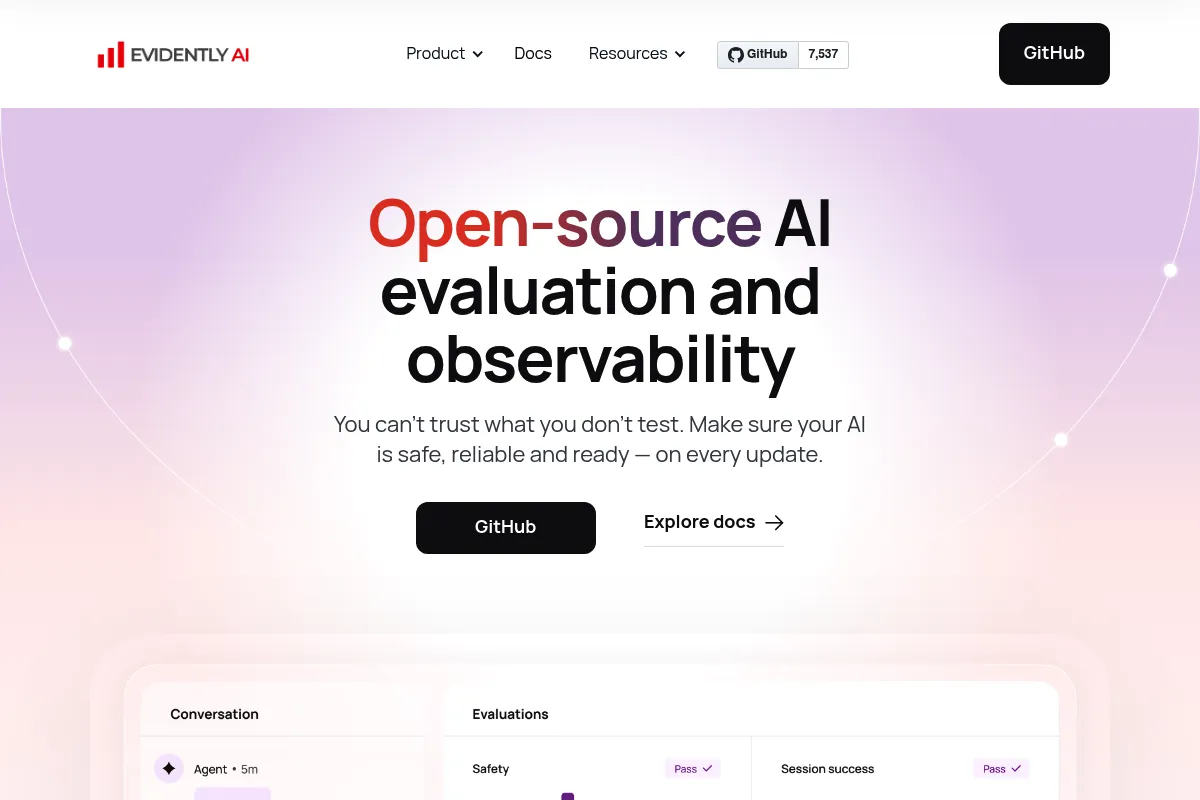
Who Should Use Evidently AI?
Typical users
Data scientists and ML engineers working in Python-centric environments, from solo researchers to mid-sized MLOps teams.
Maturity fit
beginner to scaling
Choose this if…
- You want to generate model health reports directly in Jupyter notebooks
- Your priority is open-source flexibility without mandatory vendor lock-in
- You need to integrate model testing into existing CI/CD pipelines using Python
Skip this if…
- You require a completely no-code monitoring solution
- Your workflow is outside the Python ecosystem
- You need a managed service with sub-second real-time alerting for massive data streams without manual configuration
About Evidently AI
Evidently AI provides an open-source library for evaluating and monitoring machine learning models. It bridges the gap between model development and production by offering tools to detect data drift, assess performance degradation, and ensure data quality.
Official profiles
What it actually does
The tool analyzes datasets to identify statistical shifts in features and target variables. It generates interactive HTML reports for manual inspection and JSON-based test suites that can automatically pass or fail model deployments based on predefined thresholds.
What makes it different
Unlike many MLOps platforms that force users into a proprietary dashboard, Evidently starts as a lightweight Python library. It prioritizes 'Reports' and 'Test Suites' as local objects, allowing users to verify models during the research phase before they ever reach production.
Ratings across the web

Ratings aggregated from independent review platforms.
Key Features
Data Drift Reports
Visualizes distribution shifts in input features to catch 'training-serving' skew.
Test Suites
Provides declarative checks (e.g., 'accuracy > 0.8') that return structured JSON for pipeline automation.
LLM Monitoring
Evaluates text quality, embedding drift, and specific descriptors for generative AI outputs.
Presets
Pre-configured metric sets for common tasks like regression or data integrity to save setup time.
Evidently Cloud
A managed platform for teams to store historical snapshots and collaborate on dashboards.
Custom Metrics
Allows developers to write Python functions to track domain-specific KPIs.
Integration Hooks
Works with Airflow, MLflow, and ZenML to embed monitoring into broader workflows.
Pricing
Open Source
- Core Python library
- All report presets
- Test suites
- Local HTML/JSON exports
Cloud Free
- 1 User
- Limited data snapshots
- Managed dashboard
- Basic support
Cloud Pro
- Team collaboration
- Increased data retention
- Role-based access control
- Priority support
Enterprise
- Self-hosted deployment
- SSO/SAML
- Custom SLAs
- Dedicated account manager
Pricing checked 4 months ago
Pricing guidance
- When you need a persistent history of model performance across multiple versions
- When you need to share dashboards with non-technical stakeholders
- When you require centralized access control for a team
- Cloud Free tier has strict limits on the number of 'snapshots' or data points stored
- Self-hosting the open-source UI requires managing your own database and compute costs
Highly accessible open-source entry point with a standard mid-market SaaS upsell for managed services.
Pros & Cons
Strengths
-
Notebook-first workflow
Data scientists can generate complex visualizations with a few lines of code without leaving their experimentation environment.
-
Open-source core
The primary library is Apache 2.0 licensed, allowing teams to build internal tools on top of it without recurring licensing fees.
-
Flexible output formats
Supports HTML for human review, JSON for automated systems, and Python dictionaries for custom integrations.
-
Low barrier to entry
Requires no infrastructure setup to start; you can run it locally on a CSV or Pandas dataframe in minutes.
Weaknesses
-
Self-hosting complexity
Setting up the open-source monitoring service with persistent storage (PostgreSQL) and a UI requires significant DevOps effort compared to SaaS rivals.
Affects: Small teams without dedicated platform engineers
-
Dashboard limitations
The open-source UI is functional but lacks the advanced user management and deep-dive root cause analysis found in enterprise platforms like Arize or Fiddler.
Affects: Large organizations with complex compliance and collaboration needs
-
Performance at scale
Processing very large datasets for drift calculation can be memory-intensive if not carefully sampled or batched.
Affects: Teams working with high-velocity, high-volume production data
Real User Sentiment
Generally positive, praised for its simplicity and the quality of its visual reports, though some users find the transition from local library to production monitoring service challenging.
Users tend to like
- Ease of integration with Pandas and Scikit-learn
- Clean and informative HTML visualizations
- Comprehensive documentation and active community
- The 'Test Suite' concept for CI/CD integration
Users commonly complain about
- Documentation for the self-hosted monitoring service can be confusing
- UI can feel sluggish when loading many historical snapshots
- Limited support for non-tabular data in the core drift metrics
Recurring tradeoffs
- Users trade the 'instant-on' convenience of SaaS for the control and privacy of an open-source library.
Happiest users
Data scientists who want to automate their 'sanity checks' and reporting without learning a complex new platform.
Often frustrated
Engineers trying to build a high-scale, multi-tenant monitoring platform using only the open-source components without sufficient DevOps resources.
Use Cases
Model Promotion
Using Test Suites in a CI/CD pipeline to block deployment if data drift is too high.
Stakeholder Reporting
Generating weekly HTML reports to show business owners how model accuracy is trending.
Debugging
Comparing training data against production data to find why a model is underperforming.
LLM Quality Control
Evaluating the relevance and coherence of RAG (Retrieval-Augmented Generation) outputs.
Data Quality Auditing
Running checks on incoming raw data to identify missing values or schema changes before they hit the model.
Frequently Asked Questions
How does Evidently AI compare to Great Expectations?
Great Expectations focuses primarily on data quality and pipeline testing (e.g., 'is this column a string?'). Evidently AI focuses on model-specific metrics like data drift, classification accuracy, and target distribution shifts. Many teams use both: Great Expectations for data engineering and Evidently for ML monitoring.
Can I use Evidently AI for free?
Yes, the core Python library is open-source and free to use forever for local report generation and testing. You only pay if you choose to use their managed Cloud platform or require Enterprise-level support and features.
Does it support real-time monitoring?
Evidently can be used for real-time monitoring, but it requires you to set up a service that collects data and sends it to the Evidently monitoring dashboard. It is more commonly used for batch or micro-batch monitoring out of the box.
What integrations are available?
Evidently integrates with most of the Python data stack, including Pandas, Scikit-learn, and PySpark. It also has specific integrations for workflow orchestrators like Airflow and experiment trackers like MLflow.
Does it work with LLMs?
Yes, Evidently recently introduced an LLM evaluation module that helps track text descriptors, embedding drift, and model-based evaluations for generative AI applications.
Can I host the dashboard myself?
Yes, Evidently provides a standalone Monitoring Service that you can deploy via Docker to host your own dashboards and store historical model metrics locally.
Why trust this page?
This evaluation combines product positioning, pricing analysis, traffic and market signals, and public user sentiment into a single decision-support page. Content is generated editorially — not copied from the vendor's website.
Funding & Company
Founded
2020
Stage
Seed
Total Raised
$1.15M
Latest Round
Seed (Jul 2022)
Notable Investors
Evidently AI has raised a total of $1.15 million over two rounds, including a Pre-Seed investment from Y Combinator and a later Seed round. This level of funding for an open-source developer tool suggests a focus on community-led growth and product development over aggressive marketing spend.
Market Signals & Traffic
Estimated visits, global rank, geography, traffic sources, monthly visit trends, and organic search keywords (Similarweb)—on a dedicated page built for depth and search.
- Estimated visits
- 162,177
- Global rank
- #261,394
- Snapshot
- Apr 2026
- Traffic trend
- Rising
Estimated monthly visits
Alternatives to Evidently AI
View all alternativesWhyLabs
Developer Tools, Workflow
Observability platform for monitoring data health and model performance.
Fiddler
Developer Tools, Privacy & Compliance, Automation

Monitor, explain, and analyze machine learning models and LLMs.
Similar Tools
DagsHub
Developer Tools, Workflow, Research

Collaboration platform for data science and machine learning teams
Encord
Developer Tools, Workflow, Research

Data development platform for labeling, managing, and evaluating multimodal datasets.
Kolena
Developer Tools, Workflow, Research

Testing and validation platform for machine learning models.
Activepieces
Automation, Developer Tools, Marketing Automation

Open-source workflow automation platform for connecting apps and tasks.
AgentSmyth
AI Assistant, Research, Automation & Agents

Autonomous agents for financial research and investment analysis.
Omi (Based Hardware)
AI Assistant, Productivity, Communication

Wearable necklace that transcribes and summarizes real-world conversations