

Arahi AI
An agent-centric governance platform that automates compliance workflows through autonomous 'compliance agents' rather than static dashboards.
Best for mid-market to enterprise teams needing to automate EU AI Act or HIPAA compliance, weaker for organizations requiring deep technical model-drift observability.
Analysis based on product data, pricing structure, traffic signals, and public user sentiment.
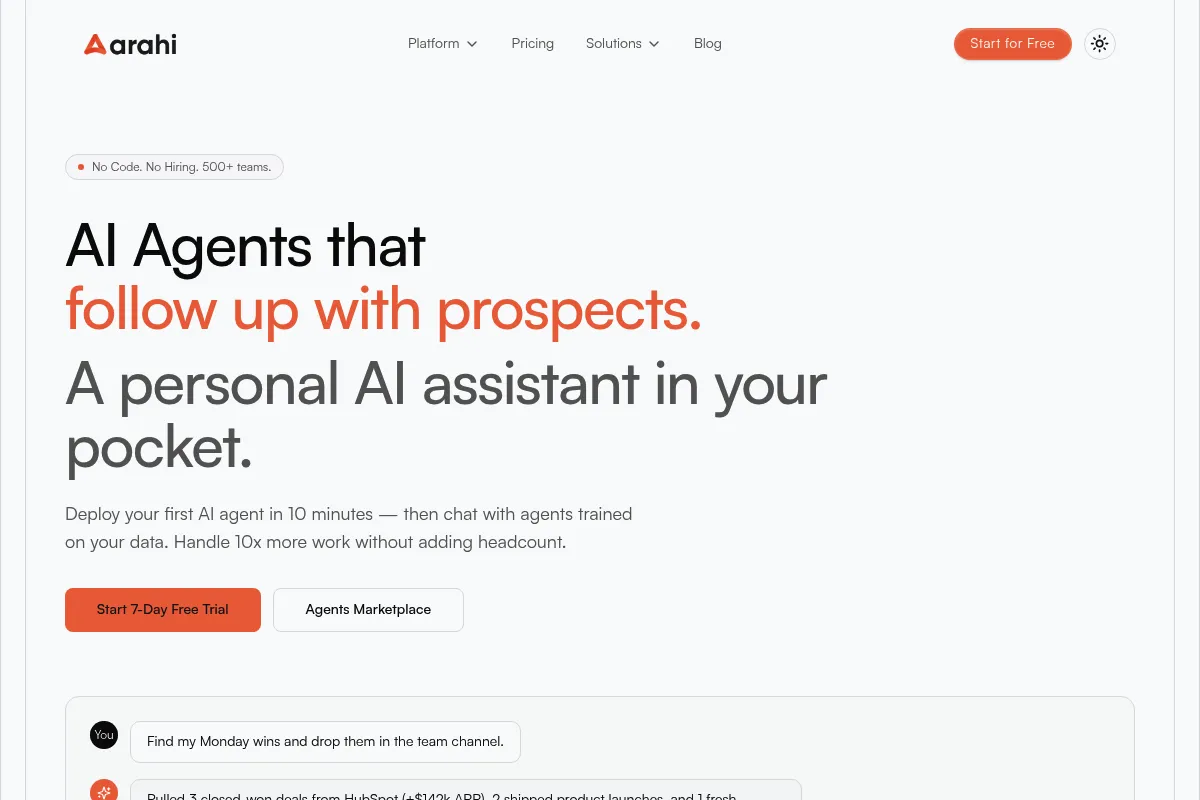
Who Should Use Arahi AI?
Typical users
Compliance officers, risk managers, and operations leads at regulated companies (FinTech, HealthTech) managing multiple AI deployments.
Maturity fit
scaling to advanced
Choose this if…
- You want to automate the collection of compliance evidence across 2,800+ connected apps.
- Your priority is mapping AI behavior to specific regulatory frameworks like the EU AI Act or NIST.
- You prefer 'active' governance where AI agents monitor and remediate policy violations in real-time.
Skip this if…
- You only need technical model monitoring (drift, latency) without the regulatory reporting layer.
- Your organization is small enough that manual risk assessments in spreadsheets are still manageable.
- You require a legacy GRC tool with decades of market presence and extensive on-site consulting.
About Arahi AI
Arahi AI is a governance-first automation platform that uses autonomous agents to manage AI risk and regulatory compliance. It moves beyond traditional record-keeping by deploying 'Agent NEO'—an engine designed to interpret legal text and enforce internal policies across an organization's software stack. The platform exists to help enterprises scale AI adoption without increasing the headcount of their compliance departments.
What it actually does
The platform allows users to build no-code AI agents that continuously monitor AI systems for bias, ethical violations, and regulatory gaps. It automatically generates audit-ready documentation and maps model performance directly to clauses in frameworks like the EU AI Act or HIPAA. When a policy is breached, the agents can take corrective actions, such as alerting stakeholders or updating CRM records.
What makes it different
Unlike competitors that function as passive registries, Arahi is built on an agentic architecture. It doesn't just store risk assessments; it uses agents with long-term memory to 'read' regulations and 'act' as a virtual compliance team. This allows it to connect to thousands of apps to pull live evidence, making governance an operational process rather than a quarterly paperwork exercise.
Ratings across the web

Ratings aggregated from independent review platforms.
Key Features
Agent NEO Engine
Powers autonomous decision-making for compliance tasks.
Regulatory Mapping
Connects technical model outputs to specific legal requirements.
Continuous Evidence Collection
Pulls data from Slack, Jira, and CRMs to prove compliance.
Bias Detection Guardrails
Identifies and flags disparate impact in model responses.
Visual Agent Builder
Allows non-technical users to describe governance workflows in plain English.
Audit-Ready Reporting
One-click generation of documentation for regulators.
Multi-Step Task Execution
Agents can plan and execute complex remediation sequences.
Zero-Hallucination Calibration
Models tuned specifically for high-accuracy compliance work.
Pricing
Starter
- 1,000 actions per month
- 1,500+ integrations
- Basic AI agents
- Standard support
Growth
- 2,000 actions per month
- Priority support
- Advanced agent memory
- Bulk actions
Pro
- 6,000 actions per month
- Multi-workspace support
- Premium integrations
- First access to new features
Enterprise
- Unlimited actions
- Full governance suite
- Regulatory mapping (EU AI Act, HIPAA)
- Dedicated account manager
Pricing checked 5 months ago
Pricing guidance
- When you need to map agents to specific regulatory frameworks (Enterprise only).
- When your monthly monitoring actions exceed 2,000.
- When you need to manage multiple projects or workspaces.
- Action credits are consumed quickly by continuous monitoring tasks.
- Regulatory mapping features are often gated behind the Enterprise tier.
- Advanced memory storage may have unlisted capacity limits on lower plans.
Aggressively priced compared to legacy enterprise GRC tools, positioning itself as a high-value alternative to both Zapier and expensive compliance suites.
Pros & Cons
Strengths
-
Active remediation vs. passive tracking
Agents can actually execute tasks like drafting follow-up emails or updating risk registries, which saves hundreds of hours of manual data entry.
-
Massive integration ecosystem
With over 2,800 native connectors, it can monitor AI activity across almost any tool in a modern enterprise stack.
-
Regulatory-specific intelligence
The platform is specifically tuned to interpret complex legal language, making it more useful for legal teams than general-purpose automation tools.
Weaknesses
-
Platform maturity
As a newer entrant in the GRC space, its ecosystem of pre-built templates is still growing compared to established players like Credo AI.
Affects: Teams looking for 'plug-and-play' templates for very niche industries.
-
Sparse technical documentation
Publicly available guides for complex, multi-agent orchestration are limited, often requiring a sales demo to understand full depth.
Affects: Developers who prefer self-serve troubleshooting and deep API docs.
-
Agent logic learning curve
Moving from linear 'if-this-then-that' workflows to autonomous agent planning requires a shift in how teams think about automation.
Affects: Operations managers used to traditional tools like Zapier or Make.
Real User Sentiment
Generally positive regarding the 'agentic' approach to automation, though users find the setup of complex agents more difficult than traditional tools.
Users tend to like
- The ability to describe a workflow in natural language.
- Significant cost savings compared to Zapier for high-volume tasks.
- The 'set and forget' nature of autonomous agents.
Users commonly complain about
- Steep learning curve for non-linear agent planning.
- Occasional unpredictability in agent decision-making.
- Lack of deep community-driven template libraries.
Recurring tradeoffs
- You trade the predictability of linear workflows for the flexibility of autonomous agents.
Happiest users
Operations leads in mid-sized companies who need to automate complex, multi-step processes without a developer.
Often frustrated
Users expecting a simple 'Zapier clone' who get overwhelmed by the agent configuration options.
Use Cases
Compliance Officer
Automating the collection of audit evidence for the EU AI Act.
Risk Manager
Deploying agents to monitor internal LLMs for PII leakage and bias.
Sales Operations
Building agents that qualify leads and update CRM deal stages autonomously.
Legal Team
Mapping internal AI policies to changing global regulations automatically.
Customer Support
Using agents to triage tickets and escalate high-risk compliance issues.
Frequently Asked Questions
How does Arahi AI compare to Zapier?
Zapier is built for linear, 'if-this-then-that' workflows. Arahi AI uses autonomous agents that can reason through tasks, handle multi-step logic, and adapt if an API fails. Arahi is also significantly cheaper for high-volume automation, often cited as being up to 90% less expensive at scale.
Is there a free plan for Arahi AI?
Yes, Arahi offers a limited free version to explore the platform and build your first agent. However, for production governance or high-volume automation, you will need to move to the Starter ($49/mo) or Growth ($149/mo) plans.
Can Arahi AI help with EU AI Act compliance?
Yes, this is one of its core enterprise use cases. It provides templates and agents specifically designed to map AI systems to the EU AI Act's risk categories and documentation requirements, automating the generation of compliance reports.
What are the main limitations of the platform?
The primary limitation is the maturity of its documentation and template library. Because it uses an agentic approach rather than simple triggers, it can be more difficult to debug complex workflows compared to traditional automation tools.
Does Arahi AI integrate with my existing CRM?
Yes, it supports over 2,800 integrations, including major CRMs like Salesforce, HubSpot, and Pipedrive. Agents can pull data from these systems to monitor for risks or update records based on compliance checks.
What is 'Agent NEO'?
Agent NEO is Arahi's proprietary AI engine. It is designed to minimize hallucinations and maintain long-term memory, allowing agents to stay consistent across multiple interactions and complex, multi-day compliance tasks.
Why trust this page?
This evaluation combines product positioning, pricing analysis, traffic and market signals, and public user sentiment into a single decision-support page. Content is generated editorially — not copied from the vendor's website.
Funding & Company
Founded
2024
Stage
Bootstrapped
Total Raised
Bootstrapped
Latest Round
—
Arahi AI is a bootstrapped company and has not raised any external funding to date. This indicates that the company is relying on its own revenue to fund its operations and growth, suggesting a lean and capital-efficient business model.
Market Signals & Traffic
Estimated visits, global rank, geography, traffic sources, monthly visit trends, and organic search keywords (Similarweb)—on a dedicated page built for depth and search.
- Estimated visits
- 29,582
- Global rank
- #970,188
- Snapshot
- Apr 2026
- Traffic trend
- Surging
Estimated monthly visits
Similar Tools
Ruh
Automation & Agents, AI Assistant, Productivity

Operating system for building and deploying digital employees and workflows.
Agenta
Developer Tools, Automation & Agents

Open-source platform for building, evaluating, and deploying LLM applications.
Glean
AI Assistant, Productivity, Documentation

Enterprise search and knowledge discovery platform for workplace teams.
Liquid AI
Developer Tools, Research

High-performance foundation models for long-context data and edge computing
Fullstory
Automation & Agents, Developer Tools, Privacy & Compliance

Digital experience intelligence platform for tracking and analyzing user behavior.
Julius
AI Assistant, Research, Productivity

Analyze data and create visualizations using natural language prompts.