

An orchestration layer for autonomous AI agents that functions as a middleware for digital labor—best for enterprises needing to automate non-linear business processes that traditional 'if-then' tools can't handle.
Excellent for scaling complex, multi-step workflows across fragmented software stacks, but overkill for teams needing simple, trigger-based automation.
Analysis based on product data, pricing structure, traffic signals, and public user sentiment.
Who Should Use Ruh?
Typical users
Operations leaders, IT managers, and automation engineers in mid-to-large enterprises managing high-volume manual tasks.
Maturity fit
scaling to advanced
Choose this if…
- Your workflows require agents to make decisions rather than just follow a fixed path
- You need to connect AI agents to a vast library of over 3,000 third-party applications
- Your priority is building 'digital employees' that maintain state and memory over long-running tasks
Skip this if…
- You only need simple, linear automations that Zapier or Make can handle for a fraction of the cost
- You lack the internal resources to define and supervise complex agentic logic
- You require transparent, self-serve pricing without going through a sales cycle
About Ruh
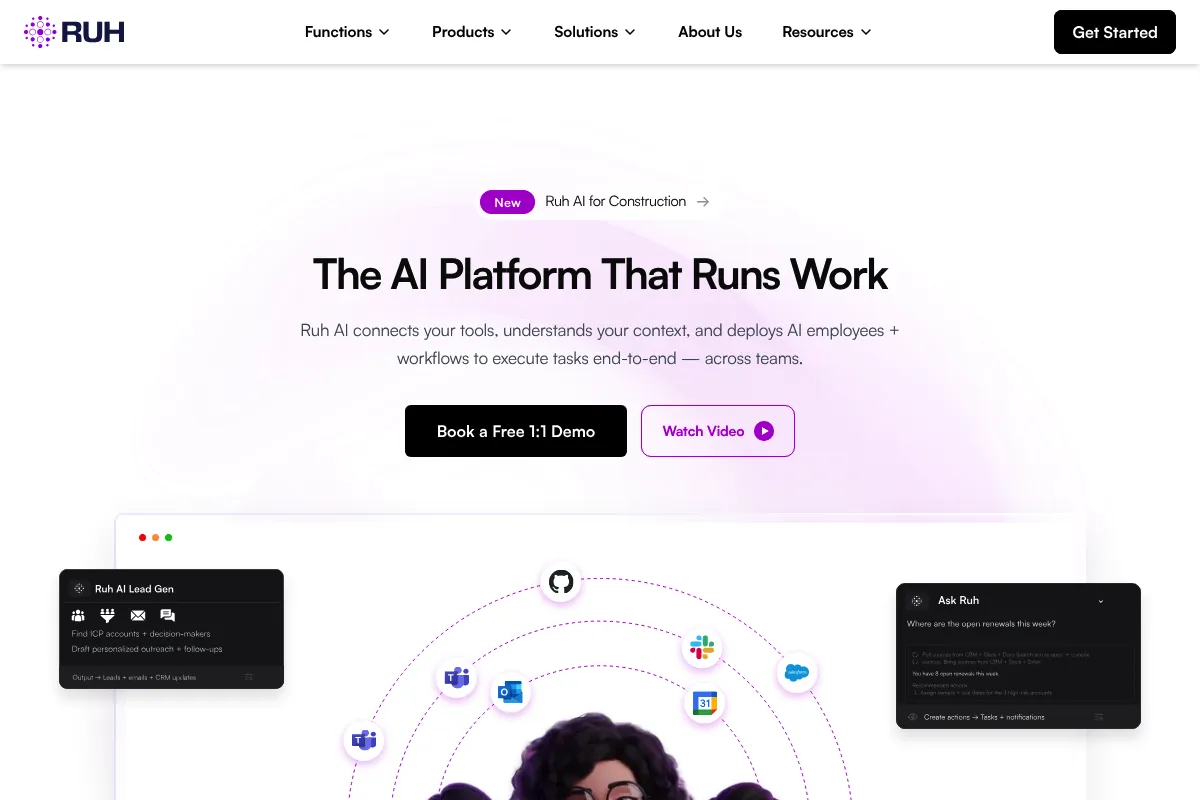
Ruh is an enterprise-focused infrastructure for building and managing a digital workforce. It provides the underlying 'operating system' that allows AI agents to interact with software, maintain context, and execute end-to-end business functions. The tool exists to move beyond simple task automation into the realm of autonomous process execution.
Official profiles
What it actually does
Ruh allows users to create specialized AI agents—termed 'digital employees'—and equip them with specific tools, data access, and goals. These agents can then navigate through various SaaS applications to complete complex jobs like lead qualification, customer support resolution, or data reconciliation.
What makes it different
Unlike standard workflow builders that rely on rigid logic gates, Ruh focuses on agentic autonomy, where the AI determines the best sequence of actions to reach a goal. It distinguishes itself by providing a unified environment for memory management and tool-calling across thousands of integrations, specifically targeting enterprise-scale security and reliability.
Key Features
Digital Employee Personas
Defines specific roles with constrained permissions and goal-oriented instructions.
State Management
Ensures agents remember data points across long-running workflows to prevent repetitive queries.
Integration Hub
Connects to CRMs, ERPs, and communication tools via a massive pre-built library.
Autonomous Decision Logic
Allows agents to choose the optimal path based on real-time input rather than fixed rules.
Security Guardrails
Provides administrative control to ensure agents operate within company compliance standards.
Process Monitoring
Offers a dashboard to track agent actions, successes, and failures in real-time.
Pricing
Contact Sales
- Full access to 3,000+ integrations
- Custom digital employee creation
- Enterprise security features
- Dedicated support and onboarding
- Scalable agent execution
Pricing checked 5 months ago
Pricing guidance
- When moving from a pilot to full-scale production
- When requiring advanced security or compliance certifications
- When increasing the volume of concurrent agent tasks
- API rate limits from third-party integrations
- Token costs associated with the underlying LLMs
- Human-in-the-loop response time bottlenecks
Premium enterprise positioning that prioritizes service and scale over accessibility.
Pros & Cons
Strengths
-
Handles non-linear complexity
Unlike Zapier, Ruh can manage tasks where the next step depends on the outcome of the previous one, making it suitable for unpredictable business processes.
-
Massive integration library
With over 3,000 connectors, it reduces the need for custom API development when building agents that need to talk to niche software.
-
Built-in memory management
The platform handles the technical difficulty of maintaining context over time, which is essential for agents performing multi-day or multi-stage tasks.
Weaknesses
-
High configuration overhead
Setting up a 'digital employee' requires precise role definition and tool mapping; it is not a 'plug-and-play' solution for casual users.
Affects: Small teams without dedicated automation staff
-
Opaque pricing structure
The lack of public pricing makes it difficult for teams to evaluate cost-effectiveness without engaging in a lengthy sales process.
Affects: Budget-conscious startups and solo operators
-
Potential for logic drift
Because agents are autonomous, they may occasionally take inefficient paths or require frequent human intervention to correct 'hallucinated' logic in complex scenarios.
Affects: Teams running mission-critical, zero-error workflows
Real User Sentiment
Users generally view Ruh as a sophisticated tool for high-end automation, though it is often noted for its enterprise-only accessibility.
Users tend to like
- Depth of integrations
- Ability to handle complex, multi-step logic
- The 'OS' approach to managing multiple agents
Users commonly complain about
- Lack of transparent pricing
- Steep learning curve for non-technical users
- Requirement for a sales demo to get started
Recurring tradeoffs
- Users trade simplicity and low cost for the ability to automate highly complex, non-linear tasks.
Happiest users
Enterprise operations teams who have successfully replaced manual data entry or lead management roles with agents.
Often frustrated
Small business owners looking for a quick, cheap way to connect two apps.
Use Cases
Sales Outreach
An agent researches leads, drafts personalized emails, and updates the CRM autonomously.
Customer Support
An agent triages tickets, searches internal docs for answers, and drafts replies for human approval.
Operations
An agent monitors inventory levels across multiple platforms and automatically generates purchase orders when stock is low.
HR Onboarding
An agent coordinates between IT, payroll, and the new hire to ensure all accounts are created and documents signed.
Data Reconciliation
An agent compares financial records across different software and flags discrepancies for review.
Frequently Asked Questions
How much does Ruh cost?
Ruh does not publish its pricing. It operates on a 'Contact Sales' model, which usually involves a custom quote based on your organization's scale, the number of agents deployed, and the volume of tasks they perform.
How does Ruh compare to Zapier?
Zapier is built for linear 'if-this-then-that' triggers. Ruh is an 'agentic' platform, meaning its agents can make decisions, use memory, and handle complex, non-linear workflows that Zapier's rigid structure cannot easily accommodate.
Does Ruh offer a free trial?
There is no self-serve free trial available on the website. Interested users must typically book a demo to discuss their use case and potentially start a guided pilot program.
What integrations does Ruh support?
Ruh supports over 3,000 integrations, covering most major SaaS platforms like Salesforce, HubSpot, Slack, Jira, and various ERP systems. It can also connect to custom APIs if needed.
Is Ruh secure for enterprise data?
Yes, Ruh is built with an enterprise-first mindset, offering security guardrails and permissioning to ensure that AI agents only access the data they are authorized to see.
Do I need to be a developer to use Ruh?
While Ruh aims for a low-code experience, successfully deploying complex agents usually requires a strong understanding of business logic and automation principles, often making it more suitable for technical operators or engineers.
Why trust this page?
This evaluation combines product positioning, pricing analysis, traffic and market signals, and public user sentiment into a single decision-support page. Content is generated editorially — not copied from the vendor's website.
Funding & Company
Founded
2023
Stage
Bootstrapped
Total Raised
Bootstrapped
Latest Round
—
Ruh.ai is currently a bootstrapped company with no publicly disclosed external funding. This indicates that the company is in its early stages, relying on its own revenue or founder capital for growth and product development.
Market Signals & Traffic
Estimated visits, global rank, geography, traffic sources, monthly visit trends, and organic search keywords (Similarweb)—on a dedicated page built for depth and search.
- Estimated visits
- 20,642
- Global rank
- #1,037,362
- Snapshot
- Apr 2026
- Traffic trend
- Surging
Estimated monthly visits
Alternatives to Ruh
View all alternatives
Similar Tools
Zest AI
Automation, Privacy & Compliance, Workflow

Automated credit underwriting and risk management for financial institutions.
Pickaxe
Automation & Agents, Website Builder, Productivity

Build, embed, and monetize custom no-code AI applications.
Bardeen AI
AI Assistant, Developer Tools

AI-powered no-code automation tool for browser workflows.
Revid AI
Video Creation, Social Media, Content Creation

Create viral short-form videos from text, scripts, and URLs.
Mastra
Developer Tools, Automation & Agents, Workflow

TypeScript framework for building and deploying production-ready agents.
Phidata
Developer Tools, Automation & Agents, Workflow

Framework for building multi-modal agents with memory and tools.