

Mastra
A TypeScript-native framework for building AI agents that prioritizes type safety and durable state management over the heavy abstractions found in Python-first alternatives.
Excellent for full-stack TypeScript teams building production-grade agents, weaker for data scientists or teams requiring a massive library of pre-built Python integrations.
Analysis based on product data, pricing structure, traffic signals, and public user sentiment.
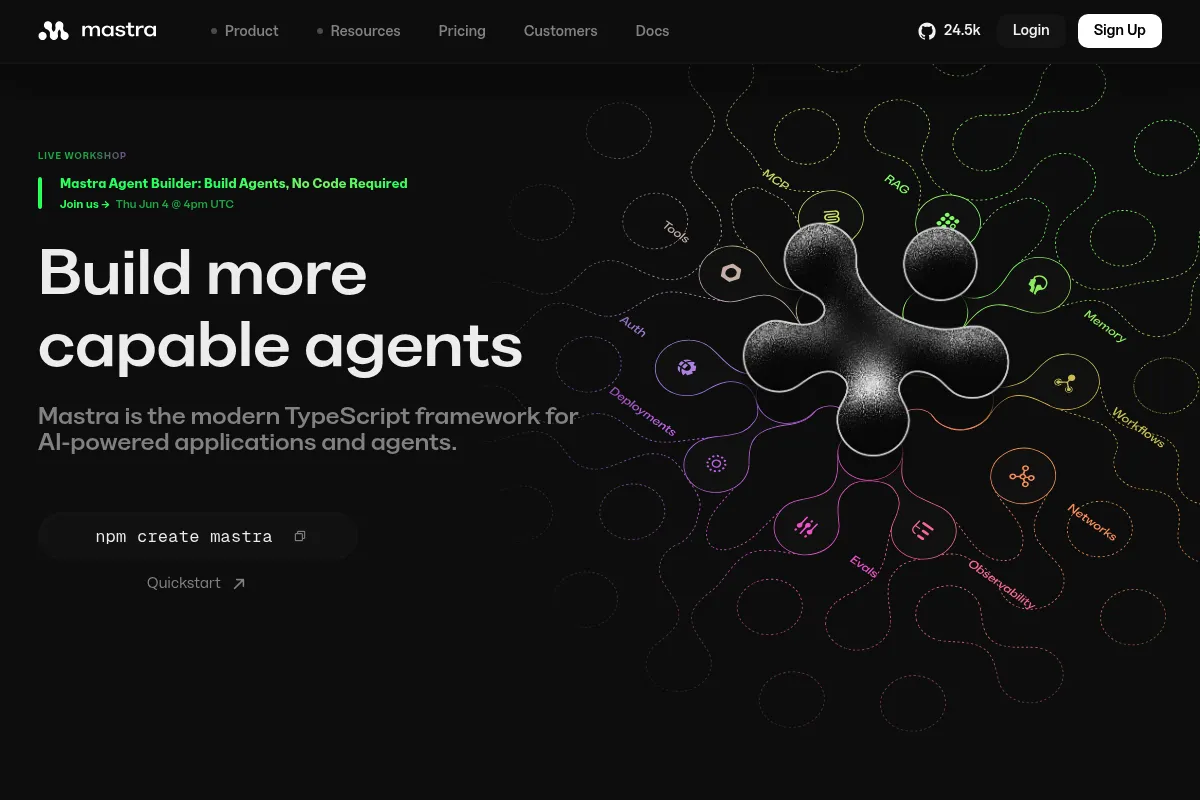
Who Should Use Mastra?
Typical users
Full-stack TypeScript developers and engineering teams building AI features into Next.js or Node.js applications.
Maturity fit
scaling
Choose this if…
- Your stack is strictly TypeScript and you want native type safety via Zod
- You need durable workflows that can pause, resume, and survive server restarts
- You want a built-in local development UI (Studio) to debug agent reasoning
- Your priority is reducing the 'black box' complexity of agentic loops
Skip this if…
- Your team primarily uses Python for AI and data science workflows
- You need a visual, no-code agent builder for non-technical stakeholders
- You require the massive, mature integration ecosystem of LangChain
- You are building a simple single-prompt wrapper that doesn't need state
About Mastra
Mastra is an open-source TypeScript framework designed to move AI agents from prototypes to production. It provides the architectural scaffolding—memory, durable workflows, and observability—that developers usually have to build from scratch when using raw LLM APIs.
Official profiles
What it actually does
It allows developers to define autonomous agents with persistent memory and give them access to tools via type-safe schemas. The framework includes a graph-based workflow engine for deterministic multi-step processes and a sync engine to ingest data from third-party SaaS apps for RAG pipelines.
What makes it different
Unlike ports of Python libraries, Mastra is built for the modern web stack, delegating low-level LLM calls to the Vercel AI SDK while focusing on the 'agent lifecycle.' Its standout feature is 'Durable Workflows,' which use state snapshots to ensure long-running tasks resume exactly where they left off after failures or deployments.
Key Features
Durable Workflows
Graph-based state machines that persist execution state to survive server restarts.
Mastra Studio
A local UI at localhost:4111 for chatting with agents and inspecting tool call traces.
Sync Engine
Automates OAuth and data ingestion from apps like Slack, Zendesk, and Google Drive.
MCP Client & Server
Native support for the Model Context Protocol to connect standardized tools.
Type-Safe Primitives
Uses Zod to enforce schemas for tool inputs and outputs, reducing runtime errors.
Multi-Agent Orchestration
Primitives for building systems where agents can hand off tasks to one another.
Observability Stack
Built-in logging and tracing that integrates with OpenTelemetry and LangFuse.
Temporal Integration
Optional supercharging of workflows for enterprise-grade reliability and retries.
Pricing
Open Source
- MIT/Apache 2.0 Licensed
- Self-host anywhere
- Full framework access
- Local Mastra Studio
- All 150+ integrations
Starter (Cloud)
- 100K observability events
- 24 CPU hours per month
- 15 days data retention
- Unlimited users and projects
Teams (Cloud)
- 1M observability events
- 250 CPU hours per month
- 6 months data retention
- SSO and SOC 2 documentation
- Multiple team support
Enterprise
- Custom volume and retention
- VPC deployment options
- RBAC and audit logs
- Dedicated support engineer
- Uptime SLAs
Pricing checked 4 months ago
Pricing guidance
- When you need managed hosting to avoid infrastructure overhead
- When you require SOC 2 compliance or SSO for your team
- When your observability event volume exceeds 100k per month
- Cloud Starter plan has a strict 15-day data retention limit
- Self-hosting requires managing your own Postgres instance for state persistence
- CPU time overages on Cloud plans are billed hourly ($0.25-$0.35/hr)
Developer-friendly open-source core with a premium managed platform for enterprise scale.
Pros & Cons
Strengths
-
TypeScript-First Developer Experience
Avoids the 'Python wrapper' feel of competitors; everything from tool definitions to workflow steps is fully typed and fits naturally into a Next.js project.
-
State Persistence by Default
The ability to pause and resume workflows is a major advantage for production apps where agents might wait hours for human approval or external API responses.
-
Reduced Boilerplate
Bundles memory, RAG, and observability into one framework, eliminating the need to wire together five different libraries to get a basic agent running.
-
Local-First Debugging
Mastra Studio provides a 'God mode' view of agent reasoning, making it significantly easier to find where a prompt or tool call went wrong.
Weaknesses
-
Ecosystem Maturity
As a newer framework, it has fewer community-contributed templates and tutorials compared to the Python-based giants.
Affects: Junior developers or teams looking for 'copy-paste' solutions
-
TypeScript Only
There is no Python SDK, which creates a hard barrier for data science teams who want to share logic with the engineering team.
Affects: Cross-functional AI teams
-
Rapid API Evolution
The framework is moving fast; early adopters have reported breaking changes and documentation that occasionally lags behind the latest release.
Affects: Teams requiring high API stability for long-term maintenance
Real User Sentiment
Highly positive regarding developer experience and architecture, with minor frustrations typical of early-stage software.
Users tend to like
- Type safety and Zod integration
- Mastra Studio's debugging capabilities
- The 'no-magic' feel compared to LangChain
- Durable workflow resilience
Users commonly complain about
- Documentation can be sparse for advanced use cases
- Occasional bugs in the early-access Cloud platform
- Frequent breaking changes in the 1.x release cycle
Recurring tradeoffs
- Trading a massive library of pre-built Python tools for a cleaner, more maintainable TypeScript codebase.
Happiest users
Full-stack engineers building complex, multi-step AI features in Next.js.
Often frustrated
Python developers trying to port existing LangChain logic or users expecting a stable, unchanging API.
Use Cases
Customer Support Agents
Building bots that pull data from Zendesk and Slack via the Sync Engine.
Automated Content Pipelines
Using durable workflows to manage multi-step research, drafting, and human approval.
Internal Database Tools
Creating agents that query company data via the Model Context Protocol (MCP).
SaaS AI Features
Adding persistent, stateful AI assistants to existing Next.js web applications.
Complex Data Ingestion
Keeping vector stores updated by syncing data from 150+ third-party SaaS apps.
Frequently Asked Questions
Is Mastra free to use?
Yes, the core framework is open-source (MIT/Apache 2.0) and can be self-hosted for free. They offer a paid 'Mastra Platform' for managed hosting and enterprise features starting at $250/month.
How does Mastra compare to LangChain?
Mastra is built specifically for TypeScript, avoiding the heavy class-based abstractions and 'Python-port' feel of LangChain. It focuses on durable state and type safety rather than providing thousands of loosely coupled integrations.
Does Mastra work with Next.js?
Yes, it is designed to integrate with Next.js (App Router) and other TS frameworks like Hono or Express. It pairs well with the Vercel AI SDK for frontend streaming.
What LLMs does Mastra support?
It supports over 40 providers including OpenAI, Anthropic, Gemini, and Groq, as well as local models via any OpenAI-compatible API server.
What are 'Durable Workflows'?
They are multi-step processes that save their state at every step. If your server crashes or a step fails, the workflow can resume from the last successful point instead of starting over.
Does it support multi-agent systems?
Yes, Mastra provides native primitives for agent orchestration, allowing you to build 'crews' or 'swarms' where agents collaborate on tasks.
Why trust this page?
This evaluation combines product positioning, pricing analysis, traffic and market signals, and public user sentiment into a single decision-support page. Content is generated editorially — not copied from the vendor's website.
Funding & Company
Founded
2024
Stage
Series a
Total Raised
$35M
Latest Round
Series A (Apr 2026)
Notable Investors
Mastra has raised a total of $35 million over two significant rounds: a $13 million Seed in October 2025 and a $22 million Series A in April 2026. The funding is backed by top-tier investors including Spark Capital, Y Combinator, and Google's AI fund, Gradient Ventures, providing substantial capital to scale its open-source TypeScript framework for AI agents.
Market Signals & Traffic
Estimated visits, global rank, geography, traffic sources, monthly visit trends, and organic search keywords (Similarweb)—on a dedicated page built for depth and search.
- Estimated visits
- 324,251
- Global rank
- #147,846
- Snapshot
- Apr 2026
- Traffic trend
- Surging
Estimated monthly visits
Alternatives to Mastra
View all alternatives
Similar Tools
Mirascope
Developer Tools, Automation & Agents, Workflow

Pythonic library for building LLM applications with structured outputs.
Back4App
Developer Tools, Automation & Agents, Workflow

Backend-as-a-Service platform for building and scaling applications.
Wordware
Developer Tools, Automation & Agents, Workflow

IDE for building and deploying complex LLM applications
Julep
Developer Tools, Automation & Agents, Workflow

Development platform for building stateful agents with long-term memory.
SGLang
Developer Tools, Automation & Agents, Workflow

High-performance framework for structured and efficient model inference.
Phidata
Developer Tools, Automation & Agents, Workflow

Framework for building multi-modal agents with memory and tools.